
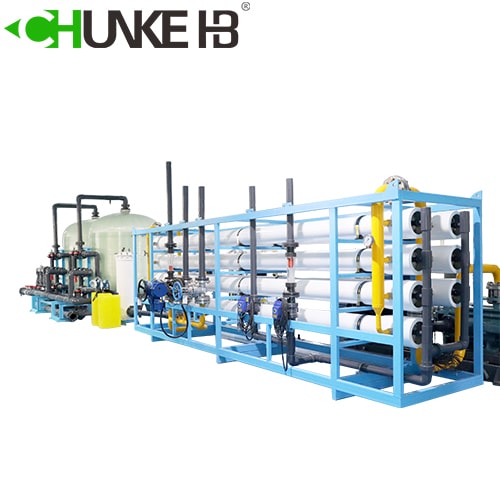
25m3/h SWRO System is an industrial seawater reverse osmosis desalination plant designed to convert seawater into fresh water for drinking water, hotel water supply, island projects, coastal communities, marine facilities, and industrial process water applications. With a product water capacity of 25 cubic meters per hour, this system can produce approximately 600,000 liters per day under standard operating conditions.
Chunke designs and manufactures the 25m3/h SWRO System according to feed water quality, seawater TDS, project location, final water standard, installation space, power supply, and customer operation requirements. A professional seawater desalination plant is not only an RO membrane skid. It is a complete process package including seawater intake, pretreatment, chemical dosing, cartridge filtration, high-pressure pumping, SWRO membrane separation, automatic control, flushing, cleaning, instrumentation, and post-treatment when required.
Chunke Seawater Desalination System Manufacturer from China
For customers who need reliable fresh water near the sea, the 25m3/h SWRO System provides a stable, independent, and long-term water supply solution. It is especially suitable for areas where municipal water is limited, groundwater is salty, or fresh water transportation cost is too high.
For more seawater desalination solutions, visit our main website:
Seawater Desalination Plant Manufacturer
You can also learn more about our company from:
Chunke Water Treatment
Professional Seawater Desalination Solution for 25m3/h Capacity
The 25m3/h SWRO System uses reverse osmosis membrane technology to remove dissolved salts from seawater. Seawater normally has high salinity, commonly around 30,000–45,000 mg/L TDS depending on the source. To produce fresh water from this high-salinity source, the system must apply high pressure to push water molecules through semi-permeable RO membranes while most dissolved salts are rejected and discharged with the concentrate stream.
Compared with small domestic RO machines, industrial SWRO equipment requires stronger engineering design. The high-pressure pump, pressure vessel, membrane model, piping material, chemical dosing system, control logic, and pretreatment system must all be selected carefully. If the pretreatment is weak, the membranes may suffer from fouling, scaling, biological growth, or oxidation damage. If the high-pressure section material is not suitable for seawater, corrosion may reduce equipment life. If the control system is too simple, operation risk and maintenance difficulty will increase.
Chunke’s 25m3/h SWRO System is designed for continuous operation, easy maintenance, and stable product water quality. The system can be supplied as a skid-mounted plant for indoor installation or as a containerized seawater desalination plant for remote sites, islands, or outdoor projects.
Typical Process Flow of 25m3/h SWRO System
A complete 25m3/h SWRO System normally includes the following process:
Seawater Intake / Raw Water Tank → Raw Water Pump → Chemical Dosing → Multimedia Filter or Quartz Sand Filter → Reducing Agent or Dechlorination → Antiscalant Dosing → 5 Micron Cartridge Filter → High Pressure Pump → SWRO Membrane System → Product Water Tank → UV Sterilizer / pH Adjustment / Remineralization if required
The exact process depends on the water analysis report and site condition. For beach well seawater, turbidity may be lower, and pretreatment can be simpler. For open seawater intake, especially near ports, fishing areas, harbors, or industrial zones, stronger pretreatment may be required. In some projects, ultrafiltration pretreatment can be added before the RO system to improve SDI and protect the membrane system.
For more process information, visit:
Industrial SWRO System
Seawater Intake and Raw Water Tank
The seawater intake section is the first step of the system. Its design affects the stability of the whole desalination plant. Seawater can be collected from a beach well, open sea intake, underground coastal well, or existing seawater storage tank. Each source has different risks.
A beach well usually has lower turbidity because sand naturally filters some suspended solids. However, the TDS may still be high. Open seawater intake may contain algae, suspended solids, microorganisms, organic matter, sand, shells, oil, or seasonal pollution. Therefore, the pretreatment design must match the intake condition.
For a 25m3/h SWRO System, the raw water tank works as a buffer tank. It stabilizes flow and helps protect the downstream pumps. The tank material can be PE, FRP, concrete with anti-corrosion lining, or stainless steel depending on site design and budget. Level control can be installed to protect the raw water pump from dry running and to support automatic operation.
Raw Water Pump and Pretreatment Feed
The raw water pump transfers seawater from the tank to the pretreatment section. Because seawater is corrosive, the pump material must be selected carefully. Depending on the project budget and seawater quality, suitable materials may include SS316, duplex stainless steel 2205, super duplex stainless steel, or engineering plastic materials for some low-pressure sections.
For stable operation, Chunke can equip the raw water pump with frequency control. A VFD helps adjust flow, reduce hydraulic shock, and improve system control. In many seawater desalination projects, one working and one standby pump arrangement is recommended to improve system reliability.
The pretreatment feed flow is higher than the final product water flow because SWRO systems have a recovery rate. For example, if the recovery rate is around 35–45%, the feed flow will be much higher than 25m3/h. This is why pump selection, pipe size, filter size, and backwash design must be calculated carefully.
Pretreatment System for Membrane Protection
Pretreatment is one of the most important parts of the 25m3/h SWRO System. The RO membrane is the core component, but it cannot handle dirty seawater directly. Suspended solids, colloids, algae, iron, manganese, organic matter, bacteria, and oil can block or damage the membranes.
A typical pretreatment system may include chemical dosing, quartz sand filter, multimedia filter, activated carbon filter, reducing agent dosing, and cartridge filtration.
Coagulant or Flocculant Dosing
For seawater with turbidity or fine suspended particles, coagulant or flocculant dosing can improve filter performance. These chemicals help small particles combine into larger particles so they can be removed more easily by the filtration system.
Bactericide Dosing
Biological growth can create serious membrane fouling. In some projects, a bactericide or oxidizing chemical is dosed before pretreatment to control microorganisms. However, before water enters the RO membranes, any oxidizing chemical must be removed or neutralized because RO membranes can be damaged by oxidation.
Quartz Sand Filter or Multimedia Filter
The sand filter removes suspended solids and reduces turbidity. For open seawater intake, multimedia filtration may be recommended because it can improve particle removal. The filter tank may be FRP or carbon steel lined with rubber, depending on system size, pressure, and project requirements.
Activated Carbon Filter or Reducing Agent Dosing
If chlorine or oxidants are used upstream, they must be removed before the RO membranes. Activated carbon filter or reducing agent dosing can be used. The final selection depends on chemical strategy, operation cost, available space, and maintenance plan.
Cartridge Filter
Before the high-pressure pump, a cartridge filter is installed as the final protection barrier. A 5-micron cartridge filter is commonly used, and in some projects 10-micron plus 5-micron filtration can be selected. The cartridge filter prevents fine particles from entering the high-pressure pump and RO membrane system.
High Pressure Pump for 25m3/h SWRO System
The high-pressure pump is the heart of the 25m3/h SWRO System. Seawater has high osmotic pressure, so the system must apply high pressure to separate fresh water from salt water. The required pressure depends on feed TDS, temperature, recovery rate, membrane type, and final permeate quality target.
For high-quality SWRO projects, Chunke can use seawater-resistant high-pressure pumps. Depending on customer requirement, the system can be designed with Danfoss high-pressure pumps for reverse osmosis applications. Danfoss APP pumps are widely used in SWRO desalination because they are compact, efficient, and designed for high-pressure seawater RO service.
A VFD can be added to the high-pressure pump to control pressure and flow more smoothly. This is useful during startup, seasonal temperature changes, and different feed water conditions. The VFD also helps reduce mechanical stress and improves system operation flexibility.
Energy Recovery Option
For seawater desalination, energy consumption is one of the main operating costs. A 25m3/h SWRO System can be designed with or without an energy recovery device depending on project budget and long-term operating cost target.
In SWRO operation, the concentrate stream leaves the membrane system with high pressure. An energy recovery device can recover part of this pressure energy and transfer it back to the feed stream. This reduces the load on the high-pressure pump and lowers electricity consumption.
For customers who operate the plant continuously, energy recovery is usually worth considering. For projects where electricity cost is high, energy recovery can significantly improve long-term economic performance.
SWRO Membrane System
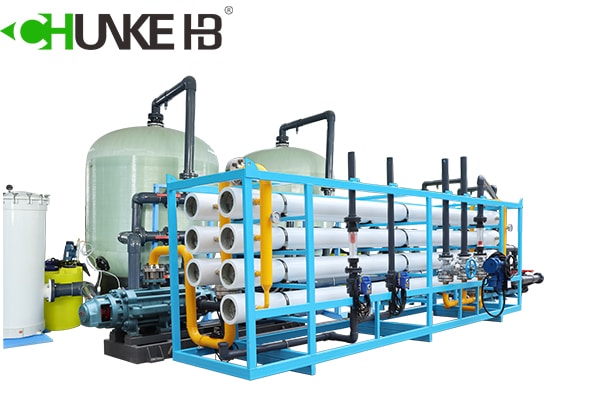
The membrane system is where the desalination process happens. The 25m3/h SWRO System normally uses 8-inch seawater RO membrane elements installed inside FRP pressure vessels. The membrane allows water molecules to pass through while rejecting most dissolved salts and impurities.
Chunke can design the membrane system using international membrane brands according to customer requirements. For example, the system can be designed with Toray reverse osmosis membranes for seawater desalination projects. Toray supplies RO membrane elements for seawater and high-salinity water applications.
The number of membranes, pressure vessel arrangement, recovery rate, and operating pressure must be calculated based on feed water analysis. Important design factors include:
- Feed water TDS
- Feed water temperature
- Required permeate TDS
- System recovery rate
- Membrane flux
- Fouling risk
- Boron control requirement
- Product water application
- Energy consumption target
A typical 25m3/h SWRO System can be designed for 35–45% recovery, but the final recovery rate should be confirmed by water chemistry and scaling calculation. If the customer requires very low product water TDS, a second-pass RO system can be added after the SWRO system.
Product Water Quality and Post-Treatment
The product water quality from a 25m3/h SWRO System depends on feed water salinity, membrane model, operating pressure, recovery rate, temperature, and system configuration. For many seawater desalination projects, the product water TDS can be designed to meet drinking water or industrial process water requirements.
However, SWRO permeate is usually low in minerals and alkalinity. If the water is used for drinking, post-treatment is often recommended. Chunke can provide pH adjustment, remineralization, UV sterilization, ozone dosing, or chlorination according to local drinking water standards and customer requirements.
For hotel and island drinking water applications, remineralization can improve taste and water stability. For industrial applications, the post-treatment may be different. Some customers need low TDS process water, while others need stable pH, low hardness, or additional polishing treatment.
Automatic Control System
A professional 25m3/h SWRO System should be easy to operate and safe to protect. Chunke can design the system with PLC control and touch screen HMI. The operator can check flow, pressure, conductivity, alarm status, tank level, pump status, valve status, and system operation mode from the control panel.
For high-quality automation, the system can use Siemens SIMATIC HMI for operation display and industrial monitoring. The HMI helps operators understand the real-time operation of the seawater desalination plant and respond quickly to alarms.
The system can include automatic functions such as:
- Automatic start and stop
- Low-pressure protection
- High-pressure protection
- Product water conductivity monitoring
- Raw water conductivity monitoring
- Product water flow monitoring
- Concentrate flow monitoring
- Automatic flushing
- Tank level control
- Chemical dosing interlock
- Fault alarm and shutdown protection
- Manual operation mode for maintenance
For electrical components, Chunke can use Schneider Electric TeSys motor control products for reliable motor control and electrical protection. Schneider components are commonly used in industrial control panels for pumps, valves, and protection circuits.
Piping and Material Selection
Material selection is very important for seawater desalination. Seawater contains high chloride, which can cause corrosion if the wrong material is used. For a 25m3/h SWRO System, low-pressure pretreatment piping can often use UPVC, CPVC, HDPE, FRP, or other corrosion-resistant plastic materials depending on pressure and temperature. For the high-pressure RO section, stronger materials are required.
Chunke can use duplex stainless steel 2205, super duplex stainless steel, high-pressure hose, or other seawater-resistant materials for the high-pressure section. The final material selection depends on operating pressure, customer standard, budget, and project environment.
The frame can be stainless steel or carbon steel with anti-corrosion coating. For containerized systems, the container can include lighting, ventilation, air conditioning, drainage, cable tray, control cabinet space, and chemical dosing area.
CIP Cleaning System
The 25m3/h SWRO System can include a CIP cleaning system for membrane maintenance. During long-term operation, RO membranes may experience fouling or scaling. When normalized permeate flow decreases, differential pressure increases, or salt rejection becomes lower, chemical cleaning may be required.
A CIP system normally includes a cleaning tank, cleaning pump, cartridge filter, valves, and cleaning piping. The cleaning solution is circulated through the membrane system to remove scale, organic fouling, biological fouling, or other deposits. Proper cleaning helps recover membrane performance and extend membrane service life.
Chunke can provide operation guidance for CIP cleaning, including when to clean, how to prepare cleaning solution, how to circulate, and how to rinse the system after cleaning.
Skid-Mounted and Containerized Design
Chunke can supply the 25m3/h SWRO System in skid-mounted or containerized configuration.
A skid-mounted system is suitable for customers who already have an equipment room or want to install the plant inside a building. It is easier to access each component for inspection and maintenance.
A containerized system is suitable for remote sites, islands, construction camps, coastal hotels, and outdoor projects. The container can reduce site installation work and protect equipment from weather. It can also make transportation easier because the main equipment is pre-installed and tested before shipment.
For remote island projects, a containerized 25m3/h SWRO System is often a very practical solution because it reduces installation time and makes the system easier to manage.
Main Applications
The 25m3/h SWRO System is suitable for many seawater desalination projects, including:
- Island drinking water supply
- Coastal hotel and resort water supply
- Fish processing plant water treatment
- Aquaculture and seafood industry
- Marine and offshore facilities
- Coastal communities and villages
- Industrial process water production
- Construction camps near the sea
- Emergency water supply projects
- Seawater to fresh water projects
For industrial customers, the system can provide stable process water. For communities and hotels, it can provide drinking water after suitable post-treatment. For islands, it can reduce dependence on transported fresh water.
Reference Technical Specification
| Item | Reference Design |
|---|---|
| Product Name | 25m3/h SWRO System |
| Product Water Capacity | 25m³/h |
| Daily Capacity | Approx. 600,000 L/day |
| Feed Water | Seawater |
| Typical Feed TDS | Up to around 35,000 mg/L, customizable |
| Process | Pretreatment + SWRO + Post-treatment |
| Recovery Rate | Normally around 35–45%, depending on design |
| Desalination Rate | Normally 97–99%, depending on membrane and conditions |
| RO Membrane | 8-inch seawater RO membrane |
| Pressure Vessel | FRP seawater RO pressure vessel |
| High Pressure Pump | Seawater-resistant high-pressure pump |
| Control | PLC + touch screen HMI |
| Chemical Dosing | Antiscalant, reducing agent, pH adjustment, optional |
| Piping Material | UPVC for low pressure, duplex stainless steel for high pressure, customizable |
| Installation Type | Skid-mounted or containerized |
| Final Water Use | Drinking water, industrial water, hotel water, island water supply |
Why Choose Chunke
Chunke provides customized engineering design for each 25m3/h SWRO System project. We do not recommend one fixed design for all customers because seawater quality and project conditions are different. Our engineering team checks the customer’s water analysis, final water use, site layout, operation schedule, power supply, and budget before finalizing the design.
Our advantages include:
- Factory-direct seawater desalination system manufacturing
- Customized process design according to feed water quality
- Strong pretreatment design for membrane protection
- Seawater-resistant material selection
- PLC automatic control and HMI operation
- Optional energy recovery system
- Skid-mounted or containerized design
- Factory testing before delivery
- Installation guidance and operation training
- Long-term spare parts and technical support
A reliable 25m3/h SWRO System must be designed as a complete engineering package, not only a membrane machine. From intake to final product water, every section affects performance, operating cost, and equipment life. Chunke focuses on practical engineering, stable operation, and customer-specific solutions.
For more product information, visit:
25m3/h SWRO System Manufacturer
Contact Us Today
If you need a professional 25m3/h SWRO System for seawater desalination, Chunke can prepare a customized technical proposal according to your water analysis and project requirements.
Contact us today !!!
📞 Mobile, WhatsApp, or WeChat: +8616616636489
🌐 Website: www.swro-plant.com
📘 Facebook: @ChunkeOfficial
📸 Instagram: @David_Chunke
📧 Email: info@chunkewatertreatment.com