
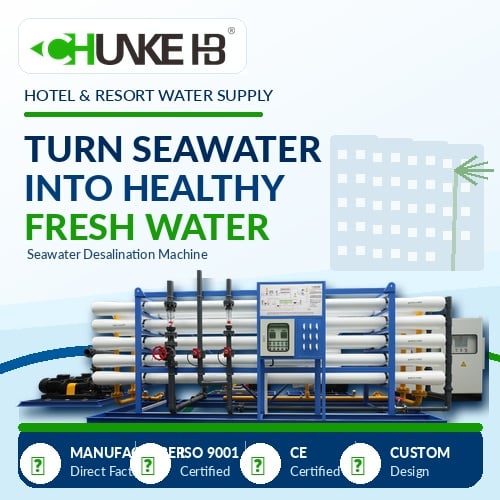
A desalination plant for hotels and resorts turns seawater or brackish water into safe, unlimited fresh water on site, and Chunke builds turnkey reverse osmosis systems that deliver from 10 m³ to 1,000 m³ per day, treat feed water up to 45,000 ppm TDS, produce water below 300 ppm, and recover 35–45% of the feed. So your property never again depends on costly water trucks, unreliable mains supply, or seasonal shortages during peak season. Instead, guests enjoy clean water for rooms, pools, kitchens, laundry, and irrigation, every single day.
Chunke Water Treatment designs, manufactures, and exports these systems from China to hotels and resorts in more than fifty countries. Hence owners get factory-direct pricing, marine-grade components, and full technical support from planning to commissioning. Below, we explain how a resort desalination plant works, which specifications matter, which brand components we use, and how to size the right system for your property.
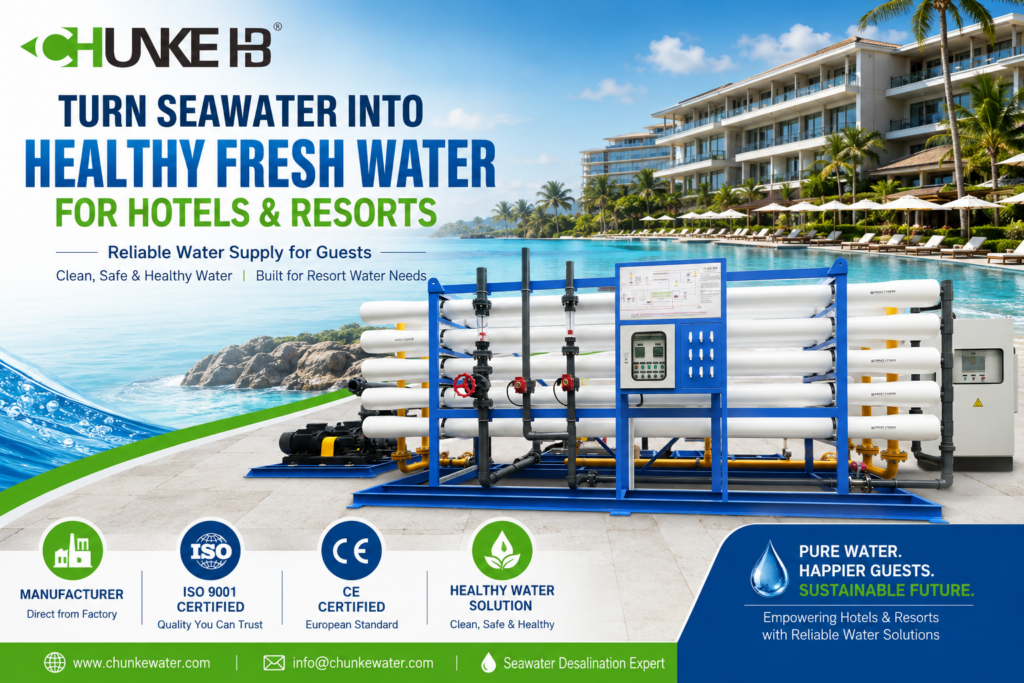
Why Hotels and Resorts Need Their Own Desalination Plant
Coastal and island properties face a hard truth: fresh water is scarce exactly where tourism thrives. Many resorts sit on islands or remote shorelines with no municipal supply, so they truck in water or rely on shallow wells that turn salty. Because a single guest can use 300–600 litres of water per day, demand climbs fast during high season. Therefore water shortages threaten guest comfort, pool hygiene, landscaping, and even a property’s reputation.
A desalination plant removes that risk. It draws from the sea or a borehole, an effectively unlimited source, and produces drinking-quality water on demand. Consequently, owners gain full control over supply, cost, and quality. Moreover, on-site production ends the expensive, unpredictable habit of buying trucked water. As a result, the plant often pays back its cost within a few years while protecting the guest experience that drives revenue.
Desalination Plant Technical Specifications
The table below summarises the typical operating range of Chunke hotel and resort desalination plants. We tailor every build to the property, so capacity, footprint, and automation always match real demand.
| Parameter | Typical Range |
|---|---|
| Fresh water output | 10 – 1,000 m³/day (scalable in modules) |
| Feed water salinity (TDS) | Seawater up to 45,000 ppm; brackish 1,000–15,000 ppm |
| Product water quality | Below 300 ppm TDS (WHO drinking standard) |
| Recovery rate | 35% – 45% seawater; up to 75% brackish |
| Operating pressure | 55 – 70 bar seawater; 10 – 25 bar brackish |
| Energy use | 3 – 4 kWh/m³ with energy recovery |
| Power supply | 220V / 380V / 415V / 440V AC, 50/60 Hz |
| Membranes | 8″ seawater or brackish RO elements |
| Pre-treatment | Multimedia / UF, dosing, 5-micron cartridges |
| Energy recovery | Pressure-exchanger or turbocharger type |
| Post-treatment | Remineralisation, UV, chlorination |
| Control | Full PLC + HMI, remote monitoring optional |
| Configuration | Skid-mounted or containerised (plug-and-play) |
How a Resort Desalination Plant Works
The process runs in clear stages, so operation stays simple for hotel maintenance staff. First, an intake pump draws seawater through a screen and into pre-treatment. Next, multimedia filters or an ultrafiltration stage remove suspended solids, while dosing pumps add antiscalant to protect the membranes. Then 5-micron cartridge filters give final polishing before the high-pressure stage. After that, a high-pressure pump raises the feed to roughly 55–70 bar and pushes it into the membrane housings, where the seawater RO membrane separates pure water from concentrated brine.
Because high pressure normally means high energy, we add an energy recovery device that reclaims pressure from the brine stream. Consequently, the plant cuts energy use to around 3–4 kWh per cubic metre, far below older designs. Finally, a post-treatment stage adds remineralisation, UV sterilisation, and chlorination, so the water tastes good and stays safe in the storage tanks. Thus the whole cycle — from raw seawater to potable water — runs continuously and automatically, day and night. You can read the deeper engineering detail on our seawater reverse osmosis technology page.
Key Components and Trusted Brands
Reliability matters even more for a hotel, because a water outage disrupts every guest at once. Therefore Chunke specifies proven international brands alongside our own quality fabrication. Moreover, owners may request specific brands to match their maintenance standards.
For membranes, we fit elements from DuPont FilmTec, LG Chem, Vontron RO membranes, Toray, or Hydranautics, so the plant achieves high salt rejection and long life. For pressurisation, we use Grundfos high-pressure pumps and Danfoss APP pumps, both built for continuous duty. For energy recovery, we integrate proven pressure-exchanger technology. In addition, every plant runs on Siemens PLC and HMI control, so staff monitor flow, pressure, salinity, and alarms from one touchscreen, and remote engineers can log in when needed.
We also supply matched spares, so replacements stay simple wherever your resort sits. For example, our seawater reverse osmosis membrane, seawater desalination pump, and energy recovery device pages list compatible parts. You can review our full component standards and broader range on our company sites, Chunke Water Treatment and Chunke RO Water Plant.
Applications Across the Property
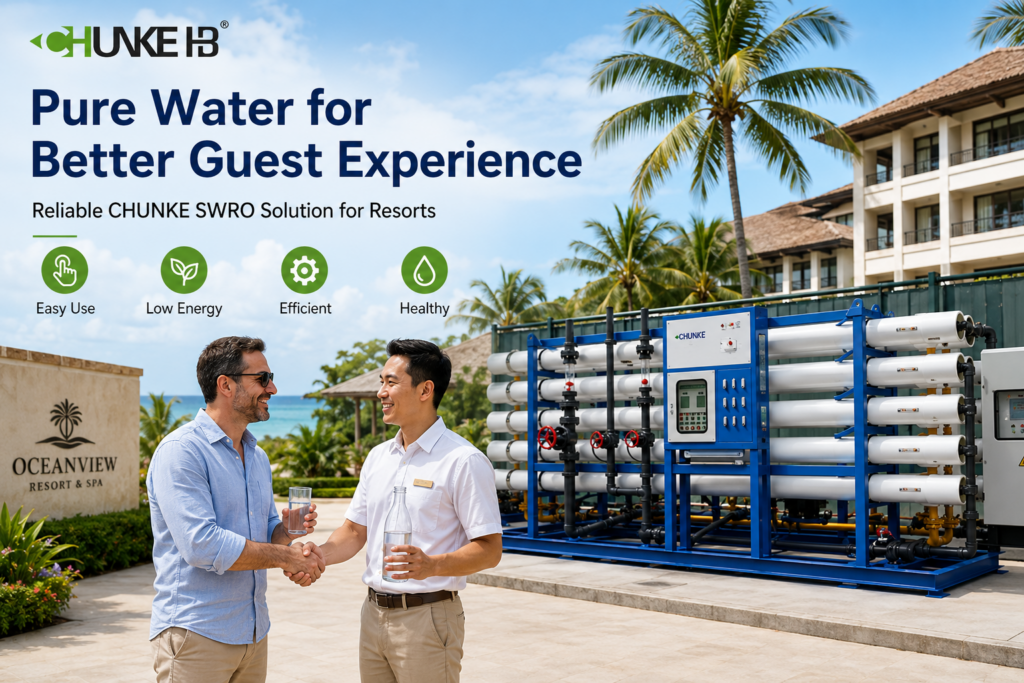
One plant serves the whole resort, so a single investment solves many needs at once. For guest rooms and villas, it supplies safe drinking water and reliable pressure for showers and taps. For swimming pools and spas, it provides clean make-up water that protects filtration and guest health. Meanwhile, kitchens and restaurants receive food-grade water for cooking, ice, and washing. For laundry, soft, low-TDS water reduces detergent use and protects linens and machines.
Beyond the building, the plant supports landscaping and irrigation, so gardens and golf courses stay green even in dry months. Because different uses need different quality, we can blend or treat streams to suit each application. Therefore the resort meets drinking standards where required, and uses cost-effective water for irrigation elsewhere. So whatever the property size, from a boutique beach hotel to a large island resort, Chunke matches the plant to the full demand profile.
Containerised and Skid-Mounted Options
Space and speed both matter on a busy property, so we offer two proven formats. A skid-mounted plant arrives as a compact, pre-assembled frame that drops into a plant room and connects quickly. A containerised plant goes further: we build the entire system inside a standard shipping container, test it at our factory, and ship it ready to run. As a result, installation on site takes days rather than months. Furthermore, a containerised unit suits remote islands, because it needs only power, feed water, and a discharge point. You can see this format on our containerized seawater desalination plant page, and larger builds on our seawater RO plant manufacturer page.
Energy Efficiency and Running Cost
Energy is usually the largest running cost, so efficiency drives the payback. A modern plant with energy recovery uses only about 3–4 kWh per cubic metre, while older systems used far more. Because resorts often run on generators or expensive island power, this saving matters every day. Therefore we size the pump, recovery device, and membrane array together to hit target output at the lowest practical energy. Moreover, we can pair the plant with solar power, so daytime production runs partly on free energy. Consequently, the total cost of ownership stays low, and the plant frees the resort from volatile trucked-water prices. In short, an efficient desalination plant turns an unpredictable expense into a fixed, controllable one.
Delivered Hotel and Resort Projects
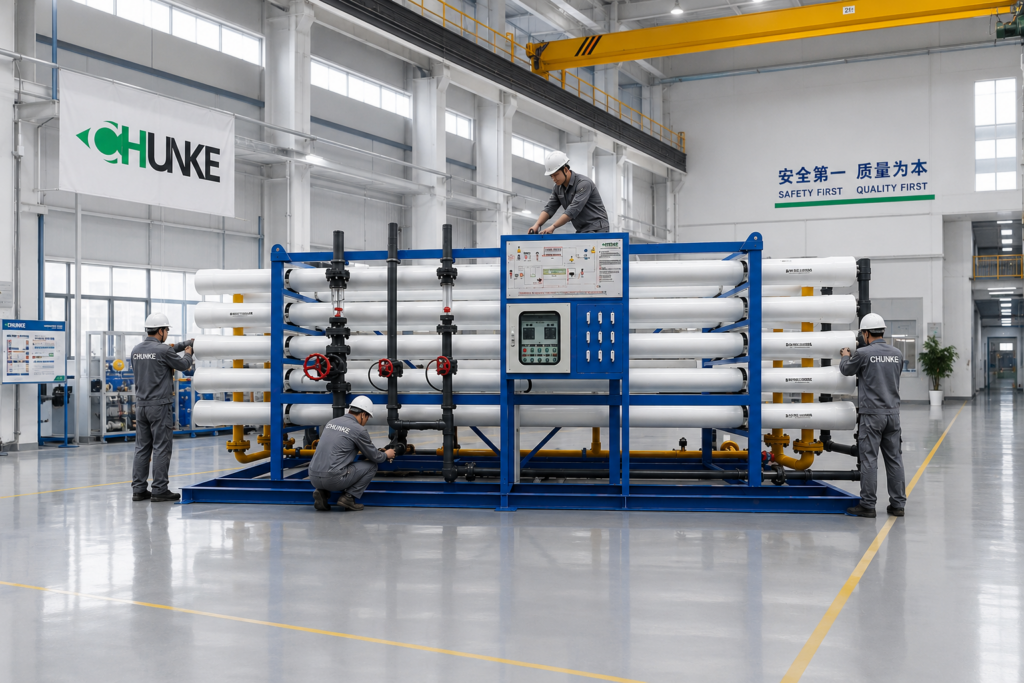
Chunke has shipped desalination and water treatment plants to resorts and coastal projects across the Maldives, the Caribbean, Southeast Asia, the Middle East, Africa, and the Pacific. Because each site brings different feed water, power, and space conditions, our engineers adapt every build accordingly. Our delivered work includes compact containerised units for island resorts, mid-range skids for beach hotels, and larger modular plants for integrated resort complexes. Thus buyers can see proven performance in demanding tourism settings. You can browse more examples on our projects page and our island seawater desalination system article. We gladly share reference details on request, so you can verify our track record before you order.
Planning, Installation, and Support
A smooth project starts with good planning, so we guide owners from the first enquiry. First, we assess your feed water, daily demand, and available space. Next, we propose a sized system with a clear specification and quotation. Then our team supports shipping, installation, and commissioning, and we train your staff to operate the plant confidently. After handover, we provide spare parts, replacement membranes, and remote troubleshooting, so downtime stays short. Because tourism never pauses, we design for easy maintenance and reliable performance in continuous service. Therefore your maintenance team keeps the water flowing with minimal fuss, and your guests never notice a thing.
On-Site Desalination vs Trucked Water
Many island resorts still buy trucked or barged water, yet that habit carries real cost and risk. First, the price swings with fuel, distance, and season, so budgeting becomes difficult. Second, deliveries can fail during storms or peak demand, exactly when the resort needs water most. Third, stored delivered water can arrive with poor quality, which threatens guest health. An on-site desalination plant removes all three problems, because it produces fresh water continuously from the sea. Consequently, the resort fixes its water cost, guarantees supply, and controls quality directly. Moreover, the plant scales with the property, so future expansion needs only another module rather than more trucks. Therefore, when owners compare the total cost and reliability over several years, on-site production wins clearly. In short, a desalination plant turns water from a daily worry into a dependable utility.
Water Storage and Redundancy
A resort must never run dry, so smart design pairs the plant with the right storage and backup. We size product-water tanks to cover peak demand and short maintenance windows, so guests feel no interruption even while staff service the system. Because reliability is critical, many owners choose a modular layout with two or more trains, so one train keeps running while another rests or receives a membrane change. Therefore the property keeps full supply during cleaning, servicing, or repair. In addition, remote monitoring alerts your team before small issues grow, so you fix problems early. As a result, the plant delivers steady water through high season, storms, and staff changes alike. This built-in redundancy is exactly why hotels prefer a properly engineered system over a cheap, single-train unit.
Environmental Care and Brine Management
Responsible resorts care about the surrounding sea, so brine discharge deserves careful planning. Our systems recover as much fresh water as the feed allows, which reduces the volume of brine we return. Moreover, we design outfalls that dilute and disperse concentrate safely, so the local marine environment stays protected. Because guests increasingly value sustainability, a well-managed plant also strengthens your green credentials. Furthermore, pairing the plant with solar power and energy recovery lowers its carbon footprint. Consequently, on-site desalination can support both reliable service and a genuine environmental commitment. So the resort meets its water needs while respecting the coastline that draws visitors in the first place.
Why Choose Chunke for Your Resort Desalination Plant
First, we manufacture directly, so you avoid trading-company markups and speak straight to the engineers who build your plant. Second, we use trusted brand components and quality fabrication, so the system lasts in a harsh coastal environment. Third, we offer full customisation of capacity, format, and automation, so the plant fits your exact property. Fourth, we support clients worldwide with fast parts supply and remote help, so you stay online. Finally, our team has years of desalination experience across resort, island, and industrial projects, so you receive practical advice, not just hardware.
Request a Quote — We Reply Within 24 Hours
Ready to plan your desalination plant for hotels and resorts? Just fill in the contact form below with your location, daily water demand, and feed-water type. As soon as we receive it, our engineers review your needs and reply with a tailored recommendation and quotation. So if you complete the form, we will contact you within 24 hours.
[WPFORM PLACEHOLDER — David will insert the WPForms contact block here]
Frequently Asked Questions
How big a desalination plant does a hotel need?
Size depends on guest count and use. As a guide, each guest uses 300–600 litres per day, so a 100-room resort often needs 50–150 m³ per day. Therefore we size the plant to your rooms, occupancy, pools, and irrigation.
Can the plant use brackish well water instead of seawater?
Yes. We build both seawater and brackish-water systems. Because brackish water needs less pressure, a brackish plant uses less energy and recovers more water. So we match the design to your available source.
How much does it cost to run?
With energy recovery, a modern plant uses only about 3–4 kWh per cubic metre. Consequently, running cost stays far below the price of trucked water, and the plant usually pays back within a few years.
Is the water safe for guests to drink?
Yes. Reverse osmosis removes salt, bacteria, and impurities, so product water falls below 300 ppm TDS and meets WHO standards. Moreover, remineralisation and UV stages improve taste and safety further.
How long does installation take?
A containerised plant arrives pre-tested and can run within days of connection. A larger custom plant takes longer, because we build it to order. So we confirm a schedule once we know your specification.
Do you provide service and spare parts internationally?
Yes. Chunke exports worldwide and supports resorts with spare parts, replacement membranes, and remote technical help. So wherever your property sits, you can keep the plant running reliably.
Can the plant run on solar power?
Yes. Because the plant is energy-efficient, it pairs well with solar. Therefore daytime production can run partly on free energy, which cuts running cost even more on remote island sites.

Comments are closed for this post.