
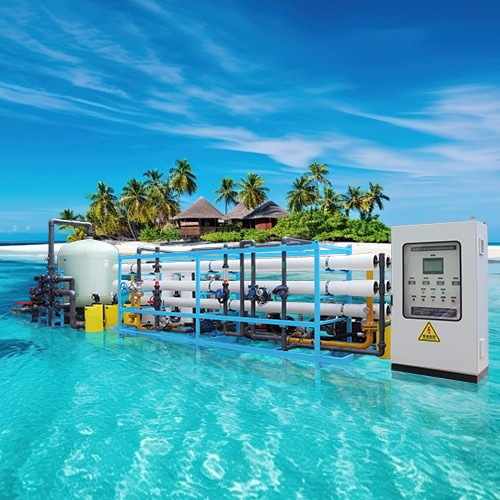
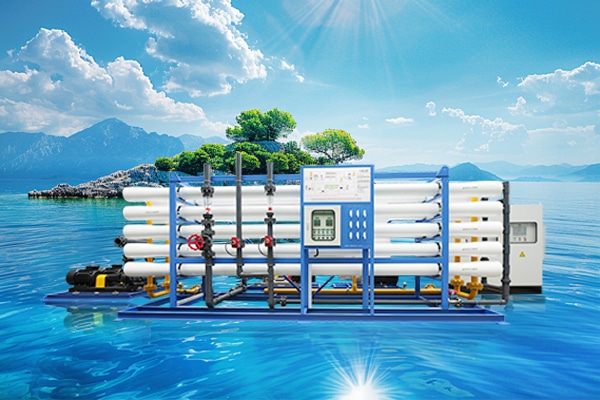
An island seawater desalination system helps islands, resorts, hotels, coastal villages, and remote communities produce fresh water from seawater when local freshwater sources cannot meet daily demand.
Many islands have seawater everywhere, yet they still struggle to secure enough clean water for drinking, cooking, washing, hotels, restaurants, laundry, irrigation, and daily life. Moreover, dry seasons reduce rainwater collection, while seawater intrusion can make groundwater salty. As a result, many island project owners choose seawater reverse osmosis technology as a long-term and stable water supply solution.
However, choosing the right system needs careful planning. You need to calculate daily water demand, check seawater quality, choose the correct pretreatment process, select suitable membranes and pumps, plan power supply, prepare product water storage, and arrange brine discharge. Therefore, a good island desalination project needs engineering design, not only equipment purchasing.
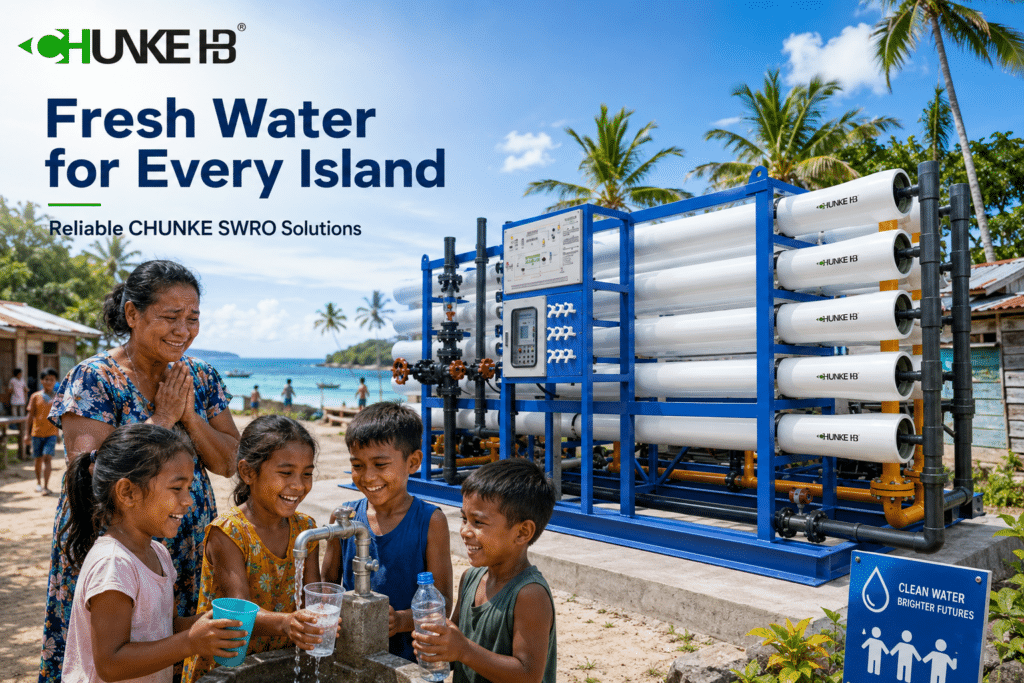
At Chunke Water Treatment manufacturer for seawater desalination and industrial RO systems, we design and manufacture seawater reverse osmosis systems for islands, resorts, hotels, coastal communities, fish farms, offshore projects, and remote drinking water supply. In this guide, we explain how to choose a practical island seawater desalination system for reliable long-term operation.
1. Start With Real Daily Water Demand
First, calculate how much fresh water your island needs every day. This step controls the complete system design. If you choose a system that produces too little water, your users may face shortage during peak demand. However, if you choose a system that produces too much water, you may waste money on equipment, electricity, chemicals, membranes, and storage tanks.
For a small island house or villa, daily demand may stay between 1 and 10 m³/day. For a small island resort, demand may reach 20 to 100 m³/day. Meanwhile, a larger island community, hotel area, or tourism project may need 100 to 1,000 m³/day or more.
You should include all water uses, including drinking water, cooking water, guest room water, restaurant water, laundry water, cleaning water, staff accommodation water, swimming pool make-up water, irrigation water, and maintenance water. In addition, you should consider peak season demand because island resorts may use much more water when hotel occupancy increases.
For example, if a resort has 100 rooms and each room uses 500 liters per day, guest room demand alone reaches 50 m³/day. Moreover, restaurants, laundry, staff, cleaning, and landscape irrigation may add another 30–80 m³/day. Therefore, the actual system capacity may need 100–150 m³/day or higher.
A correct island seawater desalination system should match real demand and include a reasonable safety margin. In many island projects, a 10–25% margin helps handle peak tourism season, future expansion, or temporary maintenance.
2. Decide Operation Hours Per Day
After you calculate daily water demand, decide how many hours per day the system will run. This decision affects hourly capacity, pump size, membrane quantity, power load, and storage tank size.
For example, if your project needs 100 m³/day and the system runs 24 hours per day, the system only needs around 4.2 m³/h. However, if you want the system to run 10 hours per day, it must produce 10 m³/h. Consequently, shorter operation time requires larger pumps, more membranes, and higher instant power demand.
Many island projects choose 16–20 hours per day operation because operators can inspect the system daily, while the product water tank stores enough water for peak use. Meanwhile, some large resorts and communities choose 24-hour automatic operation to keep water production stable.
Therefore, when you choose an island seawater desalination system, do not only ask, “How many cubic meters per day do I need?” Instead, also ask, “How many hours per day can I operate the system safely?”
3. Match the System With the Island Water Source
Not all seawater sources have the same quality. Some islands use open seawater intake. Some islands use beach wells. Others use coastal groundwater with high salinity. Therefore, the supplier must understand your water source before final design.
Open seawater may contain algae, sand, suspended solids, bacteria, organic matter, shells, and seasonal turbidity. Meanwhile, beach well water usually has lower turbidity, yet it may contain iron, manganese, hydrogen sulfide, or high hardness. In addition, coastal groundwater may change salinity during dry and rainy seasons.
Because of these differences, one standard design cannot fit every island. A professional engineer should check feed water TDS, turbidity, pH, temperature, hardness, iron, manganese, silica, bacteria, and SDI if available. Moreover, if the island has oil pollution, harbor activity, fish farming, or heavy organic matter, the system may need stronger pretreatment.
Before you request a quotation, prepare a seawater analysis report. If you cannot provide one at the beginning, the supplier can offer a preliminary proposal. However, you should still test water before final production because water quality directly affects membrane life, operating pressure, chemical dosing, and product water quality.
4. Choose the Right Pretreatment Process
Pretreatment protects the RO membranes. Therefore, you should pay serious attention to this part. A low-cost system with weak pretreatment may look attractive at first, but it can create high maintenance cost later. Sand, algae, bacteria, iron, oil, and organic matter can foul membranes quickly, increase pressure, reduce water production, and shorten membrane life.
A typical island SWRO pretreatment process may include raw seawater intake screen, raw water tank, coagulant dosing, chlorination or biocide dosing, multimedia sand filter, activated carbon filter, antiscalant dosing, reducing agent dosing, cartridge filter, and online pressure monitoring. For difficult seawater, engineers may also add ultrafiltration before RO.
For many small and medium island projects, multimedia filtration plus cartridge filtration can work if feed water quality stays stable. However, if the water has high turbidity, algae bloom, or unstable seawater conditions, ultrafiltration can improve feed water stability before RO.
5. Select Suitable Membranes and Core Components
RO membranes decide salt rejection, water quality, operating pressure, and energy consumption. Therefore, you should choose the membrane model carefully. For seawater projects, the system must use seawater RO membranes, not brackish water RO membranes.
The design also needs the right membrane quantity, reasonable flux, correct recovery rate, and suitable pressure vessel arrangement. If a supplier uses too few membranes to reduce cost, the system may run at high flux. Consequently, fouling risk increases, chemical cleaning becomes more frequent, and membrane life may decrease.
A reliable island seawater desalination system should balance initial cost, membrane life, power consumption, and product water quality.
6. Choose a Reliable High-Pressure Pump
The high-pressure pump works as the heart of a seawater desalination system. It pushes seawater through RO membranes and creates the pressure needed for desalination. Therefore, the pump must match flow rate, pressure, material, power supply, and duty condition.
Island environments create special challenges. Salt air, high humidity, limited spare parts, and difficult logistics make pump reliability very important. Therefore, the pump should use suitable corrosion-resistant materials. For seawater high-pressure parts, engineers often choose duplex stainless steel or super duplex material depending on pressure and budget.
For medium and large SWRO systems, energy recovery devices can reduce power consumption. Although they increase initial investment, they may reduce long-term operating cost, especially where electricity or diesel fuel costs remain high.
7. Use Reliable Piping, Valves, Instruments, and Electrical Brands
An island desalination plant needs corrosion-resistant and stable components because the site environment can damage weak materials quickly. Therefore, component selection affects long-term reliability.
Meanwhile, a good supplier should not only list famous brands. The supplier should select each component according to pressure, flow, salinity, temperature, control logic, and maintenance needs.
8. Decide Between Skid-Mounted and Containerized Design
Island projects often face transportation and installation difficulties. Therefore, the installation type becomes a major decision. You can choose skid-mounted design or containerized design.
A skid-mounted system works well when the island already has a proper equipment room. It may cost less than a containerized system, and the customer can arrange tanks, pumps, chemical area, and control room according to site layout. However, the customer must prepare building space, ventilation, drainage, lighting, foundation, and protection from rain and salt air.
A containerized system places the SWRO equipment inside a modified 20ft or 40ft container. This design helps remote islands because the supplier can assemble and test more equipment in the factory before shipment. Moreover, the container protects the system from outdoor weather, reduces site installation work, and allows faster project startup.
For example, a resort island may prefer a containerized design because civil work costs too much and installation workers may have limited time on site. Meanwhile, a large industrial island project may prefer skid-mounted trains inside a permanent equipment building.
9. Plan Product Water Storage
A desalination system produces water continuously, but island water demand changes during the day. Resorts use more water in the morning and evening. Restaurants use more water during meal times. Laundry may run during certain hours. Meanwhile, communities may use more water before work, after school, and at night.
Therefore, you need a product water tank to balance production and consumption. If the tank is too small, the system may start and stop too often. Consequently, pumps, valves, and electrical components may face extra wear. However, if the tank is too large, the project needs more space and higher civil cost.
For island projects, storage also improves safety. Bad weather may delay chemical delivery or spare parts. Maintenance may stop the system for several hours. Power supply may fluctuate. Therefore, many island projects use larger product water storage than normal inland projects.
A practical design may include at least half-day to one-day water storage, depending on project importance. For resorts and communities, extra storage can protect users from short-term shutdown.
10. Check Power Supply Carefully
Power supply often creates a major challenge for islands. Some islands use a public grid. Others depend on diesel generators, solar power, battery systems, or hybrid power. Therefore, before you choose an island seawater desalination system, you must confirm voltage, frequency, phase, generator capacity, and available operating hours.
A larger SWRO system needs a stronger high-pressure pump, so it also needs higher electrical load. If the generator cannot support pump startup and continuous operation, the system may trip frequently. As a result, water production becomes unstable.
Variable frequency drives can help control pump speed and reduce startup impact. Moreover, energy recovery can reduce power demand in medium and large systems. For solar-powered island projects, engineers need to calculate daily water demand, solar generation, battery capacity, and operating schedule carefully.
In many projects, the best solution combines water storage and power planning. For example, the system can run during daytime when solar power remains strong, while the product water tank supplies water at night.
11. Understand Recovery Rate and Brine Discharge
A seawater RO system does not turn all seawater into fresh water. Part of the feed water becomes product water, and the rest becomes concentrate, also called brine. Therefore, customers must plan both seawater intake and brine discharge.
Typical seawater RO recovery often stays around 35–45%, depending on feed water TDS, temperature, membrane design, and scaling risk. For example, if you need 100 m³/day of fresh water and the system recovery reaches 40%, the system needs about 250 m³/day of feed seawater. Then it produces 100 m³/day of product water and discharges about 150 m³/day of concentrate.
This calculation matters for island design. The intake pump, intake pipeline, pretreatment filter, and discharge line must handle the right flow. Moreover, the project should discharge brine safely according to local environmental rules and site conditions.
A professional supplier will explain feed flow, product flow, recovery rate, and concentrate flow clearly in the proposal. If a quotation only shows product water capacity and ignores brine discharge, you should ask for more details.
12. Choose the Right Capacity Range
| Island Project Type | Common Capacity Range | Design Suggestion |
|---|---|---|
| Island villa or small house | 1–10 m³/day | Use compact design and simple automatic control |
| Small island resort | 20–100 m³/day | Add enough storage and reliable pretreatment |
| Medium resort or coastal hotel | 100–500 m³/day | Consider containerized design and energy-saving options |
| Island community | 200–1,000 m³/day | Use modular trains and plan brine discharge carefully |
| Large island or municipal project | Above 1,000 m³/day | Use detailed engineering, intake design, and redundancy |
This table only gives a first reference. Your final system capacity should come from real daily water demand, operating hours, feed water quality, power supply, and future expansion plan.
13. Check Automation and Operator Skill
Island operators may not have strong technical experience. Therefore, automation helps reduce mistakes. A good SWRO control system should include automatic startup, automatic flushing, low-pressure protection, high-pressure protection, tank level control, conductivity monitoring, flow monitoring, and alarm display.
For example, when the product water tank reaches high level, the system should stop automatically. When the tank level drops, the system can start again. Meanwhile, if the product water conductivity becomes too high, the system should alarm or reject poor-quality water until the quality returns to the set range.
PLC and HMI control make operation easier. Operators can check pressure, flow, conductivity, pump status, tank level, and alarm history on the screen. In addition, remote monitoring can help the supplier support the project from another location.
A good island seawater desalination system should not depend only on a highly skilled operator. Instead, it should give clear alarms, easy operation steps, and safe protection logic.
14. Plan Maintenance and Spare Parts
Maintenance planning matters more on islands because spare parts may take longer to arrive. Therefore, customers should keep critical consumables and spare parts on site.
Common spare parts include cartridge filters, O-rings, pressure gauges, conductivity sensors, dosing pump accessories, chemical dosing tubes, valve seals, and spare fuses. Meanwhile, consumables may include antiscalant, reducing agent, cleaning chemicals, and calibration solution.
RO membranes may last several years under good operation, but poor pretreatment or wrong operation can shorten their life. Therefore, operators should record daily pressure, flow, conductivity, temperature, and chemical dosing. These records help engineers find problems early.
The supplier should provide an operation manual, maintenance schedule, troubleshooting guide, spare parts list, and CIP cleaning procedure. Moreover, the supplier should train operators before handover.
15. Information Needed for a Correct Quotation
To design a suitable island seawater desalination system, the supplier needs basic project information. You should prepare the required fresh water capacity per day, operation hours per day, feed water source, seawater analysis report, final product water quality target, application, power supply voltage and frequency, installation type, product water tank requirement, project location, nearest seaport, preferred component brands, and future expansion plan.
With this information, the engineering team can calculate process flow, membrane quantity, pump size, recovery rate, power consumption, tank size, footprint, and price range.
Conclusion
Choosing an island seawater desalination system requires careful planning because island projects face special challenges. You must consider water demand, seawater quality, pretreatment, membrane selection, high-pressure pump, power supply, tank storage, brine discharge, installation type, automation, and spare parts.
A good system should produce stable fresh water, reduce operator workload, control energy cost, and support long-term island development. Moreover, the system should match real site conditions instead of using a one-size-fits-all design.
Chunke Water Treatment can help you design skid-mounted SWRO systems, containerized seawater desalination plants, commercial desalination systems, and large island water supply projects. If you plan a project for an island resort, coastal village, hotel, fish farm, offshore platform, or remote community, our engineering team can prepare a practical technical solution.
Please fill in the inquiry form below with your required water capacity, seawater analysis report, project location, power supply information, and application. After we receive your information, our engineering team will contact you and help you choose the right island seawater desalination system for reliable drinking water and long-term operation.

Comments are closed for this post.