
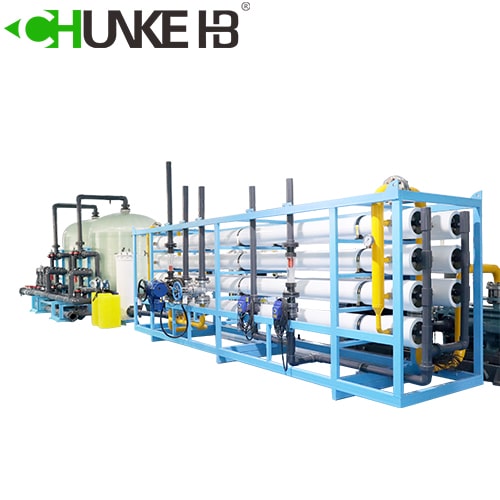
Chunke is a seawater RO plant manufacturer in China that designs, builds, and exports SWRO (seawater reverse osmosis) systems from 100 LPH to 500 m³/h for islands, resorts, marine vessels, and coastal industry. Each plant turns seawater of roughly 35,000 ppm TDS into fresh water below 300 ppm, so buyers receive drinking- or process-grade water at a typical energy use of about 3–4 kWh per cubic metre. We build every system around proven industrial components, and we adapt each one to your exact feed-water analysis. Therefore, you can study finished work on our seawater desalination plant page, and you can explore our wider range on our reverse osmosis water treatment system website.
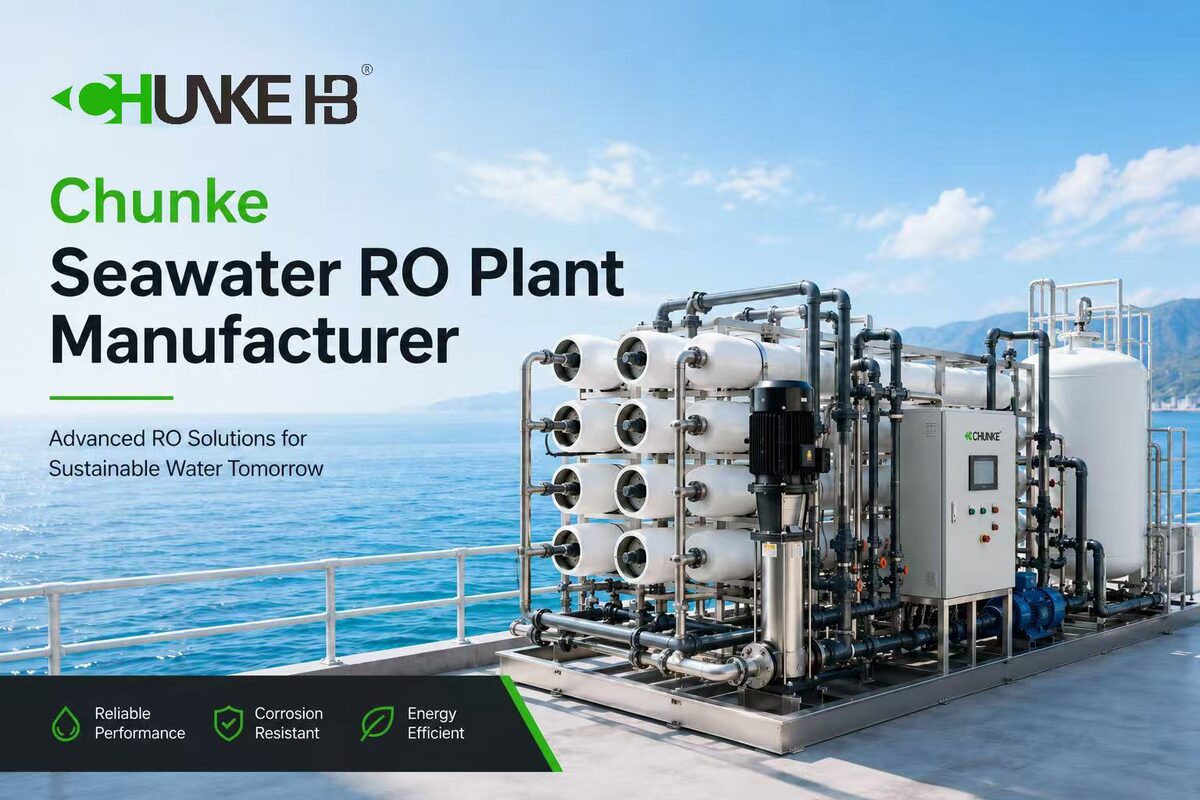
What a seawater RO plant does
A seawater RO plant forces pre-treated seawater through semi-permeable membranes at high pressure, so dissolved salt stays behind while clean permeate passes through. Because seawater carries far more salt than brackish water, an SWRO system runs at 55–70 bar and recovers roughly 35–45% of the feed in a single pass. The rest leaves as concentrated brine, which we discharge safely. Therefore three things decide whether a plant performs: membrane quality, pump and energy-recovery efficiency, and the pre-treatment that protects the membranes from fouling. We engineer all three together, so the plant holds steady output for years rather than fading after a few months.
The process sounds simple, yet the balance behind it is precise. So a good plant matches pressure, flow, recovery, and energy use to one stable operating point, and then it holds that point through changing seasons. Meanwhile, the control system watches every key value and flushes the membranes automatically, which protects your investment around the clock. Hence, even a small team can run a Chunke plant with confidence.
Capacity range and standard models
Chunke builds both standard skid-mounted units and fully customized plants across a wide range, so a small island guesthouse and a coastal factory can each get the right size. Smaller projects often start with a unit like our 25 m³/h SWRO system or an 8000 LPH seawater desalination plant, while larger sites move up to a 50 TPH seawater desalination machine and beyond, up to 500 m³/h. In addition, we engineer containerized and bespoke configurations to match a specific feed-water analysis and footprint. So you never force your site to fit a fixed box; instead, the plant fits your site.
We also help you choose the right size before you buy. First, you tell us your daily water demand and your peak demand. Next, we add a sensible safety margin, because real demand often grows. Then we set the membrane count and the pump duty to match. Hence, your plant meets demand even on the hottest, busiest day, yet it never wastes power on capacity you do not need.
Technical specifications
| Parameter | Chunke SWRO range |
|---|---|
| Capacity | 100 LPH – 500 m³/h |
| Feed water (seawater TDS) | ~35,000 ppm (up to ~45,000 ppm) |
| Product water TDS | < 300 ppm (single pass) |
| Recovery rate | 35–45% |
| Operating pressure | 55–70 bar |
| Energy consumption | ~3–4 kWh/m³ (with PX energy recovery) |
| Membranes | Hydranautics (or DuPont, Toray, LG, Vontron on request) |
| High-pressure pumps | Grundfos / Danfoss |
| Energy recovery | Energy Recovery PX (Pressure Exchanger),Isave |
| Configuration | Skid-mounted, containerized, or custom |
Core components and brands
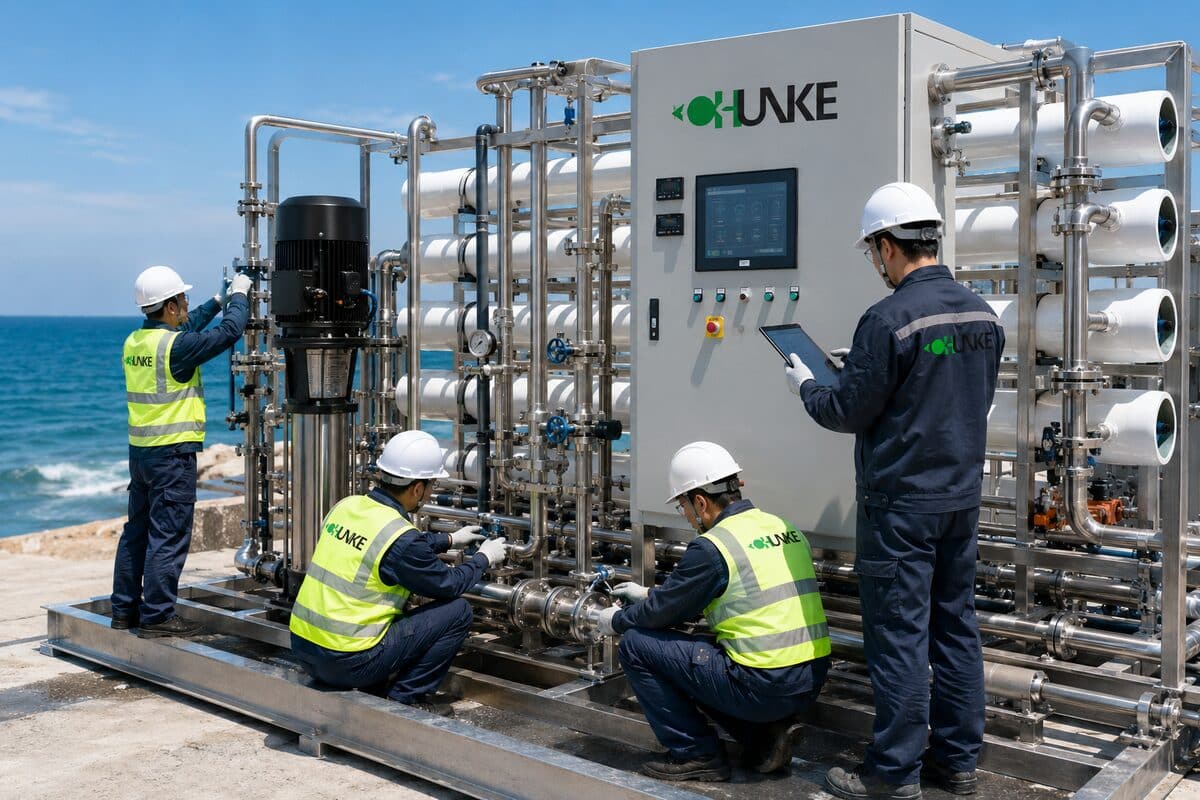
Reliability in seawater service comes from the components, so Chunke specifies proven industrial brands rather than the cheapest parts. Membranes come from Hydranautics seawater membranes; booster pump; CNP, NYP, Grundfos, KSB high-pressure pumping uses Grundfos high-pressure pumps, Danfoss, CNP, NYP; and an Energy Recovery PX device recovers energy from the brine stream to cut power draw. Furthermore, piping and valves use Georg Fischer (+GF+) corrosion-resistant systems, instrumentation relies on Endress+Hauser, and control runs on a Siemens PLC and HMI with Schneider Electric components. So every contact point with seawater resists corrosion, and every signal reaches a reliable controller.
We choose these brands for a clear reason: they last. A cheap pump or a weak membrane fails fast in seawater, and a failure at sea or on a remote island costs far more than the part. Therefore, we spend a little more on the parts that matter, and you save much more over the fifteen-year life of the plant. Meanwhile, these global brands keep spare parts available worldwide, so service stays simple wherever your plant runs.
Pre-treatment that protects the membranes
Strong pre-treatment decides how long your membranes last, so we design it with great care. Raw seawater carries sand, mud, algae, and oil, and these foulants attack the membrane surface if they slip through. Therefore, each plant starts with a multimedia sand filter and an active carbon filter, and then a fine 5-micron cartridge filter removes the last small particles. Meanwhile, dosing pumps add antiscalant and, when needed, sodium bisulfite to stop scaling and protect the membranes. Because clean feed water keeps the membranes working for years, good pre-treatment saves you money twice over.
We also match the pre-treatment to your local water, since seawater changes from place to place and from season to season. So a site near a busy harbor needs a different setup than a clean open coast. Our engineers study your water report, and then they choose the right filters and chemicals for your conditions. Hence, your plant stays stable all year, and your membranes reach their full service life.
Energy efficiency and running cost
Energy forms the biggest share of desalination cost, so efficiency directly shapes your bottom line. A well-designed seawater RO plant uses about 3–4 kWh per cubic metre of fresh water when it includes a PX energy-recovery device. Without recovery, that figure can almost double. Therefore, we fit energy recovery on every medium and large plant, because the upfront cost pays itself back fast through lower power bills.
Membrane replacement forms the next major cost, yet good care keeps it low. Quality membranes last three to five years when pre-treatment stays effective, so clean feed water protects both your output and your budget. Meanwhile, cartridge filters and antiscalant form a small but steady expense. We give every customer a clear cost breakdown before they buy, so you plan your budget with full confidence and avoid surprises later.
Delivered projects
Chunke SWRO plants already run across our target export markets. Recent installations include a 40 m³/h seawater RO plant in Iran (2024), a 20 m³/h plant in the Philippines (2023), and a compact 3 m³/h system in Indonesia (2025). Consequently, buyers can see the same engineering applied at very different scales, from small island supply to mid-size industrial output. We share photos, test data, and references from these projects on request, so you judge our work before you commit.
Applications and markets we serve
Chunke supplies SWRO plants to islands and resorts that lack fresh groundwater, to hotels that need a reliable on-site supply, to marine and offshore applications, and to coastal municipal and industrial sites. Moreover, we focus on overseas projects across the Middle East, Southeast Asia, Africa, the CIS region, and South America, where dependable desalination matters more than a rock-bottom price. So if your project sits near the sea and needs steady fresh water, we can build the right plant for it.
Quality control, testing, and factory visits
Quality control runs through our whole process, not just the final check. We inspect incoming parts, we watch each assembly step, and we test every finished plant under full pressure. During the test, we measure salt rejection, flow, and recovery, and we tune the system until it meets its targets. So your plant arrives proven, not promised. Furthermore, we pack each unit with care for the sea journey, so it reaches your port in the same condition it left our factory.
We also welcome customers to visit, because a real manufacturer has nothing to hide. You can walk our workshop, meet our engineers, and watch a plant come together step by step. If you cannot travel, we offer a live video tour instead, so you still see our team and our equipment with your own eyes. Hence, you choose us with clear proof, not just a promise on paper.
Export, delivery, and after-sales service
We export to customers worldwide, so we handle the whole shipping process with care. We arrange professional sea packing, we prepare clear export documents, and we load each container safely. Meanwhile, our sales engineers speak clear English and reply quickly, so communication stays smooth from the first inquiry to the final delivery. After your plant arrives, we guide your team through installation and start-up by video or, for large projects, in person. So you reach stable production fast, and you keep our support for years.
Why buyers choose Chunke
Chunke positions itself as a mid-segment professional manufacturer, not a low-price competitor. We handle design, manufacturing, factory testing, and commissioning support, and we adapt each plant to the client’s water analysis instead of shipping a one-size box. Therefore, you gain lower cost than a trading company, stronger quality than a budget supplier, and faster technical support than either. For wider water-treatment needs beyond seawater — brackish RO, UF, EDI, and reuse systems — you can also explore our parent company at Chunke Water Treatment.
How to choose the right SWRO plant capacity
Capacity sizing starts with one clear question: how much fresh water do you need each day? First, list every use, from drinking and cooking to process water and irrigation. Next, add a safety margin of 15–20%, because demand almost always grows. Then we work back to the feed flow, since seawater recovery usually sits between 35% and 45%. So a plant that produces 100 m³ of fresh water per day needs roughly 220–280 m³ of feed seawater. Hence, we size the membranes, the high-pressure pump, and the pre-treatment to that feed flow, and your plant meets demand without wasting energy.
Containerized, skid-mounted, or custom: which to choose
One build type never fits every site, so we offer three. A skid-mounted plant sits on a compact steel frame, and it suits an indoor room or a sheltered plant building. Meanwhile, a containerized plant lives inside a sealed 20-foot or 40-foot shipping container, so it ships easily, installs fast, and resists harsh weather, dust, and salty air. Furthermore, a custom plant fits a large municipal or industrial project, and we design it around your civil layout and output goals. Therefore, you pick the build that matches your space, your climate, and your budget, and we engineer every detail to support it.
Maintenance and membrane life
A Chunke plant needs only simple, scheduled care, so daily work stays light. You replace the 5-micron cartridge filters often, you clean the membranes when performance drops, and you check the pump and dosing systems on a regular cycle. Meanwhile, the PLC logs pressure, flow, and conductivity, so it warns you early when a value drifts. Because good pre-treatment keeps fouling low, seawater membranes typically last three to five years before replacement. Hence, your running cost stays predictable, and your downtime stays short.
Frequently asked questions
Are you a real seawater RO plant manufacturer or a trader?
We are a real manufacturer with our own factory and engineers, so we control design, quality, price, and delivery. Moreover, we welcome factory visits and live video tours.
What product water quality can the plant reach?
A single-pass SWRO plant brings ~35,000 ppm seawater down to below 300 ppm TDS. So the water meets WHO drinking standards after post-treatment, and a second pass can reach far lower TDS for special process needs.
How much energy does a seawater RO plant use?
With a PX energy-recovery device, a Chunke plant uses about 3–4 kWh per cubic metre of fresh water. Therefore, energy recovery roughly halves the power a plant would draw without it.
How long does delivery take?
Most standard plants ship within a few weeks, while large custom plants take longer. So tell us your deadline early, and we plan production to meet it.
Do you offer a warranty and spare parts?
Yes. We back each plant with a clear warranty, and we keep common parts in stock, so you receive fast spare-part delivery and reliable support for years.
Can you build the plant to our brand or special design?
Yes. We offer OEM and ODM service, so we build under your brand and to your specification, including voltage, layout, and control language for your market.
Get a quotation
Tell us your required capacity, your feed-water source, and your target product quality, and our engineering team will respond with a tailored proposal. Please fill in the enquiry form below with these details. Once you submit the form, our team will contact you within 24 hours with a custom solution and a clear quote. Hence, you take the first step toward a steady supply of clean, affordable fresh water today.