
When customers plan to buy a seawater desalination plant, one of the first questions is always: How much does a seawater desalination plant cost?
This is a very normal question. A seawater reverse osmosis system is not a simple water filter. It is a complete engineering system, including pretreatment, high-pressure pump, seawater RO membranes, pressure vessels, dosing systems, instruments, control panel, piping, valves, cleaning system and sometimes containerized installation.
Because every project has different feed water quality, capacity, power supply, installation condition and final water requirement, the seawater desalination plant cost cannot be calculated only by one fixed price. However, we can give a useful price range and explain clearly what affects the final price.
At Chunke Water Treatment, we design and manufacture SWRO systems for islands, resorts, hotels, coastal factories, fish farms, ships, offshore projects, drinking water supply and industrial water use. This guide will help you understand the main cost factors before you request a quotation.
1. General Seawater Desalination Plant Cost Range
For a standard industrial seawater RO system, the price can vary from tens of thousands of USD to several hundred thousand USD, depending on capacity and configuration.
Below is a practical reference range:
| System Capacity | Daily Production | Estimated Equipment Price Range |
|---|---|---|
| Small SWRO system | 5–20 m³/day | USD 8,000–35,000 |
| Commercial SWRO system | 50–200 m³/day | USD 35,000–120,000 |
| Medium industrial SWRO system | 200–600 m³/day | USD 80,000–280,000 |
| Large industrial SWRO system | 600–1,200 m³/day | USD 180,000–650,000 |
| Containerized SWRO plant | Depends on capacity | Usually 15–40% higher than skid-mounted type |
| Large customized desalination plant | Above 1,200 m³/day | Customized quotation required |
These are general price ranges only. The final price depends on technical design, feed water condition, membrane brand, pump brand, material selection, automation level, container design and site requirements.
2. Why Capacity Has the Biggest Effect on SWRO Plant Price
Capacity is the first and most important factor. A 10 m³/day seawater desalination machine and a 1,000 m³/day seawater desalination plant cannot use the same pump, membrane quantity, pipe size, pretreatment system or control system.
For example, a small seawater RO system may only need a simple sand filter, cartridge filter, one high-pressure pump and several membranes. But a larger industrial SWRO plant needs bigger pretreatment filters, chemical dosing systems, multiple pressure vessels, high-pressure stainless steel piping, larger control cabinet, flowmeters, pressure transmitters and sometimes an energy recovery device.
This is why customers should not only ask, “What is the price?” The better question is:
How many cubic meters of fresh water do I need per day, and what water quality do I need after treatment?
For drinking water, the system may need post-treatment such as UV sterilizer, mineral adjustment or pH correction. For industrial use, the product water TDS target may be different. For boiler, power plant, beverage or pharmaceutical use, the system may also need a second-pass RO or EDI system after the seawater desalination plant.
3. Feed Water TDS and Water Quality Affect the Cost
Seawater quality is not the same in every country. Some seawater has around 30,000–35,000 ppm TDS. Some locations may reach 40,000–45,000 ppm or even higher. Higher TDS means higher osmotic pressure, and the system needs higher operating pressure to push water through the seawater RO membrane.
If the feed water has high turbidity, algae, oil, iron, manganese or organic matter, the pretreatment system must be stronger. This may include:
Quartz sand filter
Activated carbon filter
Ultrafiltration system
Chemical dosing system
Antiscalant dosing
Reducing agent dosing
pH adjustment
Cartridge filter
Automatic backwash system
A good pretreatment design protects the seawater RO membranes and reduces long-term operation problems. Some customers only compare the initial machine price, but a cheaper system with weak pretreatment can cause frequent membrane fouling, high chemical cleaning frequency and shorter membrane life.
A reliable SWRO plant should not only be cheap to buy. It should be stable to operate.
4. Membrane Brand and Quantity
The seawater RO membrane is one of the most important parts of a desalination system. Different membrane brands and models have different salt rejection, flux, energy consumption and service life.
Common seawater RO membrane brands include DOW / DuPont, Hydranautics, Toray, Vontron and other qualified brands. Imported membranes usually increase the equipment cost, but they can provide better performance and more stable water quality.
The quantity of membranes depends on the system capacity, recovery rate, feed TDS, design flux and final water quality requirement. A larger system may use dozens or even more than one hundred 8040 seawater RO membranes.
For customers, the important point is not only the membrane brand. The membrane design should be reasonable. If the system uses too few membranes to reduce cost, the flux may be too high, membrane fouling risk will increase and operation pressure may become unstable.
5. High-Pressure Pump and Energy Consumption
The high-pressure pump is another major cost item in a seawater desalination plant. Seawater RO normally requires high pressure because salt concentration is high. The pump must be suitable for seawater service and corrosion resistance.
For small systems, the pump cost may be moderate. For large systems, the high-pressure pump can become one of the most expensive components.
Material is also very important. For seawater applications, the wet parts of high-pressure pumps and high-pressure piping are commonly made of corrosion-resistant materials such as duplex stainless steel or super duplex stainless steel, depending on design and budget.
Energy consumption is also a key part of the total cost. A system with lower equipment price but higher power consumption may cost more in the long term. For medium and large SWRO systems, customers can consider an energy recovery device. It increases the initial investment, but it can reduce energy consumption and improve long-term operating cost.
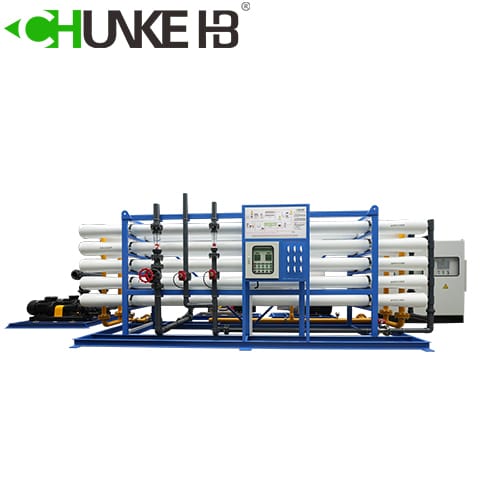
6. Skid-Mounted or Containerized SWRO Plant?
A skid-mounted seawater desalination plant is usually installed inside the customer’s equipment room. It is suitable when the customer already has a building, power supply, drainage and enough space.
A containerized seawater desalination plant is installed inside a 20ft or 40ft container. It is especially useful for islands, remote coastal areas, construction sites, emergency water supply, military camps, mining sites and resorts.
Containerized design usually costs more because it may include:
Container modification
Thermal insulation
Ventilation or air conditioning
Lighting
Internal piping and cable layout
Floor treatment
Fire extinguisher
Factory assembly and testing
Easier transportation and installation
Although the initial cost is higher, a containerized SWRO plant can save installation time and reduce civil work at site. For remote projects, this can be a very good choice.
7. Material Selection Changes the Price
Seawater is highly corrosive. The correct material selection is very important for long service life.
Common material choices include:
UPVC for low-pressure piping
FRP for filter tanks and pressure vessels
SS316 for some medium-duty parts
Duplex 2205 stainless steel for high-pressure seawater sections
Super duplex 2507 for more demanding seawater applications
Carbon steel frame with anti-corrosion coating
If a customer asks for all stainless steel frame, high-grade duplex piping, international brand valves and instruments, the price will increase. If the project is for industrial use with standard requirements, a cost-effective configuration can be selected.
The best solution is not always the most expensive solution. The best solution is the one that matches the feed water quality, working pressure, site environment and customer budget.
8. Automation and Instrumentation
A basic SWRO system can use simple electric control, while a professional industrial seawater desalination plant usually uses PLC and HMI touch screen control.
A better control system can include:
- Automatic start and stop
- Low pressure protection
- High pressure protection
- Automatic flushing
- Product water conductivity monitoring
- Raw water conductivity monitoring
- pH monitoring
- ORP monitoring
- Flow monitoring
- Pressure monitoring
- Alarm display
- Operation status display
- Manual and automatic operation modes
Automation increases the initial price, but it improves operation safety and reduces operator mistakes. For remote projects or large industrial plants, PLC automatic control is strongly recommended.
9. Installation, Commissioning and After-Sales Cost
When comparing seawater RO system price, customers should check what is included and what is not included.
Some quotations only include equipment EXW factory price. Some quotations may include container, spare parts, technical documents, factory testing, sea freight, site installation, commissioning and operator training.
Common cost items outside equipment price may include:
- Sea freight
- Local tax and customs clearance
- Site civil work
- Raw water intake system
- Product water tank
- Concentrate discharge pipeline
- Power cable to site
- Installation labor
- Engineer travel cost
- Commissioning cost
- Chemical and consumables
- Spare parts
Before buying, customers should ask the supplier to clearly define the scope of supply. This avoids misunderstanding later.
10. How to Reduce Seawater Desalination Plant Cost Without Reducing Quality
Many customers want to reduce investment cost. This is possible, but it must be done carefully.
Good ways to optimize cost include:
Choose the correct capacity instead of oversizing too much
Use standard skid-mounted design if container is not necessary
Use reliable but cost-effective membrane brands
Choose proper pretreatment according to real water analysis
Avoid unnecessary instruments for small simple systems
Use local tanks and civil works when possible
Use VFD control for better energy management
Select energy recovery for medium and large systems when power cost is high
Bad ways to reduce cost include:
Using too few membranes
Using weak pretreatment
Using poor material for seawater high-pressure section
Removing important protection instruments
Using low-quality high-pressure pump
Ignoring feed water analysis
Ignoring after-sales service and spare parts
A seawater desalination plant is a long-term investment. The cheapest system may become expensive if it causes frequent shutdown, high membrane replacement cost or unstable water quality.
11. What Information Is Needed for an Accurate Quotation?
To calculate the correct SWRO plant price, the supplier needs basic project information.
Please prepare the following details:
Required product water capacity, m³/day or m³/hour
Feed water source: open seawater, beach well, brackish water or seawater intake
Feed water TDS and water analysis report
Required final water TDS
Application: drinking water, irrigation, hotel, industry, fish farm, boiler or others
Power supply voltage and frequency
Installation type: indoor, outdoor, skid-mounted or containerized
Required automation level
Project location and port of delivery
Any special brand requirements for membrane, pump or electrical parts
With this information, the supplier can design a suitable process and provide a more accurate price range.
12. Conclusion: How Much Should You Budget?
For small commercial use, a seawater desalination machine may start from several thousand to tens of thousands of USD. For medium industrial projects, the cost is often in the range of tens of thousands to several hundred thousand USD. For large-capacity or containerized desalination plants, the budget can be much higher.
The most important point is that seawater desalination plant cost depends on engineering design. Capacity, feed water TDS, pretreatment, membrane brand, pump brand, material, energy recovery, control system and installation scope all affect the final price.
Chunke Water Treatment can help customers design a suitable SWRO system based on real project needs. We can provide skid-mounted seawater RO systems, containerized seawater desalination plants, commercial desalination systems and large industrial SWRO plants.
Send us your required capacity, seawater analysis report and project location. Our engineering team will prepare a practical technical proposal and price range for your project.

Comments are closed for this post.