
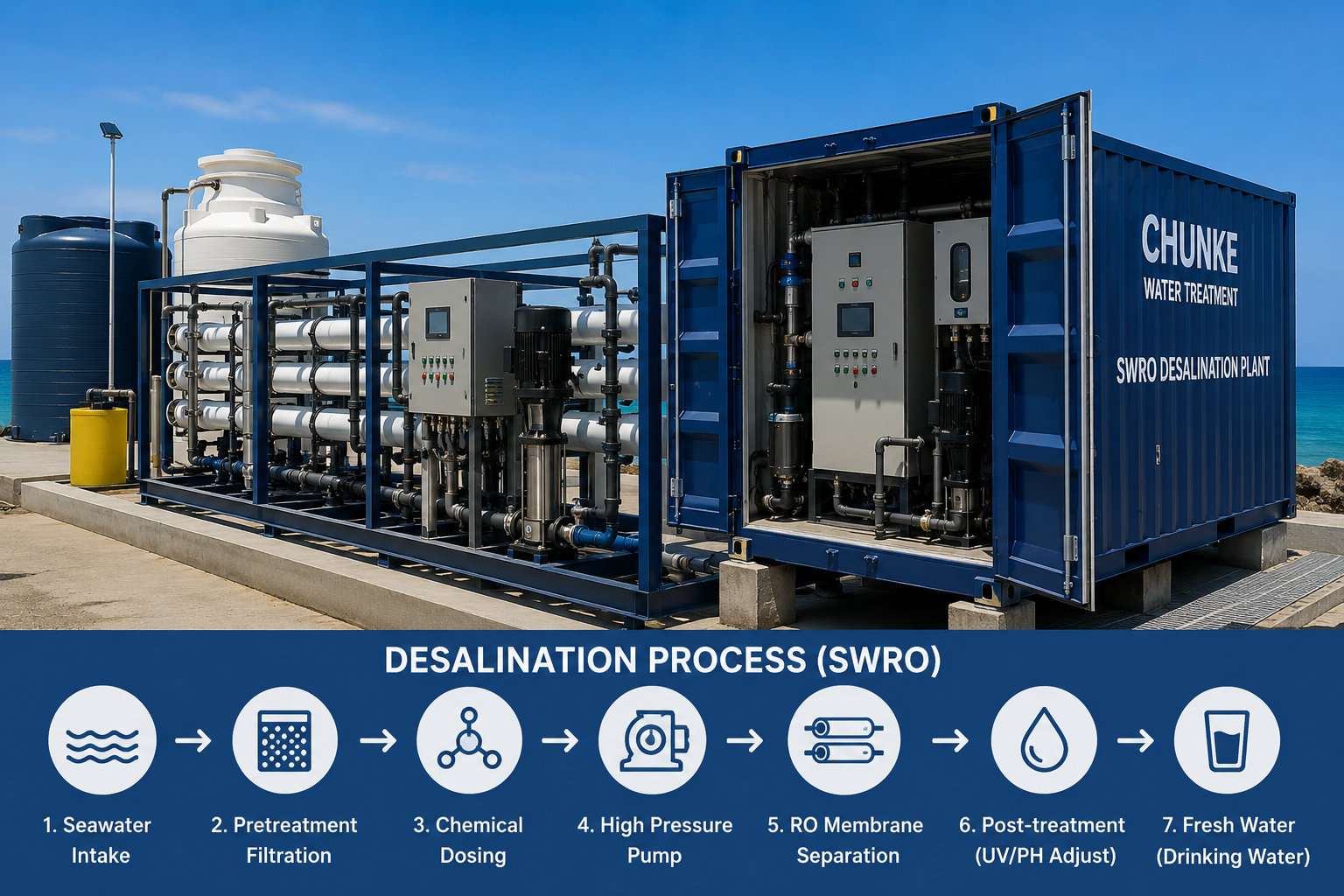
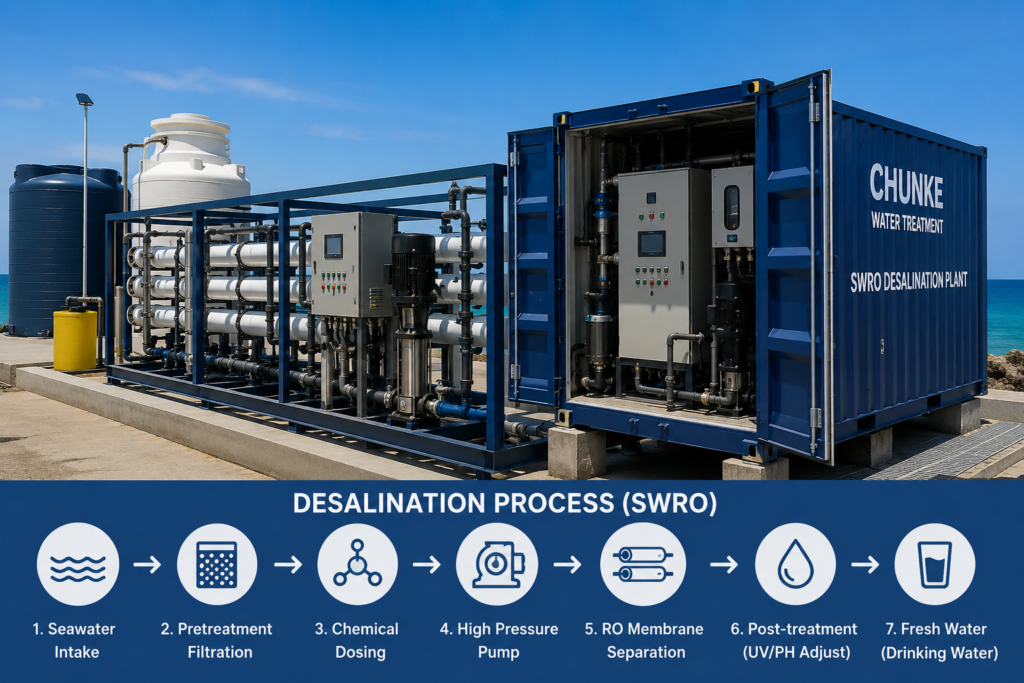
The desalination process converts seawater into fresh water by removing dissolved salts, suspended solids, microorganisms, and other unwanted substances through a complete water treatment system.
Many islands, hotels, resorts, coastal factories, ships, offshore platforms, fish farms, and remote communities struggle to secure a stable freshwater source. Moreover, transporting fresh water by tanker, truck, or boat often costs too much and creates long-term supply risks. Therefore, a professional seawater desalination system gives customers a reliable way to produce fresh water directly from the sea.
However, customers should not view a desalination plant as a simple sea water purifier. A reliable system needs several treatment stages. First, the plant collects seawater. Next, pretreatment filters remove particles, turbidity, algae, and other contaminants. Then, chemical dosing protects the membranes. After that, a high-pressure pump pushes seawater through SWRO membranes. Finally, post-treatment improves product water quality according to the final application.
1. What Is the Desalination Process?
The desalination process removes salt from seawater or brackish water and produces fresh water for drinking, industrial use, hotels, resorts, irrigation, fish farms, ships, or coastal communities.
Seawater contains a high concentration of dissolved salts. Therefore, customers cannot use it directly as drinking water or process water. In most coastal areas, seawater TDS commonly reaches around 30,000–45,000 mg/L, although actual values depend on location, season, and seawater source.
A seawater desalination plant solves this problem. It uses pretreatment, high-pressure pumping, reverse osmosis membranes, instruments, automatic control, and optional post-treatment to desalinate seawater efficiently.
Many customers search for different terms when they need this equipment. Some search for a desalination system. Others search for a desalination plant, SWRO plant, seawater desalination machine, sea desalination system, sea water purifier, saltwater desalination system, or desalinator for seawater. Although these terms look different, customers usually need the same result: a reliable system that converts seawater to drinking water or usable fresh water.
2. Why Reverse Osmosis Works Well for Seawater Desalination
Reverse osmosis gives customers an efficient and practical way to produce drinking water from seawater. During the desalination process, the high-pressure pump creates enough pressure to overcome osmotic pressure. Then, water molecules pass through the RO membrane surface, while most dissolved salts remain in the concentrate stream.
This method offers several advantages. First, SWRO plants use a modular design. Therefore, customers can select small, medium, or large capacities according to daily demand. Second, engineers can customize pretreatment according to feed water quality. Moreover, PLC control systems make operation easier. Finally, containerized designs help customers reduce site installation work.
A professional SWRO plant can support many applications:
- Drinking water supply for islands and coastal villages
- Fresh water production for hotels and resorts
- Process water for factories near the sea
- Water supply for ships and offshore platforms
- Fresh water production for fish farms
- Emergency water supply after disasters
- Municipal water supply for remote communities
- Commercial water production projects
3. Stage One: Seawater Intake and Raw Water Assessment
Every successful desalination process starts with the seawater source. Therefore, the supplier should understand where the feed water comes from before finalizing the design.
Some customers use open seawater intake. Others use beach wells, coastal wells, or underground seawater. Open seawater may contain sand, shells, algae, suspended solids, microorganisms, oil, and seasonal turbidity. Meanwhile, beach well water often contains fewer suspended solids, but it may contain iron, manganese, hydrogen sulfide, or hardness.
Because water quality changes from one site to another, Chunke recommends a water analysis report before final design. The report should include TDS, conductivity, pH, temperature, turbidity, hardness, alkalinity, chloride, sulfate, silica, iron, manganese, and SDI if available. In addition, customers should test oil, COD, bacteria, and organic matter when the seawater source sits near harbors, factories, fish farms, or wastewater discharge points.
A good raw water assessment protects the complete desalination plant. Moreover, it helps engineers choose the right filter size, dosing chemicals, membrane quantity, operating pressure, and recovery rate.
4. Stage Two: Pretreatment Before SWRO Membranes
Pretreatment protects RO membranes and improves long-term stability. Therefore, customers should never choose desalination equipment only by checking membrane quantity and pump size.
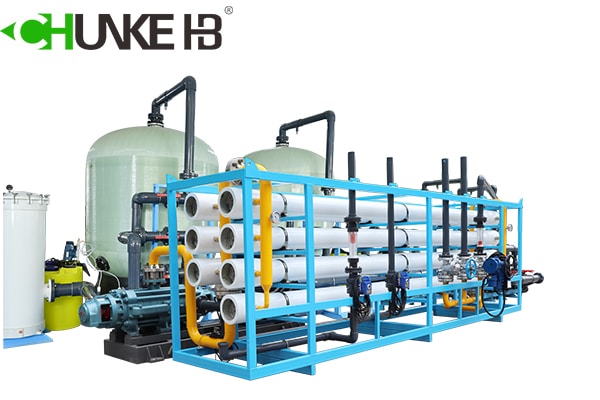
During pretreatment, filters and chemicals remove particles, turbidity, organic matter, oxidizing agents, and other contaminants before seawater enters the high-pressure section.
A typical seawater desalination process may include:
- Raw seawater intake screen
- Raw water storage tank
- Raw water pump
- Coagulant dosing
- Biocide or chlorination dosing
- Multimedia sand filter
- Activated carbon filter or dechlorination stage
- Antiscalant dosing
- Reducing agent dosing
- Cartridge filter
- Ultrafiltration for difficult water sources
For stable beach well water, multimedia filtration and cartridge filtration may provide enough protection. However, open seawater may require stronger pretreatment. For example, if algae blooms or seasonal turbidity affect feed water, engineers may add ultrafiltration before SWRO.
Pretreatment quality directly affects membrane life. If the supplier installs weak pretreatment, membrane fouling may increase quickly. Consequently, the system may lose production capacity, consume more energy, and require frequent chemical cleaning.
Chunke can customize pretreatment according to feed water quality, site condition, operating hours, and budget. Therefore, customers receive a complete seawater desalination system rather than only an RO skid.
5. Stage Three: Chemical Dosing and Cartridge Filtration
Chemical dosing supports stable operation during the desalination process. Each chemical has a specific purpose, so engineers should calculate dosing according to feed water quality and system recovery.
Antiscalant helps reduce scaling risk inside the RO membranes. Meanwhile, a reducing agent such as sodium bisulfite removes residual chlorine before seawater reaches the membranes. In some projects, engineers also use pH adjustment to improve membrane performance or control scaling.
Before the high-pressure pump, cartridge filters remove fine particles that escape from earlier pretreatment stages. Many commercial systems use 5-micron cartridge filters. However, the final selection depends on process design and customer requirements.
A professional desalination system should include pressure gauges or differential-pressure monitoring across filters. Therefore, operators can replace cartridges at the right time instead of waiting for a major pressure drop.
6. Stage Four: High-Pressure Pump Operation
The high-pressure pump plays a critical role in every seawater desalination plant. It pushes pretreated seawater through the SWRO membranes and creates the pressure required to separate salt from water.
Because seawater creates corrosion risk, pump material matters. Engineers should select suitable materials according to salinity, pressure, capacity, and operating conditions. For many seawater projects, duplex stainless steel or super duplex material gives better corrosion resistance.
For medium and large systems, energy recovery devices can reduce electricity consumption. Consequently, customers can reduce long-term operating costs, especially when electricity or diesel prices remain high.
7. Stage Five: SWRO Membrane Separation
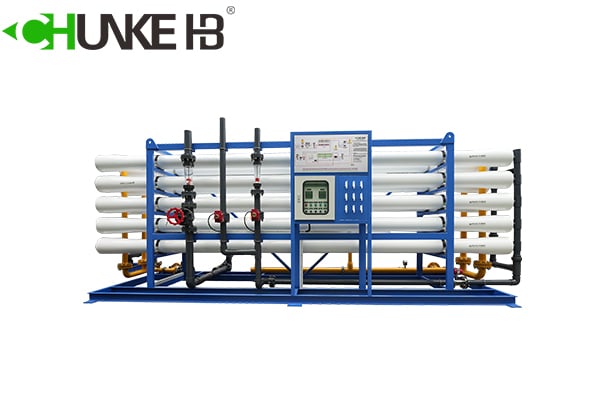
SWRO membranes form the heart of the desalination process. The high-pressure pump sends seawater into membrane pressure vessels. Then, the membrane surface allows water molecules to pass through while rejecting most dissolved salts.
The system creates two water streams:
Product water, also called permeate
Concentrate water, also called brine
Product water flows toward the fresh water tank. Meanwhile, concentrate water carries rejected salts away from the membranes and leaves the system through the discharge line.
Membrane selection affects product water quality, salt rejection, operating pressure, power consumption, and membrane life. Therefore, the supplier should calculate membrane quantity and flux carefully.
If a supplier uses too few membranes to lower the price, each membrane carries a higher load. Consequently, membrane fouling risk increases, cleaning frequency rises, and membrane life may decrease.
8. Stage Six: Product Water Post-Treatment
After SWRO membranes remove most dissolved salts, the product water may need post-treatment. Therefore, the final application determines the next step.
For industrial process water, the customer may use product water directly or add second-pass RO, mixed-bed resin, or EDI. Meanwhile, drinking water projects may need UV sterilization, mineral adjustment, pH correction, and final disinfection.
A drinking-water-from-seawater project should not focus only on low TDS. The final water should also meet customer requirements for taste, safety, and distribution. Therefore, hotels, resorts, island communities, and bottled water projects often add remineralization or pH adjustment after SWRO.
For a commercial desalination plant, Chunke can customize post-treatment according to the customer’s final water target.
9. Recovery Rate, Feed Flow, and Brine Discharge
Customers often ask how much seawater the plant needs. To answer correctly, engineers must calculate recovery rate.
Typical seawater RO recovery often stays around 35–45%, depending on feed water TDS, temperature, membrane design, scaling risk, and customer requirements.
For example, if the customer needs 100 m³/day of fresh water and the system recovery reaches 40%, the plant needs around 250 m³/day of feed seawater. Then, the desalination process produces 100 m³/day of product water and discharges about 150 m³/day of concentrate.
Therefore, customers must prepare enough seawater intake capacity. Moreover, they should plan brine discharge carefully according to local environmental requirements and site conditions.
Higher recovery does not always mean better design. If engineers push recovery too high, scaling risk may increase. Consequently, the plant may need more frequent cleaning and stricter chemical control. A reliable supplier should balance water production, membrane safety, energy consumption, and operating cost.
10. Instruments and Automatic Control
A professional desalination system needs clear monitoring and safe control logic. Therefore, customers should check which instruments and control components the supplier includes.
A typical SWRO plant may include:
- Raw water conductivity meter
- Product water conductivity meter
- Pressure gauges
- Pressure transmitters
- Flowmeters
- Level transmitters
- pH meter
- ORP meter
- Differential-pressure monitoring
- Low-pressure protection
- High-pressure protection
- Automatic flushing
- Tank level control
- PLC control
- HMI touch screen
- Variable frequency drive
However, brands alone do not create a reliable system. Engineers must also design correct control logic, protection settings, alarm strategy, and maintenance access.
11. How to Choose the Right Desalination Plant Capacity
Customers should calculate daily water demand before ordering a desalination plant. Capacity affects membrane quantity, pump size, filter size, power consumption, container size, tank volume, and total project cost.
For example, a hotel may need 50–200 m³/day. Meanwhile, an island community may need 200–1,000 m³/day. A coastal factory may require 500–5,000 m³/day or more.
Customers should also confirm daily operating hours. If the plant runs 20 hours per day, a 10 m³/h system produces about 200 m³/day. However, if the customer wants only 10 hours of daily operation, the same project needs around 20 m³/h capacity.
12. Skid-Mounted or Containerized Desalination Equipment
Customers can choose skid-mounted or containerized desalination equipment according to site conditions.
A skid-mounted system works well when the customer already has an equipment room. Therefore, the customer can prepare tanks, drainage, ventilation, and power supply according to local conditions.
A containerized seawater desalination system works well for islands, remote communities, construction sites, fish farms, hotels, resorts, and emergency water projects. The factory installs equipment inside a modified container, so the customer can reduce site work and simplify transportation.
Moreover, containerized systems help protect equipment from rain, salt air, and outdoor conditions. They also support faster installation and easier relocation.
13. Applications of the Desalination Process
The desalination process supports many commercial and industrial applications.
Hotels and resorts use seawater desalination systems to reduce fresh water transportation costs. Meanwhile, islands and coastal villages use SWRO plants to create a stable drinking water source. Factories near the sea use desalination equipment for process water, cooling water, cleaning water, and boiler feed pretreatment.
In addition, fish farms, ships, offshore platforms, mining sites, and construction projects can use sea desalination systems when local fresh water supply remains limited.
Customers may search for these applications with different keywords:
- Saltwater desalination system
- Sea water purifier
- Desalinator for seawater
- SWRO plant
- Seawater desalination equipment
- Desalination plant manufacturer
- Seawater-to-drinking-water system
- Drinking water from seawater
- Sea water for drinking
- Commercial desalination plant
- Industrial seawater desalination system
Chunke can customize the process according to feed water quality, capacity, product water target, power supply, installation location, and budget.
14. Why Choose Chunke Water Treatment?
Chunke Water Treatment operates as a water treatment equipment factory in Guangzhou, China. Therefore, we can design, manufacture, assemble, test, and supply complete seawater desalination systems according to customer requirements.
We provide:
- Commercial SWRO systems
- Industrial seawater desalination plants
- Containerized desalination systems
- Skid-mounted desalination equipment
- Island drinking water systems
- Hotel and resort desalination plants
- Fish farm water treatment systems
- Offshore and marine fresh water systems
- Customized pretreatment systems
- Post-treatment systems for drinking water and industry
Moreover, our engineering team can customize membrane brands, pump brands, piping materials, instrumentation, automation level, container layout, power supply, and spare parts package.
As a factory, Chunke can support customers from initial inquiry to final delivery. First, we review the customer’s water analysis report. Next, we calculate capacity, recovery, membrane quantity, pump pressure, and power consumption. Then, we prepare a technical proposal and quotation. After production, we test the desalination equipment before shipment. Finally, we provide technical support, commissioning guidance, operator training, and spare parts service.
15. Information Needed for a Technical Proposal
To prepare the right desalination process design, please send us:
- Required fresh water capacity per hour or per day
- Feed water source
- Seawater analysis report
- Feed water TDS
- Required final water quality
- Application of product water
- Power supply voltage, phase, and frequency
- Installation location
- Indoor, outdoor, skid-mounted, or containerized installation
- Project country and nearest seaport
- Preferred membrane and pump brands
- Required automation level
- Available budget range if possible
With this information, Chunke can prepare a suitable process flow, equipment list, technical proposal, power estimate, layout, and quotation.
Conclusion
The desalination process needs more than one RO membrane and one pump. A reliable seawater desalination plant needs intake design, pretreatment, chemical dosing, cartridge filtration, high-pressure pumping, SWRO membranes, post-treatment, instruments, automatic control, storage planning, and brine discharge.
Therefore, customers should choose desalination equipment according to real water quality and actual project demand. A properly designed SWRO plant can turn seawater into drinking water, industrial water, hotel water, resort water, island water, or process water efficiently and reliably.
Chunke Water Treatment designs and manufactures commercial and industrial seawater desalination systems for customers worldwide. Whether you need a compact sea water purifier, a containerized SWRO plant, an island desalination system, or a large industrial desalination plant, our engineering team can prepare a practical solution for your project.
Please fill in the inquiry form below with your required capacity, feed water information, final water quality target, project location, and application. After we receive your information, the Chunke Water Treatment team will contact you and help you choose the right seawater desalination system.

Leave a Reply