
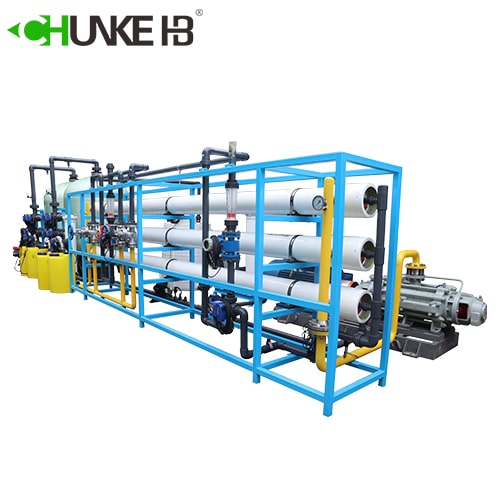
An 8000 lph Seawater Desalination Plant is a professional reverse osmosis water treatment system designed to convert seawater into usable fresh water for drinking water, process water, hotel water supply, island projects, marine applications, fishery plants, and coastal industrial facilities. “8000 lph” means the system can produce approximately 8,000 liters per hour, equal to about 192,000 liters per day under standard operating conditions.
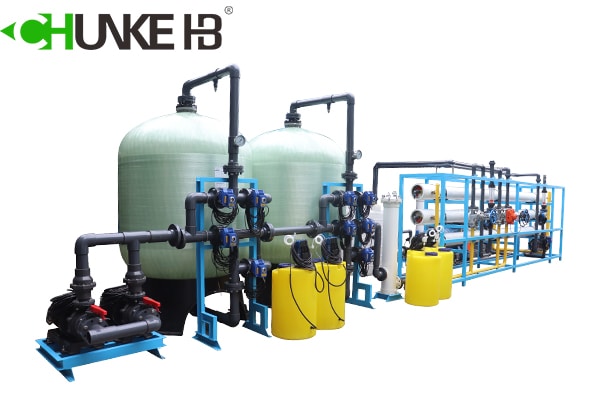
Chunke designs and manufactures seawater reverse osmosis systems for customers who need a stable, compact, and reliable fresh water source where municipal water is not available or where groundwater salinity is too high. Our 8000 lph Seawater Desalination Plant uses pretreatment, precision filtration, high-pressure pumping, seawater RO membranes, automatic control, chemical dosing, and optional post-treatment to make seawater suitable for the required application.
For more seawater RO solutions, visit our main website:
Seawater Desalination System Manufacturer
You can also learn more about Chunke Water Treatment from our company website:
Chunke Water Treatment
What Is an 8000 lph Seawater Desalination Plant?
An 8000 lph Seawater Desalination Plant is a complete SWRO system that removes dissolved salts and impurities from seawater by using reverse osmosis membrane technology. Seawater usually contains high TDS, often around 30,000–45,000 mg/L depending on the sea area. The RO membrane cannot work alone, so the complete plant must include pretreatment, chemical dosing, safety filtration, high-pressure equipment, membranes, instruments, and control logic.
The working principle is simple but technically precise. Seawater is first collected into a raw water tank or intake system. It is then pressurized by a raw water pump and passes through pretreatment filters to remove suspended solids, turbidity, particles, and oxidizing agents. After that, the water passes through cartridge filters before entering the high-pressure pump. The high-pressure pump increases pressure to overcome seawater osmotic pressure and push fresh water through the semi-permeable RO membrane. Clean permeate water is collected, while concentrated brine is discharged or handled according to project requirements.
Chunke can design the 8000 lph Seawater Desalination Plant as a skid-mounted system, containerized system, or customized industrial system based on the customer’s site condition, feed water quality, power supply, operation requirements, and final water quality target.
Main Applications
The 8000 lph Seawater Desalination Plant is suitable for medium-capacity projects where stable fresh water is required every day. It is widely used in:
- Island hotels and resorts
- Coastal villas and residential communities
- Fish processing plants
- Aquaculture and seafood factories
- Marine and offshore support facilities
- Small coastal towns and villages
- Construction camps near the sea
- Industrial process water supply
- Emergency water supply projects
- Seawater to drinking water projects
For many coastal projects, buying and transporting fresh water is expensive and unstable. A properly designed 8000 lph Seawater Desalination Plant gives the customer independent water production, better control of water quality, and long-term operating convenience.
Typical Process Flow
A professional 8000 lph Seawater Desalination Plant normally follows this process:
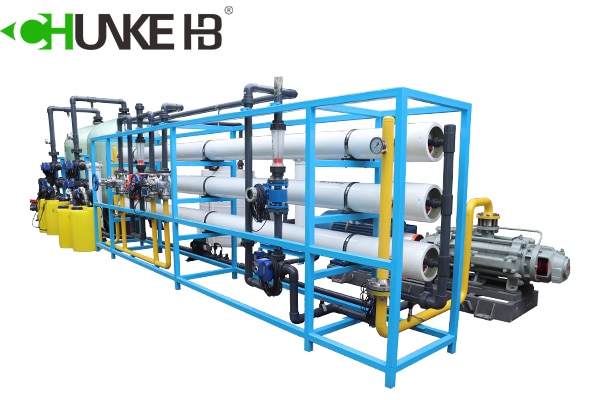
Seawater Intake / Raw Water Tank → Raw Water Pump → Chemical Dosing → Quartz Sand Filter → Activated Carbon Filter or Dechlorination System → Antiscalant Dosing → Cartridge Filter → High Pressure Pump → SWRO Membranes → Product Water Tank → UV Sterilizer / pH Adjustment / Remineralization if required
The process can be adjusted according to feed water analysis. For open seawater intake, the pretreatment may need stronger filtration, such as multimedia filtration, disc filter, ultrafiltration, or additional chemical dosing. For beach well seawater, turbidity may be lower, and the system can be more compact.
Pretreatment System
Pretreatment is one of the most important parts of any seawater reverse osmosis system. If pretreatment is not designed correctly, the RO membranes may become blocked, fouled, scaled, or damaged. Chunke designs the pretreatment section according to seawater quality, SDI, turbidity, iron, organic matter, microbial risk, and intake type.
For an 8000 lph Seawater Desalination Plant, the pretreatment section may include:
Raw Water Tank
The raw water tank helps stabilize system operation. It provides a buffer between the seawater intake and the desalination system. The tank can be made from PE, FRP, concrete with anti-corrosion treatment, or stainless steel depending on project requirements.
Raw Water Pump
The raw water pump transfers seawater from the raw water tank to pretreatment filters. For seawater service, pump wetted parts should be selected carefully. Stainless steel 316, duplex stainless steel 2205, or other seawater-resistant materials can be used according to pressure, chloride level, and budget.
Coagulant or Flocculant Dosing
If the seawater has high turbidity or fine suspended solids, coagulant or flocculant dosing can help improve filtration performance. This is especially useful for open seawater intake, harbor water, or coastal water with seasonal turbidity variation.
Biocide / Oxidant Dosing
For biological control, a bactericide or oxidant dosing system may be used before filtration. However, before water enters RO membranes, free chlorine or strong oxidizing agents must be removed or neutralized because seawater RO membranes are sensitive to oxidation.
Quartz Sand Filter
The quartz sand filter removes suspended solids, sediment, and larger particles. It protects downstream equipment and improves the stability of the cartridge filter and RO membrane system.
Activated Carbon Filter or Reducing Agent Dosing
Activated carbon filter can help reduce organic matter, color, odor, and residual chlorine. In some industrial SWRO designs, reducing agent dosing is used to remove oxidants before the RO membrane. The final selection depends on the feed water condition and operating strategy.
Cartridge Filter
The cartridge filter is the final safety barrier before the high-pressure pump and RO membranes. Typical filter precision may be 5 micron, and in some projects 1 micron or multi-stage cartridge filtration can be used. This protects the high-pressure pump and membrane elements from fine particles.
SWRO High Pressure System
The high-pressure system is the core of the 8000 lph Seawater Desalination Plant. Seawater RO requires much higher pressure than brackish water RO because seawater has high osmotic pressure. The high-pressure pump must provide stable pressure and flow to the membrane system.
Chunke can use high-pressure pumps made from seawater-resistant materials such as duplex stainless steel or super duplex materials for better corrosion resistance. A VFD can be added to control flow and pressure more accurately, reduce water hammer risk, and improve energy efficiency.
For energy-saving design, an energy recovery device can also be considered. In medium and large seawater systems, energy recovery helps reduce total operating cost by recovering pressure energy from the concentrate stream.
SWRO Membrane System
The membrane system is where desalination happens. The RO membrane allows water molecules to pass through while rejecting most dissolved salts and many other impurities. For seawater desalination, special seawater RO membranes are used. These membranes are designed for high salinity feed water and high operating pressure.
A typical 8000 lph Seawater Desalination Plant may use 8-inch seawater RO membrane elements installed inside FRP pressure vessels. The exact membrane quantity, vessel arrangement, recovery rate, and operating pressure must be calculated according to:
- Feed water TDS
- Feed water temperature
- Required permeate TDS
- Recovery rate
- Membrane brand and model
- Fouling risk
- Energy consumption target
- Final water application
For seawater at around 35,000 mg/L TDS, a single-pass SWRO system can commonly produce fresh water suitable for many drinking water and industrial applications. If the customer needs very low TDS, double-pass RO or post-treatment can be added.
Chemical Dosing System
Chemical dosing protects the RO membranes and improves system performance. For an 8000 lph Seawater Desalination Plant, common chemical dosing systems include:
Antiscalant Dosing
Antiscalant helps prevent mineral scaling inside the RO membrane. Scaling may be caused by calcium carbonate, calcium sulfate, barium sulfate, strontium sulfate, silica, and other sparingly soluble salts. Antiscalant dosing is normally required for seawater RO systems.
pH Adjustment
pH adjustment can be used before or after RO depending on water chemistry and final water target. If drinking water is required, post-treatment may include pH correction and remineralization to improve water taste and stability.
Reducing Agent Dosing
If chlorine or oxidants are present before RO, reducing agent dosing helps protect RO membranes from oxidation damage.
Cleaning Chemicals
The plant can include a CIP cleaning system. When membrane performance decreases because of fouling or scaling, the CIP system is used to circulate cleaning solution through the membrane system.
Instrumentation and Automatic Control
Chunke designs the 8000 lph Seawater Desalination Plant with professional instruments and control logic to make operation easier and safer.
Typical instruments may include:
- Raw water conductivity meter
- Product water conductivity meter
- Product water flow meter
- Concentrate flow meter
- Pressure gauges
- Pressure sensors
- Low-pressure protection switch
- High-pressure protection switch
- ORP meter
- pH meter
- Tank level control
- PLC control system
- Touch screen HMI
The PLC control system can monitor system status, start and stop pumps, open and close electric valves, protect the high-pressure pump, flush membranes, show alarms, and help operators understand real-time working conditions.
Automatic flushing is important for SWRO systems. It helps reduce salt concentration around membrane surfaces after shutdown and supports longer membrane service life.
Product Water Quality
The final water quality depends on feed water TDS, temperature, membrane model, system recovery, and design configuration. For many seawater desalination projects, the product water TDS can be designed to meet drinking water or process water requirements.
For drinking water applications, post-treatment may be necessary. Reverse osmosis removes salt very effectively, but RO permeate may have low alkalinity and low mineral content. Therefore, Chunke can add:
- pH adjustment system
- Remineralization filter
- UV sterilizer
- Final cartridge filter
- Product water tank
- Ozone or chlorination system if required
This makes the 8000 lph Seawater Desalination Plant more suitable for hotels, resorts, communities, and island water supply.
Containerized or Skid-Mounted Design
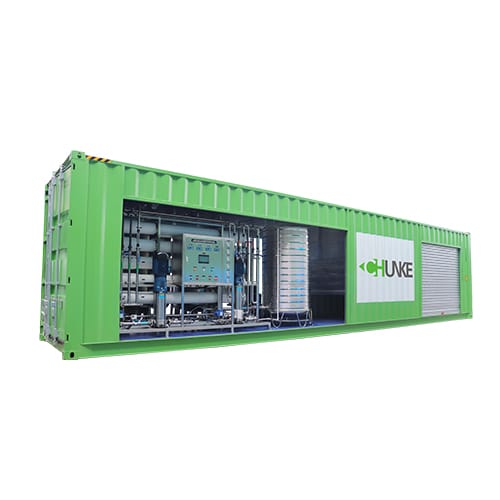
Chunke can manufacture the 8000 lph Seawater Desalination Plant in skid-mounted or containerized design.
Skid-Mounted Design
A skid-mounted system is suitable for indoor installation or existing equipment rooms. It is easier to inspect and maintain when enough space is available.
Containerized Design
A containerized SWRO system is suitable for remote islands, construction camps, emergency projects, and outdoor installation. The container can include piping, electrical control cabinet, lighting, ventilation, chemical dosing area, and main desalination equipment. This reduces site installation work and makes transportation easier.
For customers who want fast installation, containerized design is often a very good solution.
Main Advantages of Chunke 8000 lph Seawater Desalination Plant
1. Customized Engineering Design
Every seawater source is different. Chunke does not suggest using one fixed design for every customer. We check feed water quality, project location, operation hours, final water use, site space, power supply, and budget before final design.
2. Strong Pretreatment Protection
Membrane protection starts before the RO skid. Chunke can provide sand filtration, carbon filtration, chemical dosing, cartridge filtration, ultrafiltration pretreatment, or other customized solutions according to feed water conditions.
3. Seawater-Resistant Materials
Seawater is highly corrosive. Chunke selects suitable materials for pumps, valves, high-pressure piping, membrane vessels, and frames. High-pressure sections can use duplex stainless steel or other corrosion-resistant materials based on project requirements.
4. PLC Automatic Control
PLC and touch screen operation make the system easier for operators. Alarm functions, pressure protection, conductivity monitoring, automatic flushing, and flow control help improve operation safety.
5. Energy-Saving Options
For long-term operation, energy cost is very important. Chunke can design VFD control and energy recovery options to help reduce operating cost.
6. Complete Support
Chunke provides technical proposal, process design, equipment manufacturing, factory testing, packing, installation guidance, operation training, spare parts support, and after-sales service.
Recommended Technical Specification
The following data is a general reference for an 8000 lph Seawater Desalination Plant. Final parameters should be confirmed after water analysis and project design.
| Item | Reference Design |
|---|---|
| Product Name | 8000 lph Seawater Desalination Plant |
| Product Water Capacity | 8,000 LPH |
| Daily Capacity | Approx. 192,000 L/day |
| Feed Water | Seawater |
| Typical Feed TDS | Up to around 35,000 mg/L, customizable |
| Process | Pretreatment + SWRO + Post-treatment |
| Recovery Rate | Normally around 35–45%, depending on design |
| Desalination Rate | Normally 97–99%, depending on membrane and conditions |
| RO Membrane | 8-inch seawater RO membrane |
| Pressure Vessel | FRP seawater RO pressure vessel |
| High Pressure Pump | Seawater-resistant high-pressure pump |
| Control | PLC + touch screen HMI |
| Chemical Dosing | Antiscalant, reducing agent, pH adjustment, optional |
| Power Supply | Customized according to country standard |
| Installation Type | Skid-mounted or containerized |
| Final Water Use | Drinking water, process water, hotel water, island water supply |
Why Feed Water Analysis Is Important
Before finalizing an 8000 lph Seawater Desalination Plant, the customer should provide a water analysis report if possible. Important parameters include:
- TDS
- pH
- Temperature
- Turbidity
- SDI
- TSS
- Iron
- Manganese
- Calcium
- Magnesium
- Sulfate
- Chloride
- Silica
- Boron if drinking water standard requires control
- Oil and grease if industrial seawater intake is near port or factory area
- Microbiological condition
Without water analysis, Chunke can still provide a preliminary proposal based on typical seawater data, but final membrane design and pretreatment selection should be confirmed after actual water quality is checked.
Watch Our Seawater Desalination System Video
You can watch our seawater desalination system video here:
This video helps customers understand the real equipment arrangement, manufacturing quality, piping, membrane system, control panel, and overall SWRO plant design.
FAQ
1. Can the 8000 lph Seawater Desalination Plant produce drinking water?
Yes. The system can be designed for drinking water production. For drinking water use, Chunke may add UV sterilizer, pH adjustment, remineralization, and final disinfection according to local drinking water standards.
2. What is the recovery rate of the system?
For seawater RO, the recovery rate is commonly around 35–45%, depending on feed water TDS, temperature, membrane design, pretreatment, and scaling risk.
3. Can the system be installed inside a container?
Yes. Chunke can supply the 8000 lph Seawater Desalination Plant as a containerized SWRO system. This is very useful for islands, remote sites, outdoor projects, and fast installation.
4. What pretreatment is required?
Pretreatment depends on seawater source. For beach well seawater, pretreatment may be simpler. For open seawater intake, stronger pretreatment is normally required, such as sand filter, carbon filter, chemical dosing, cartridge filter, or even ultrafiltration.
5. How often should RO membranes be cleaned?
Membrane cleaning frequency depends on feed water quality and operation. If the system is operated correctly with good pretreatment, cleaning frequency is reduced. When product flow decreases, pressure increases, or permeate quality becomes worse, CIP cleaning may be required.
Contact Us Today
If you are looking for a professional 8000 lph Seawater Desalination Plant, Chunke can design a complete SWRO solution according to your seawater quality, site condition, and final water requirement.
Contact us today !!!
📞 Mobile, WhatsApp, or WeChat: +8616616636489
🌐 Website: www.swro-plant.com
📘 Facebook: @ChunkeOfficial
📸 Instagram: @David_Chunke
📧 Email: info@chunkewatertreatment.com