

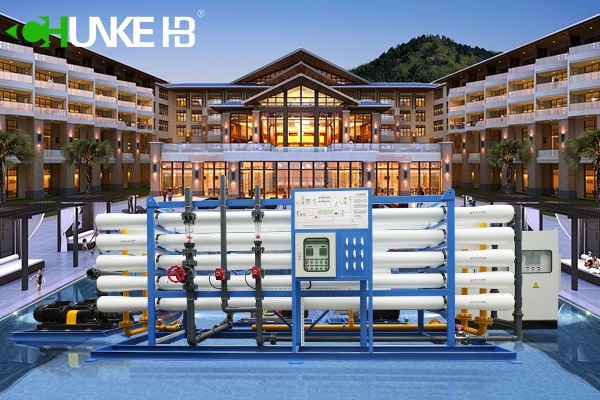
Seawater desalination system capacity directly affects your project cost, water production, membrane quantity, pump size, power consumption, installation space, operating cost and long-term water supply reliability.
Many customers know they need a seawater desalination plant. However, they often do not know whether they should choose 5 m³/day, 50 m³/day, 200 m³/day, 600 m³/day or a larger industrial SWRO system. Therefore, before you buy any equipment, you should first understand your real water demand, application, feed water quality, operation time and future expansion plan.
A seawater reverse osmosis system does not work like a simple water filter. Instead, it works as a complete engineering system. It includes pretreatment, chemical dosing, cartridge filtration, high-pressure pump, seawater RO membranes, pressure vessels, instruments, control cabinet, cleaning system, valves and piping. Hence, when you choose the wrong capacity, you may face high cost, unstable water supply or unnecessary energy consumption.
1. What Does Seawater Desalination System Capacity Mean?
First, you need to understand what capacity means. In SWRO projects, capacity normally means the amount of fresh water the system produces. Customers may describe this capacity as liters per hour, cubic meters per hour, gallons per day or cubic meters per day.
For example, an 8000 LPH system produces around 8 cubic meters per hour. If the system runs 20 hours per day, it can produce around 160 cubic meters per day. Meanwhile, a 25m³/h SWRO system can produce around 600 cubic meters per day if it runs 24 hours. In addition, a 50 TPH seawater desalination plant means the system produces around 50 tons, or about 50 cubic meters, per hour.
However, customers must confirm one important point: does the supplier quote hourly capacity or daily capacity? For example, 100 m³/day and 100 m³/h mean two completely different systems. Therefore, before you compare prices, you should confirm the capacity unit clearly.
2. Start From Your Daily Water Demand
The first step in selecting seawater desalination system capacity starts with daily water demand. You should calculate how much fresh water your project needs every day. Moreover, you should include all water uses, not only drinking water.
For a hotel or resort, you should consider guest rooms, restaurants, laundry, swimming pools, cleaning, staff accommodation and landscape irrigation. For an island community, you should consider the number of people, shops, clinics, schools, public buildings and emergency reserve. For a factory, you should consider process water, cooling water, boiler feed water, equipment washing and staff domestic use.
A simple calculation method works like this:
Daily water demand = number of users × water consumption per person per day
For example, if an island has 1,000 people and each person uses 150 liters per day, the island needs 150,000 liters per day, which equals 150 m³/day. However, if restaurants, cleaning and small workshops need another 30 m³/day, the total demand becomes 180 m³/day. Therefore, the project may need around 200–250 m³/day SWRO capacity, depending on storage tank size and operation hours.
Meanwhile, you should not select a system that only matches today’s minimum demand. Instead, you should add a reasonable safety margin. For many commercial and community projects, 10–25% additional capacity gives better reliability. However, you should not oversize too much, because a larger system increases investment cost and power consumption.

3. Decide How Many Hours Per Day the System Will Run
Many customers only focus on daily production. However, operation hours also strongly affect system size. For example, if you need 100 m³/day fresh water, you can design the system in different ways.
If the system runs 24 hours per day, it only needs to produce about 4.2 m³/h. However, if the system runs 10 hours per day, it must produce 10 m³/h. Consequently, shorter operation time requires higher hourly capacity, larger pumps, more membranes and higher instant power consumption.
For small hotels, resorts and islands, many customers choose 16–20 hours per day operation. Meanwhile, industrial plants often prefer 24-hour continuous operation because stable production matters more. In addition, remote projects should use automatic control and enough storage because operators may not always stay near the system.
Therefore, when you select seawater desalination system capacity, do not only ask, “How many cubic meters per day do I need?” Instead, also ask, “How many hours per day can I operate the system?”
4. Match Capacity With Product Water Storage
A seawater RO plant produces water continuously. However, your project may consume water unevenly during the day. For example, hotels use more water in the morning and evening. Communities also use more water during cooking, bathing and cleaning times. Meanwhile, factories may use more water during production shifts.
Therefore, you need a product water tank to balance production and consumption. If the tank size remains too small, the system may start and stop frequently. Consequently, pumps, valves and electrical components may face more wear. However, if the tank size becomes too large, the project needs more space and higher civil cost.
For example, if your project needs 200 m³/day and your SWRO system produces 10 m³/h for 20 hours, you may still need a 50–100 m³ product water tank, depending on peak demand. Meanwhile, remote islands usually need larger storage because bad weather, maintenance or logistics may stop operation for a short time.
Hence, you should choose seawater desalination system capacity together with product water tank volume. A good system design does not only make water; it also supports stable water supply during peak demand.
5. Consider Feed Water Quality Before Final Capacity Selection
Feed water quality strongly affects SWRO design. Open seawater, beach well seawater and coastal brackish groundwater have different characteristics. Open seawater may contain algae, suspended solids, bacteria, organic matter, oil, seasonal turbidity and marine life. Meanwhile, beach well water usually looks cleaner, but it may contain iron, manganese, hydrogen sulfide or hardness.
If the feed water has poor quality, the system needs stronger pretreatment. For example, the process may include multimedia filter, activated carbon filter, ultrafiltration, chemical dosing, antiscalant dosing, reducing agent dosing and cartridge filtration. Moreover, the pretreatment system must protect RO membranes from fouling and scaling.
If the pretreatment design remains too weak, the system may lose capacity after a short operation time. Then, the customer may face frequent chemical cleaning, cartridge filter replacement, membrane fouling and unstable water quality. Therefore, a professional supplier always checks water quality before final design.
Before finalizing seawater desalination system capacity, you should provide a water analysis report. The report should include TDS, turbidity, pH, temperature, hardness, alkalinity, chloride, sulfate, silica, iron, manganese, SDI if available, bacteria and oil if applicable.
6. Choose Capacity According to Application
Different projects need different design strategies. Therefore, you should select capacity according to application, not only according to price.
For drinking water projects, the SWRO system should produce stable low-TDS water. Moreover, the system may need UV sterilization, pH adjustment, remineralization and final disinfection. For hotels and resorts, reliability matters because guests expect continuous water supply. Meanwhile, for fish farms and aquaculture, stable water quality protects animal health. For industrial factories, shutdown may cause production loss; therefore, the design may need redundancy.
Therefore, when you choose seawater desalination system capacity, you should also decide whether the system should use skid-mounted design, containerized design or a customized layout.
7. Understand Recovery Rate and Feed Water Requirement
SWRO capacity means product water capacity, not feed water capacity. A seawater RO system cannot convert all feed seawater into fresh water. Instead, part of the water becomes product water, and the rest becomes concentrate water.
Typical seawater RO recovery often ranges from 35% to 45%, depending on feed TDS, temperature, membrane design and scaling risk. For example, if your project needs 100 m³/day product water and the system recovery reaches 40%, the feed water requirement becomes about 250 m³/day. As a result, the system produces 100 m³/day fresh water and discharges around 150 m³/day concentrate.
Therefore, your seawater intake system must supply enough feed water. Moreover, your project must have a proper concentrate discharge plan. If the intake system cannot provide enough feed water, the SWRO plant cannot reach the required capacity.
Consequently, when you select seawater desalination system capacity, you should also check feed water pump capacity, intake pipeline size, seawater source stability and brine discharge conditions.
8. Select Membranes and Pumps Based on Capacity
RO membranes and high-pressure pumps form the core of any seawater desalination plant. Therefore, capacity selection directly affects membrane quantity, pressure vessel quantity, pump flow, pump pressure and energy consumption.
In addition, medium and large SWRO systems may use energy recovery devices to reduce power consumption. Although energy recovery increases initial cost, it can reduce long-term operating cost, especially in areas with high electricity prices.
Hence, a professional design must match membranes, pumps and energy recovery with the selected seawater desalination system capacity.
9. Plan for Future Expansion
Many customers calculate only current water demand. However, projects often grow. A resort may add rooms. An island may develop tourism. A factory may expand production. A community may grow in population. Therefore, your SWRO system should consider future demand.
You can plan expansion in two ways. First, you can install a larger system from the beginning. However, this method increases initial investment. Second, you can use modular design. For example, instead of buying one large system, you can use two or three SWRO trains. Then, you can operate one train now and add another train later.
Moreover, modular design improves maintenance flexibility. If one train needs cleaning or repair, another train can continue producing water. Consequently, important projects such as hotels, hospitals, factories and islands often benefit from modular design.
Therefore, before you finalize seawater desalination system capacity, you should discuss your 3-year or 5-year water demand forecast with the supplier.
10. Check Power Supply and Energy Cost
The following table gives general guidance. However, final design still needs water analysis, application details and site information.
| Project Type | Common Capacity Range | Design Notes |
|---|---|---|
| Small villa or small island house | 1–10 m³/day | Use compact design, simple operation and basic pretreatment |
| Small hotel or resort | 20–100 m³/day | Use automatic control and enough product water storage |
| Medium resort or island community | 100–500 m³/day | Strengthen pretreatment and design proper storage tank volume |
| Industrial factory near the sea | 200–2,000 m³/day | Consider redundancy, PLC control and stronger pretreatment |
| Large island or municipal project | Above 1,000 m³/day | Plan intake, brine discharge, civil work and long-term operation carefully |
12. Avoid Common Capacity Selection Mistakes
Some customers choose capacity only according to the lowest price. However, this can create serious problems later. If the system cannot meet real water demand, the customer may need to buy another system soon. Consequently, the total investment becomes higher.
Another common mistake involves seasonal demand. Resorts may have low water demand during normal season, but they may need much more water during peak tourism season. Therefore, the customer should calculate both average demand and peak demand.
Some customers also forget water loss. Backwash water, flushing water, CIP cleaning water and pipeline distribution loss all affect real demand. Moreover, the system may need maintenance time, so customers should not assume that the system can run 24 hours every day without any stop.
Hence, when you choose seawater desalination system capacity, you should think like an operator, not only like a buyer.
13. Information Needed Before Final Quotation
To recommend the best SWRO capacity, our engineering team needs some basic project information:
- Required fresh water volume per day
- Required operation hours per day
- Application of product water
- Feed water source
- Seawater analysis report
- Final water quality target
- Project location
- Power supply
- Indoor, outdoor or containerized installation
- Space limitation
- Future expansion plan
- Preferred membrane and pump brands
- Budget range if available
With this information, we can calculate the suitable capacity, process flow, membrane quantity, pump selection, power consumption, footprint and price range.
Conclusion
Choosing the right seawater desalination system capacity requires more than a simple capacity number. You need to calculate daily water demand, operation hours, peak demand, storage tank size, feed water quality, recovery rate, power supply, application and future expansion. Moreover, you should match membranes, pumps, pretreatment and automation with your real project needs.
If you plan a seawater desalination project for an island, hotel, resort, factory, fish farm, offshore platform or coastal community, Chunke can help you choose a practical SWRO solution. We can provide small commercial systems, industrial skid-mounted systems, containerized SWRO plants and large customized seawater desalination systems.
Send us your required water capacity, seawater analysis report and project location. Our engineering team will help you choose the correct seawater desalination system capacity and prepare a suitable technical proposal for your project.

Comments are closed for this post.