
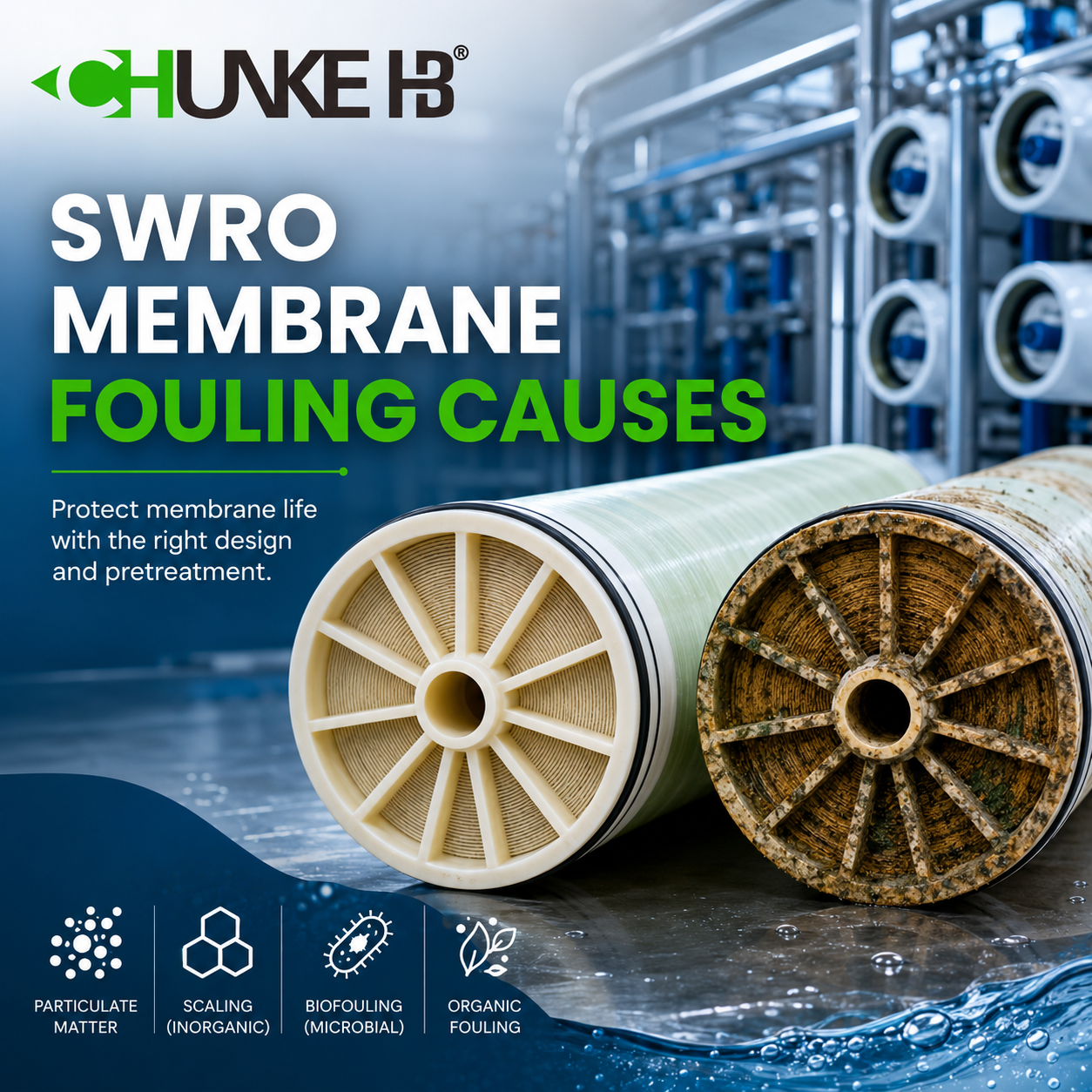
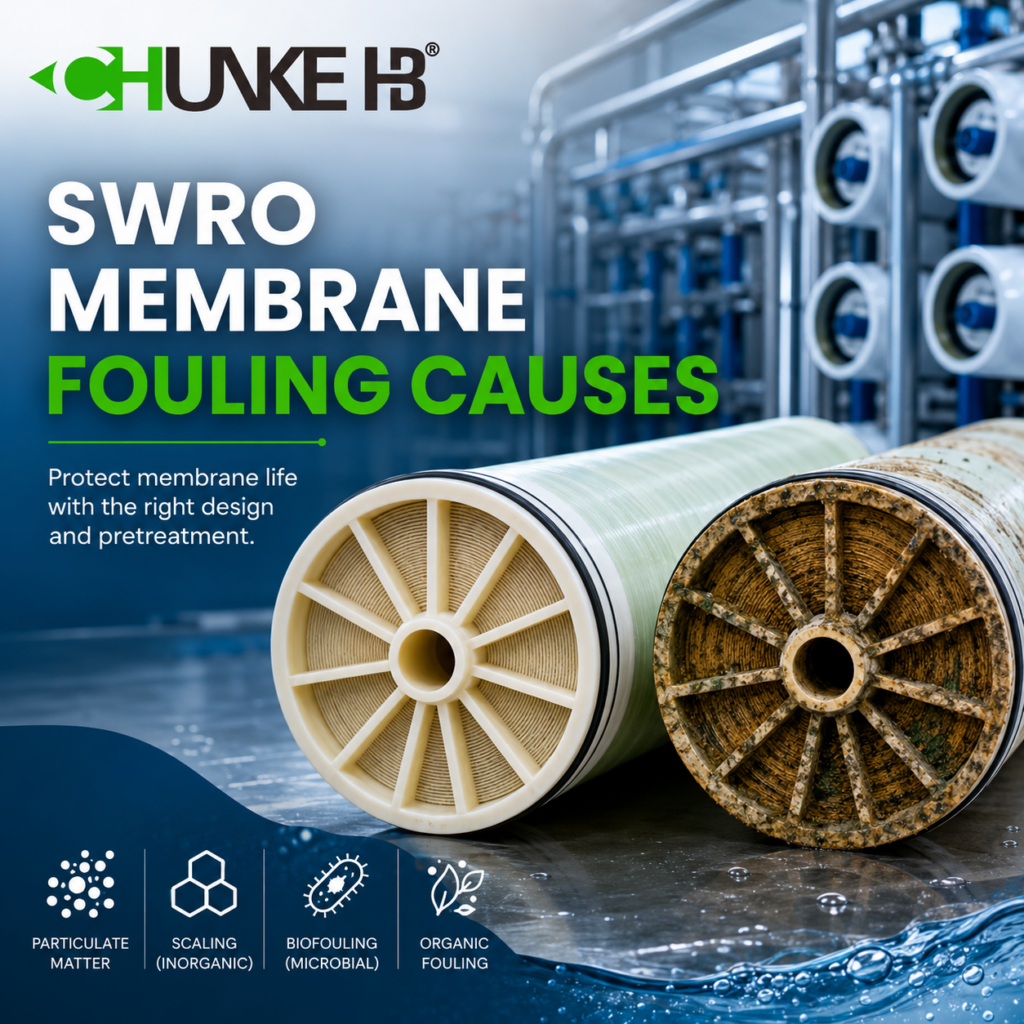
SWRO membrane fouling causes include four main problems: biofouling, colloidal fouling, organic fouling, and inorganic scaling. Together they explain most of the flux decline, pressure rise, and salt passage increase seen on seawater RO plants. This guide breaks down each cause, shows the warning signs, and explains how Chunke designs pretreatment to prevent them. Understanding fouling early saves membrane life and keeps operating cost predictable for every seawater desalination project.
What Is Membrane Fouling?
Membrane fouling is the buildup of unwanted material on the surface or inside the pores of an RO membrane. As material collects, it blocks flow paths and forces the system to work harder for the same output. Left unchecked, fouling raises energy cost, shortens membrane life, and can cause permanent damage that no cleaning can reverse.
Fouling differs from scaling in cause, though both reduce performance the same way. Fouling comes from particles, organics, and biological growth in the feed water. Scaling comes from dissolved minerals that precipitate once concentration passes their solubility limit. Chunke’s engineers diagnose the difference before recommending a fix, because the wrong chemical treatment can make the problem worse. Getting the diagnosis right the first time saves both money and downtime for the client.
The Four Main SWRO Membrane Fouling Causes
The table below summarizes the four main SWRO membrane fouling causes. It lists the typical source and the first symptom operators usually notice.
| Fouling Type | Main Cause | First Symptom | Key Indicator |
|---|---|---|---|
| Biofouling | Bacteria, algae, and biofilm growth | Sharp rise in differential pressure | Rapid ΔP increase, often within weeks |
| Colloidal Fouling | Suspended solids, silt, fine particles | Gradual decline in normalized flux | SDI15 above 3–5 |
| Organic Fouling | Natural organic matter, oil, humic substances | Slow flux decline with rising ΔP | High TOC in feed water |
| Inorganic Scaling | Calcium carbonate, sulfate, and silica precipitation | Flux decline at the concentrate end | LSI or S&DSI above zero |
Biofouling: Bacteria and Biofilm
Biofouling is often the fastest and most aggressive of all SWRO membrane fouling causes. Bacteria, algae, and fungi attach to the membrane surface and build a protective slime layer called biofilm. This layer traps nutrients and shields microorganisms from disinfectants, so it grows quickly once established.
Uncontrolled biofouling can cut membrane flux by 20 to 40 percent within a few weeks. Warm seawater, high organic content, and inconsistent biocide dosing all speed up the process. Once biofilm matures, standard cleaning struggles to remove it completely, so prevention matters more than cure.
Chunke controls biofouling with shock chlorination at the intake, followed by dechlorination before the membrane. This combination kills microorganisms early and protects the membrane from oxidation damage at the same time.

Colloidal Fouling: Suspended Solids and Silt
Colloidal fouling happens when suspended solids, silt, and fine particles deposit on the membrane surface. It is more common with open seawater intake than with beach well sources, because open intake carries more particulate load. Unlike biofouling, colloidal fouling develops gradually and shows up as a steady decline in normalized flux.
Operators track colloidal fouling risk with the Silt Density Index, or SDI15. A feed water SDI15 above 3 to 5 signals high risk. Flux decline can accelerate quickly once that threshold is crossed. Therefore, Chunke tests SDI during the water analysis stage, before finalizing the pretreatment design.
Multimedia filtration, coagulation, and cartridge filtration all reduce colloidal load before water reaches the membrane. For difficult feed water, an ultrafiltration pretreatment stage brings SDI down further and protects the SWRO membranes more reliably.
Organic Fouling: Natural Organic Matter and Oil
Organic fouling occurs when carbon-based substances accumulate on the membrane surface. Common sources include natural organic matter, humic substances, algae byproducts, and oil traces near ports or industrial coastlines. Organic fouling often combines with biofouling, since organic material also feeds bacterial growth.
High total organic carbon in the feed water is the main warning sign. Meanwhile, symptoms on the membrane side include slow flux decline paired with rising differential pressure over several months. Activated carbon filtration and careful intake site selection both reduce organic fouling risk significantly.
Inorganic Scaling: Calcium, Sulfate, and Silica
Inorganic scaling is technically different from fouling, but operators group it with the same troubleshooting process. Scaling happens when dissolved minerals precipitate once their concentration exceeds solubility limits. Common culprits include calcium carbonate, calcium sulfate, barium sulfate, and silica. This usually happens at the concentrate end of the membrane system, where salts become most concentrated.
Engineers use the Langelier Saturation Index or the Stiff and Davis Stability Index to predict scaling risk before startup. A positive index value signals scaling risk, so antiscalant dosing becomes necessary at that recovery rate. Chunke calculates recovery rate and antiscalant dosage together. This way, the system avoids scaling from day one instead of reacting after damage appears.
Warning Signs: How to Diagnose Fouling Early
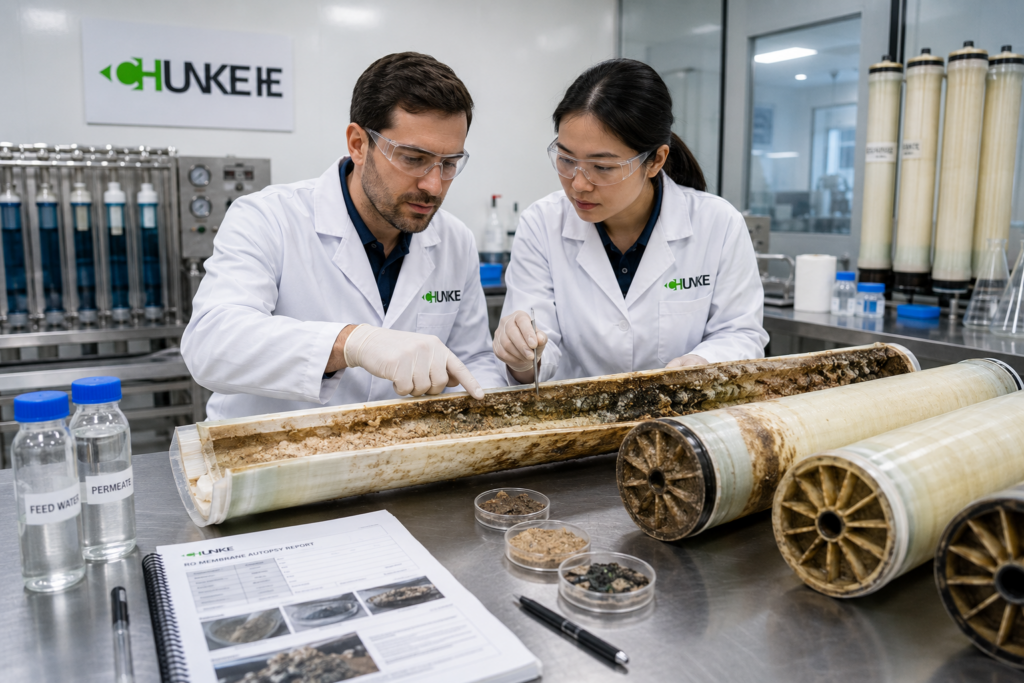
Three measurements reveal fouling before it becomes severe: normalized permeate flow, normalized differential pressure, and salt passage. Chunke’s PLC control system logs all three continuously. This way, operators catch problems early instead of discovering them after output drops sharply.
- A 10 to 15 percent drop in normalized permeate flow signals fouling or scaling has begun
- A differential pressure rise above 15 percent from baseline usually triggers a cleaning recommendation
- A salt passage increase of 5 to 10 percent points to membrane surface damage or severe fouling
Tracking these three numbers weekly lets operators schedule cleaning before performance collapses. As a result, membrane life extends and unplanned downtime drops significantly.
Choosing Fouling-Resistant Membranes and Monitoring Equipment
Component selection plays a large role in fouling resistance. Chunke offers several established membrane brands so clients can match element choice to their feed water risk profile.
Fouling-Resistant Membrane Brands
For difficult feed water, Hydranautics SWC fouling-resistant elements slow pressure-drop increase and reduce CIP frequency. DuPont FilmTec also offers low-fouling seawater elements with stable long-term performance. Other proven options include Vontron SW series membranes, LG Chem seawater elements, and Toray Romembra membranes. Each brand meets seawater salt rejection targets while offering different fouling tolerance for specific feed conditions.
Dosing Pumps and Monitoring
Accurate antiscalant and biocide dosing depends on reliable pumps. Chunke fits Grundfos or CNP dosing pumps, controlled by Danfoss variable frequency drives for consistent chemical feed rates. On the monitoring side, Siemens PLC and HMI track differential pressure, flow, and conductivity continuously. This flags fouling trends before they become failures.
Prevention: Pretreatment Design That Stops Fouling Before It Starts
Correct pretreatment prevents most SWRO membrane fouling causes before water ever reaches the membrane. Chunke’s standard pretreatment train for seawater intake includes several stages. These are coagulant dosing, multimedia or sand filtration, activated carbon or dechlorination, antiscalant dosing, and cartridge filtration. For particularly difficult feed water, an SWRO pretreatment system upgrade with ultrafiltration reduces SDI further and protects membranes more reliably.
Feed water analysis drives every pretreatment decision. Chunke reviews TDS, SDI, turbidity, iron, organic content, and biological activity before finalizing the design. This step matters. A pretreatment train built for beach well seawater will not protect membranes fed by open intake near a harbor.
Beach Well vs Open Seawater Intake: Fouling Risk Compared
Intake type has a large effect on which SWRO membrane fouling causes matter most for a given project. Beach wells pull seawater through sand, which acts as natural pretreatment. As a result, turbidity and biological load stay lower, and colloidal fouling risk drops significantly.
Open seawater intake skips this natural filtration step. Harbors, fishing ports, and areas near river mouths often carry algae, oil traces, and higher organic content. Therefore, open intake projects need stronger pretreatment. Coagulation and sometimes ultrafiltration help reach a safe SDI level before the membrane.
Chunke reviews the intake type during the earliest project stage. This decision shapes the entire pretreatment budget, so getting it right early avoids costly redesign after startup.
Why Fouling Costs More Than Operators Expect
Fouling rarely shows up as a single large expense. Instead, it accumulates through higher energy use, more frequent cleaning, and shortened membrane life. A fouled membrane needs more pressure to maintain the same flow, which raises electricity cost month after month.
Membrane replacement itself is not cheap either. Industry data shows membrane replacement can represent roughly 5 percent of total water cost. It can also equal around 12 percent of operating cost. Severe fouling shortens replacement cycles, pushing that cost higher than a well-maintained system would ever see.
Unplanned downtime adds a hidden cost too. Islands, resorts, and remote sites depend on continuous fresh water. Hence, an emergency shutdown for cleaning can disrupt operations far more than the cleaning cost itself suggests.
Seasonal Fouling Risk and Water Temperature
Fouling risk changes with the seasons, especially for biofouling and organic fouling. Warmer water temperatures speed up bacterial growth, so summer months often bring higher biofouling risk in tropical and subtropical regions. Algae blooms can also spike seasonally near certain coastlines.
Chunke designs dosing systems with enough flexibility to handle seasonal swings. Biocide dosing rates and cleaning schedules can adjust as water temperature and organic load change through the year. This proactive approach keeps performance stable, rather than reacting only after fouling has already reduced output.
CIP Cleaning: Recovering Performance After Fouling
Chemical cleaning, known as CIP, restores membrane performance once fouling has already reduced output. The correct sequence matters, since using the wrong cleaner can push foulant deeper into the membrane structure. A common protocol starts with a high-pH alkaline clean to remove organic and biological fouling. A low-pH acid rinse then dissolves mineral scale.
Cleaning frequency depends on feed water quality and how well pretreatment performs. Well-designed systems with strong pretreatment may need cleaning only twice a year. Poorly protected systems on difficult feed water may need cleaning every one to two months. This raises operating cost significantly over the plant’s service life.
Fouling Prevention Checklist
Operators can reduce SWRO membrane fouling causes significantly by following a short list of proven habits. This checklist works for both new projects and existing plants looking to extend membrane life.
- Test feed water SDI, TOC, and TDS before finalizing pretreatment design
- Match pretreatment strength to intake type, not a generic template
- Dose antiscalant continuously at the correct rate for the target recovery
- Track normalized flow, differential pressure, and salt passage weekly
- Schedule CIP cleaning before performance drops below the trigger threshold
- Adjust biocide dosing seasonally as water temperature changes
Following this checklist consistently keeps membranes running closer to their rated life. Consequently, total cost of ownership drops, and unplanned shutdowns become far less common.
How Chunke Designs Systems to Prevent Fouling
Chunke treats fouling prevention as a core design requirement, not an afterthought. Every seawater RO membrane system starts with a water analysis review. Pretreatment sizing then follows, matched to the actual feed water risk. The SWRO control system logs differential pressure and flux trends automatically. This lets clients see fouling coming before it costs them production.
Pump selection also matters for fouling control. Chunke’s seawater desalination pump options include VFD control, which keeps flow steady and reduces hydraulic stress that can accelerate fouling. Clients with containerized systems can review the containerized SWRO system guide for how pretreatment fits inside a compact footprint.
For further reading, see Chunke Water Treatment’s fouling and scaling guide. Also check Chunke RO Water Plant’s membrane fouling article. Both resources expand on the chemistry behind each fouling mechanism.
Are you seeing flux decline, rising pressure, or frequent cleaning on your current system? Fill in the contact form below. Chunke’s team replies to every enquiry within 24 hours with a technical review and a pretreatment recommendation.
Frequently Asked Questions
1. What are the main SWRO membrane fouling causes?
The four main causes are biofouling, colloidal fouling, organic fouling, and inorganic scaling. Each has a different source and requires a different prevention strategy tailored to the feed water.
2. How do I know if my membrane is fouled or scaled?
Fouling usually shows a gradual flux decline with rising differential pressure. Scaling often appears first at the concentrate end of the last vessel, where salt concentration peaks.
3. How often should SWRO membranes be cleaned?
Well-protected systems may need cleaning only twice a year. Systems with weak pretreatment on difficult feed water may need cleaning monthly.
4. Can fouling be reversed once it happens?
Early-stage fouling usually responds well to CIP cleaning. Severe or long-term fouling may cause permanent flux loss that cleaning cannot fully reverse. Regular monitoring catches most cases while they are still reversible.
5. What is SDI and why does it matter for fouling?
SDI, or Silt Density Index, measures the colloidal fouling potential of feed water. A value above 3 to 5 signals high risk and often requires stronger pretreatment.
6. Does a fouling-resistant membrane remove the need for pretreatment?
No. Fouling-resistant membranes reduce fouling speed and extend cleaning intervals, but they cannot replace proper pretreatment design. Feed water still needs correct filtration and dosing to protect long-term performance.

Comments are closed for this post.