
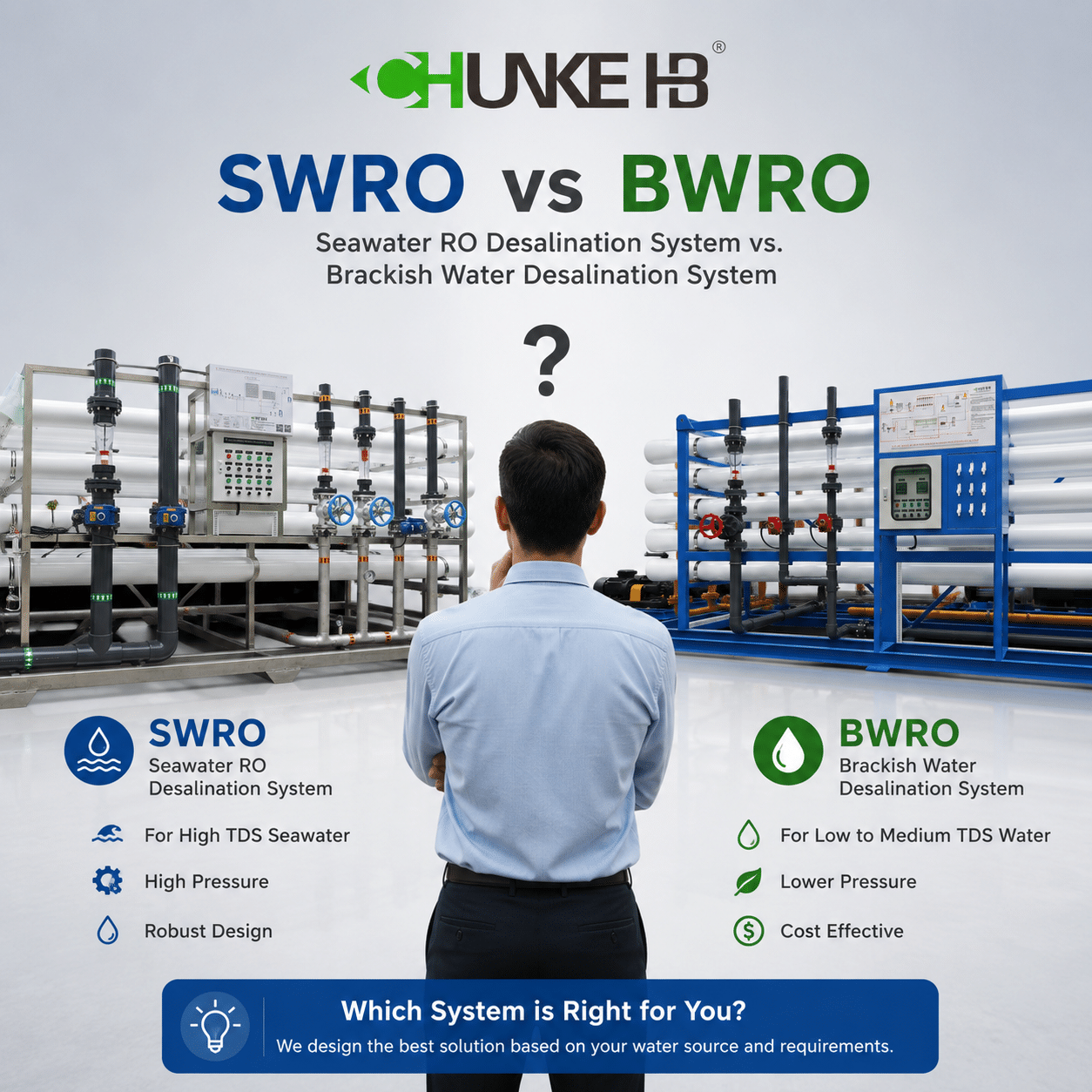
SWRO vs BWRO difference comes down to feed water salinity. SWRO treats seawater at 30,000 to 45,000 mg/L TDS. BWRO treats brackish water at 1,000 to 10,000 mg/L TDS instead. That single difference changes the pressure, energy use, membrane type, and cost of the whole system. This guide compares both technologies side by side. Use it to choose the right one for your project and avoid an expensive design mistake.
What Is SWRO?
SWRO stands for seawater reverse osmosis. It uses high-pressure pumps to push seawater through membranes designed for high-salinity feed water. Seawater osmotic pressure is high, so SWRO systems need strong pumps, thick pressure vessels, and corrosion-resistant materials throughout.
What Is BWRO?
BWRO stands for brackish water reverse osmosis. It treats water with moderate salinity, usually from underground aquifers, estuaries, or areas where seawater and freshwater mix. Because brackish water has lower osmotic pressure, BWRO systems run at lower pressure and cost less to operate every day.
SWRO vs BWRO: Full Specification Comparison
The table below lays out the SWRO vs BWRO difference across every major design parameter.
| Parameter | SWRO | BWRO |
|---|---|---|
| Feed Water Source | Seawater, ocean intake | Underground aquifer, estuary, well |
| Feed Water TDS | 30,000–45,000 mg/L | 1,000–10,000 mg/L |
| Operating Pressure | 55–82 bar | 10–25 bar |
| Recovery Rate | 35–45% | Up to 85% |
| Energy Consumption | 3.0–4.0 kWh/m³ | 1.5–2.5 kWh/m³ |
| Membrane Type | Seawater RO elements | Brackish water RO elements |
| Typical Applications | Islands, coastal hotels, marine, industrial | Municipal, agriculture, inland industrial |
As the table shows, BWRO wins on energy and recovery rate. Meanwhile, SWRO is the only option when the feed source is true seawater.
Feed Water: The Core SWRO vs BWRO Difference
Salinity drives every other design decision in reverse osmosis. Seawater typically carries 30,000 to 45,000 mg/L of dissolved salt, sometimes reaching 50,000 mg/L in enclosed seas. Brackish water usually falls between 1,000 and 10,000 mg/L, though some wells reach higher levels closer to seawater.
This gap explains why a BWRO membrane cannot treat seawater safely. The membrane would face pressure and salt concentration far beyond its design rating. Likewise, using an SWRO system on brackish water works technically, but wastes energy and money on unnecessary pressure.
Operating Pressure and Energy: Why BWRO Costs Less to Run
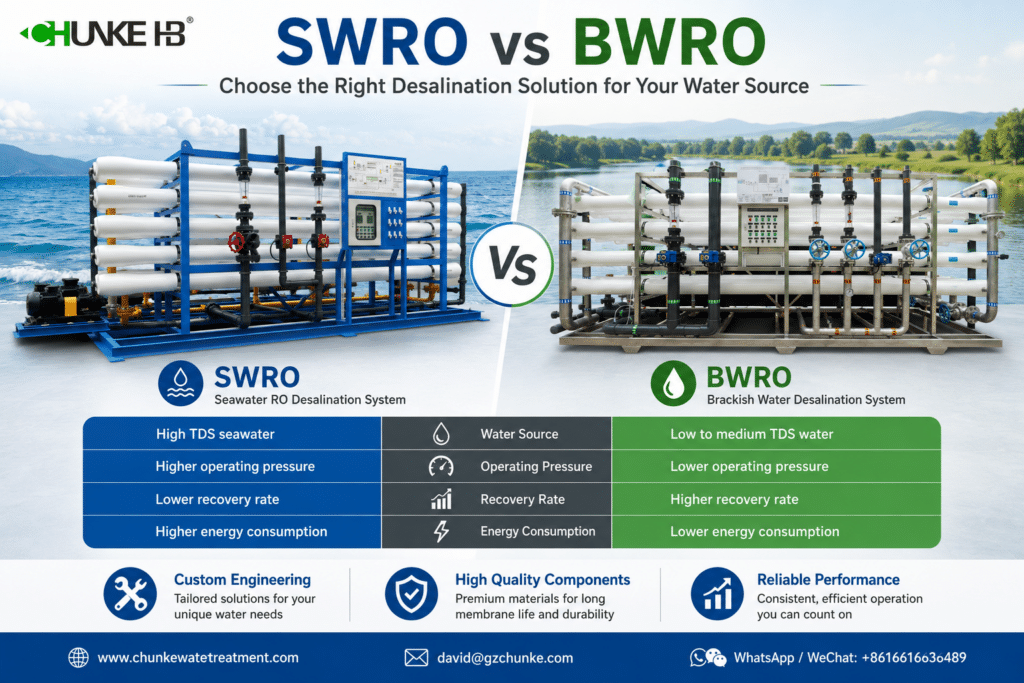
Osmotic pressure rises with salinity, so SWRO systems need much higher operating pressure than BWRO systems. SWRO typically runs at 55 to 82 bar. BWRO runs at only 10 to 25 bar for most feed water conditions.
Lower pressure means lower energy consumption. BWRO systems use roughly 1.5 to 2.5 kWh per cubic meter. SWRO systems use 3.0 to 4.0 kWh per cubic meter under typical conditions. Therefore, a BWRO plant of the same capacity costs significantly less to operate every month.
Membrane and Component Differences
Component selection changes with feed water type. Chunke sources SWRO membranes designed for high-salinity service, while BWRO systems use lower-pressure elements built for milder feed water.
Membrane Brands for Both Technologies
For SWRO projects, Chunke offers DuPont FilmTec seawater elements and Vontron SW series membranes. LG Chem seawater elements and Toray Romembra membranes are also available. For difficult feed water on either technology, Hydranautics offers fouling-resistant options for both SWRO and BWRO service.
Pumps and Control Systems
Pump sizing differs sharply between the two technologies. Chunke fits Grundfos or CNP pumps on both system types, sized for the correct pressure range. Danfoss variable frequency drives adjust flow smoothly on either technology. Siemens PLC and HMI monitor pressure, flow, and conductivity across both SWRO and BWRO plants.
Pretreatment Differences Between SWRO and BWRO
Pretreatment strength depends on the feed source, not just salinity. Open seawater intake often carries algae, suspended solids, and biological load, so SWRO pretreatment typically needs stronger filtration. Common stages include multimedia filtration, coagulation, and sometimes ultrafiltration ahead of the membrane.
Brackish well water is often cleaner going in, since underground aquifers naturally filter out suspended solids. Therefore, BWRO pretreatment can sometimes be simpler, using only cartridge filtration and antiscalant dosing. However, some brackish sources carry high iron, manganese, or hardness, which still demands careful pretreatment design.
Chunke tests feed water for both technologies before finalizing the pretreatment train. This step matters because skipping it risks fouling or scaling on either system type.
Scaling and Fouling Risk: SWRO vs BWRO
Both technologies face fouling and scaling risk, but the balance differs. SWRO faces higher biofouling risk from marine organisms and organic matter in open seawater. BWRO often faces higher scaling risk instead, since some aquifers carry high hardness, iron, or silica levels.
Antiscalant dosing protects both systems from mineral scaling. Meanwhile, biocide dosing and dechlorination protect SWRO systems from biological growth more aggressively than most BWRO projects require. Understanding which risk dominates helps operators choose the right chemical program from day one.
Brine Disposal and Environmental Considerations
Both technologies reject a concentrate stream, often called brine, but disposal options differ. SWRO brine returns to the ocean in most coastal projects. Diffusers help limit local salinity impact near the outfall point. Regulations often require environmental studies before approval.
BWRO brine disposal is usually harder, since inland projects lack an ocean outlet. Options include deep well injection, evaporation ponds, or discharge to an existing wastewater system, depending on local regulation. This is a factor worth researching early, since brine disposal cost can affect total project budget for inland projects significantly.
Which One Do You Need? A Simple Decision Guide
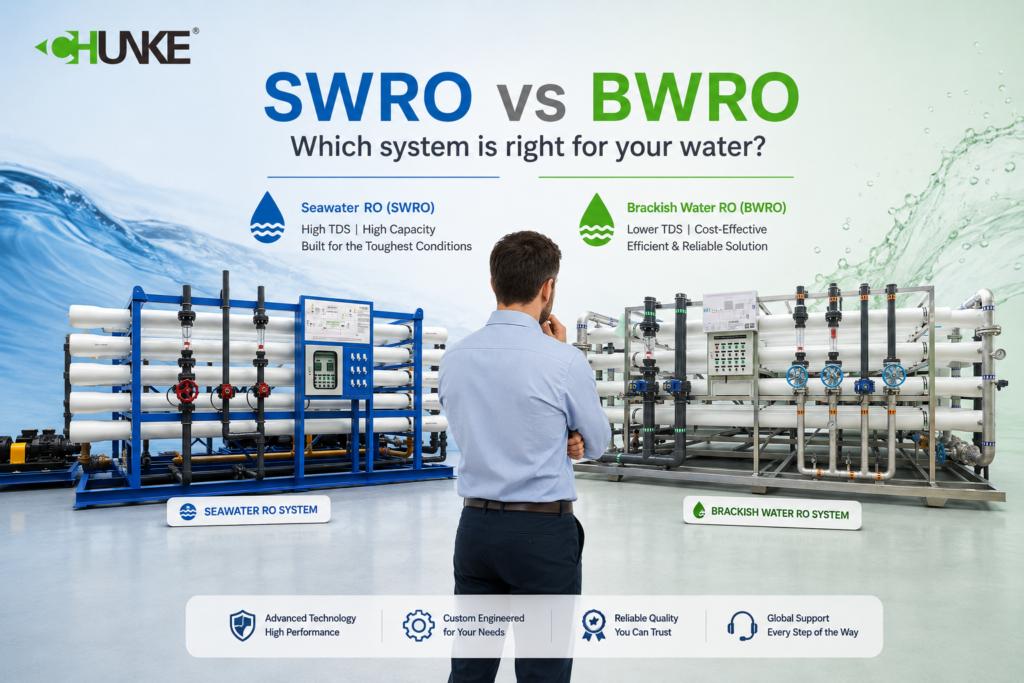
Start by testing your feed water TDS. Below 10,000 mg/L, BWRO almost always makes sense, since it saves energy and equipment cost. Above 20,000 mg/L, SWRO becomes necessary, because BWRO membranes cannot handle that pressure and salt load safely.
Between 10,000 and 20,000 mg/L, the decision depends on membrane brand and design margin. Chunke reviews a full water analysis before recommending either technology. This step avoids underdesigning a system that fails to meet target water quality.
Location also matters. Coastal projects pulling water directly from the ocean almost always need SWRO. Inland projects near aquifers or wells usually need BWRO instead.
Applications: Where Each Technology Fits Best
SWRO dominates island water supply, coastal hotels and resorts, marine vessels, and offshore platforms. These projects have no access to fresh groundwater. BWRO dominates municipal water treatment, agricultural irrigation, and inland industrial process water instead. Wells and aquifers in these areas provide moderately salty feed water.
Some regions need both. A coastal city might use SWRO for its main desalination plant while running BWRO systems on brackish wells further inland. Chunke supplies both technologies, so clients get one supplier for mixed-source projects.
Cost Comparison: Capex and Opex
SWRO systems cost more upfront than BWRO systems of the same capacity. Thicker pressure vessels, stronger pumps, and higher-grade corrosion-resistant materials all add to the equipment price. BWRO equipment costs less because it operates at lower pressure with lighter components.
Operating cost follows the same pattern. Lower pressure means lower energy bills for BWRO every month. Over a ten-year service life, this difference adds up. The gap in total cost of ownership between the two technologies becomes significant.
Membrane Life and Maintenance Comparison
Membrane life depends on feed water quality and operating conditions for both technologies. SWRO membranes typically last 3 to 5 years under normal operation, since high pressure and salinity accelerate wear. BWRO membranes often last longer, sometimes 5 to 7 years, because lower pressure reduces mechanical stress on the membrane surface.
Cleaning frequency follows a similar pattern. Well-protected SWRO systems may need CIP cleaning twice a year. BWRO systems on clean well water sometimes go longer between cleanings. Poor pretreatment shortens membrane life on either technology, so the pretreatment design matters more than the base technology choice.
Can One System Handle Both Brackish and Seawater?
A single system cannot efficiently treat both water types without redesign. However, Chunke can design a plant with interchangeable membrane housings for projects where feed water quality changes seasonally. This approach costs more upfront but adds flexibility for variable water sources.
Most projects are better served by choosing the correct technology from the start. Matching the system to the actual feed water avoids wasted capacity and unnecessary energy use. It also simplifies spare parts planning, since a single membrane type is easier to stock than two.
Regulatory and Permitting Differences
Permitting requirements often differ between the two technologies, especially near the coast. SWRO projects usually need intake and outfall permits, since seawater withdrawal and brine discharge affect marine ecosystems. Environmental impact studies are common for larger coastal plants.
BWRO projects face different rules, tied to groundwater extraction and brine disposal instead. Many regions regulate how much water can be pulled from an aquifer, to prevent over-extraction and land subsidence. Chunke advises clients to check local permitting requirements early. Permit delays can push back a project timeline more than equipment lead time does.
A Simple Example: Matching Technology to Water Source
Consider two projects with the same target capacity of 500 cubic meters per day. A beachfront resort pulling water from an open seawater intake needs SWRO. Its feed water sits at roughly 35,000 mg/L TDS. That system needs high-pressure pumps, seawater-grade membranes, and stronger pretreatment.
Meanwhile, an inland factory drawing from a brackish well at 4,000 mg/L TDS needs only BWRO. The pumps run at a fraction of the pressure. Energy use drops significantly, and the membrane cost is lower per element too. Same capacity target, very different system, all because of feed water salinity.
How Chunke Designs Both SWRO and BWRO Systems
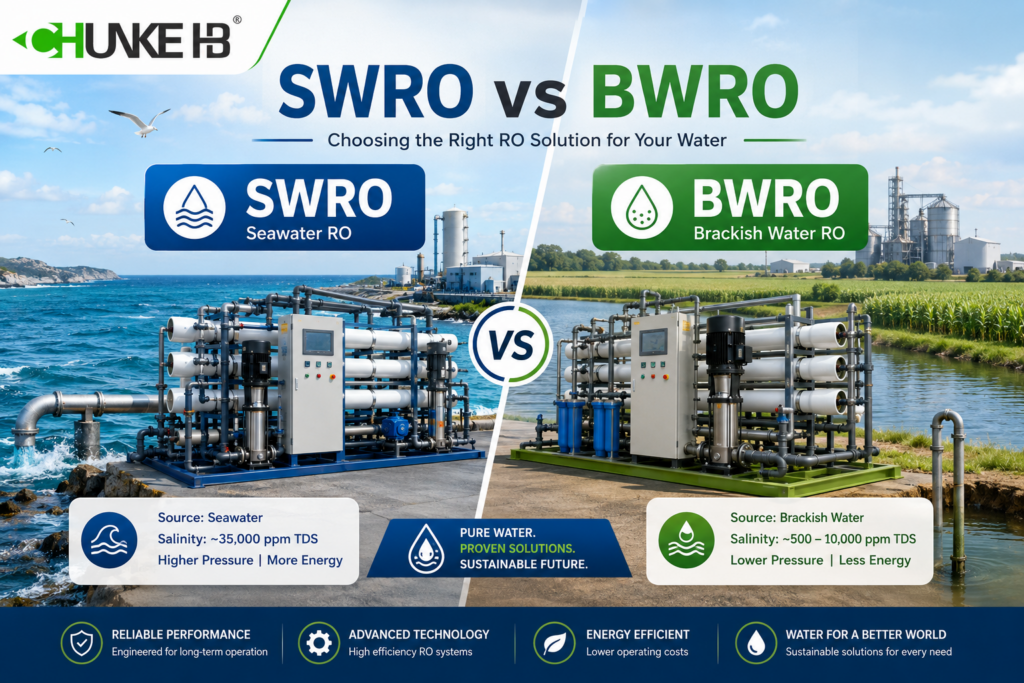
Chunke manufactures both SWRO systems and BWRO systems from the same Guangzhou factory. Every project starts with feed water analysis, followed by pretreatment sizing through the SWRO pretreatment system page. Pump selection draws from the seawater desalination pump lineup, and automation runs through the SWRO control system.
Clients needing a compact SWRO solution can also review the containerized SWRO system guide. For membrane troubleshooting on either technology, see the SWRO membrane fouling causes post.
Working with one manufacturer for both technologies also simplifies spare parts and technical support. Clients running mixed SWRO and BWRO fleets across different sites can standardize equipment. Shared pump brands, membrane suppliers, and control panel designs make this possible. This reduces training time for local operators and shortens the wait for replacement parts.
For further reading, see Chunke Water Treatment’s BWRO systems page. Also check Chunke RO Water Plant’s guide on choosing the right RO system. Both resources expand on technology selection for salty water.
If you are unsure whether SWRO or BWRO fits your project, fill in the contact form below. Chunke’s team replies to every enquiry within 24 hours with a technology recommendation and budget estimate.
Common Misconceptions About SWRO and BWRO
Some buyers assume a bigger pump always means better performance, regardless of feed water type. In reality, oversizing a BWRO pump for brackish water wastes energy without improving output. The pump should match the actual osmotic pressure of the source water, not a generic industry maximum.
Another common myth is that SWRO membranes work fine on brackish water, just with room to spare. While technically true, this wastes significant capital on unnecessary pressure-rated components. A properly sized BWRO system delivers the same water quality at a fraction of the equipment and energy cost.
Finally, some buyers believe recovery rate should always be maximized. Pushing recovery too high on either technology raises scaling risk substantially. Chunke calculates recovery rate based on water chemistry, not a fixed target number. This keeps the system reliable over its full service life.
Frequently Asked Questions
1. What is the main SWRO vs BWRO difference?
The main difference is feed water salinity. SWRO treats seawater at 30,000 to 45,000 mg/L TDS. BWRO treats brackish water at 1,000 to 10,000 mg/L TDS.
2. Is BWRO cheaper to run than SWRO?
Yes. BWRO uses 1.5 to 2.5 kWh per cubic meter, while SWRO uses 3.0 to 4.0 kWh per cubic meter. Lower pressure requirements make BWRO less energy-intensive.
3. Can a BWRO membrane treat seawater?
No. BWRO membranes are not rated for seawater pressure or salt concentration. Using one on seawater risks membrane failure and poor water quality. The membrane housing may also fail under seawater-level pressure.
4. Which technology has a higher recovery rate?
BWRO typically reaches up to 85 percent recovery. SWRO usually stays around 35 to 45 percent, since higher salinity limits how much fresh water can be recovered safely.
5. Does Chunke manufacture both SWRO and BWRO systems?
Yes. Chunke designs and builds both technologies from its Guangzhou factory, matched to each client’s actual feed water analysis.
6. What TDS range should I test before choosing a system?
Test total dissolved solids first. Below 10,000 mg/L usually points to BWRO. Above 20,000 mg/L usually points to SWRO. Between those numbers, a full water analysis helps confirm the right choice.

Comments are closed for this post.