
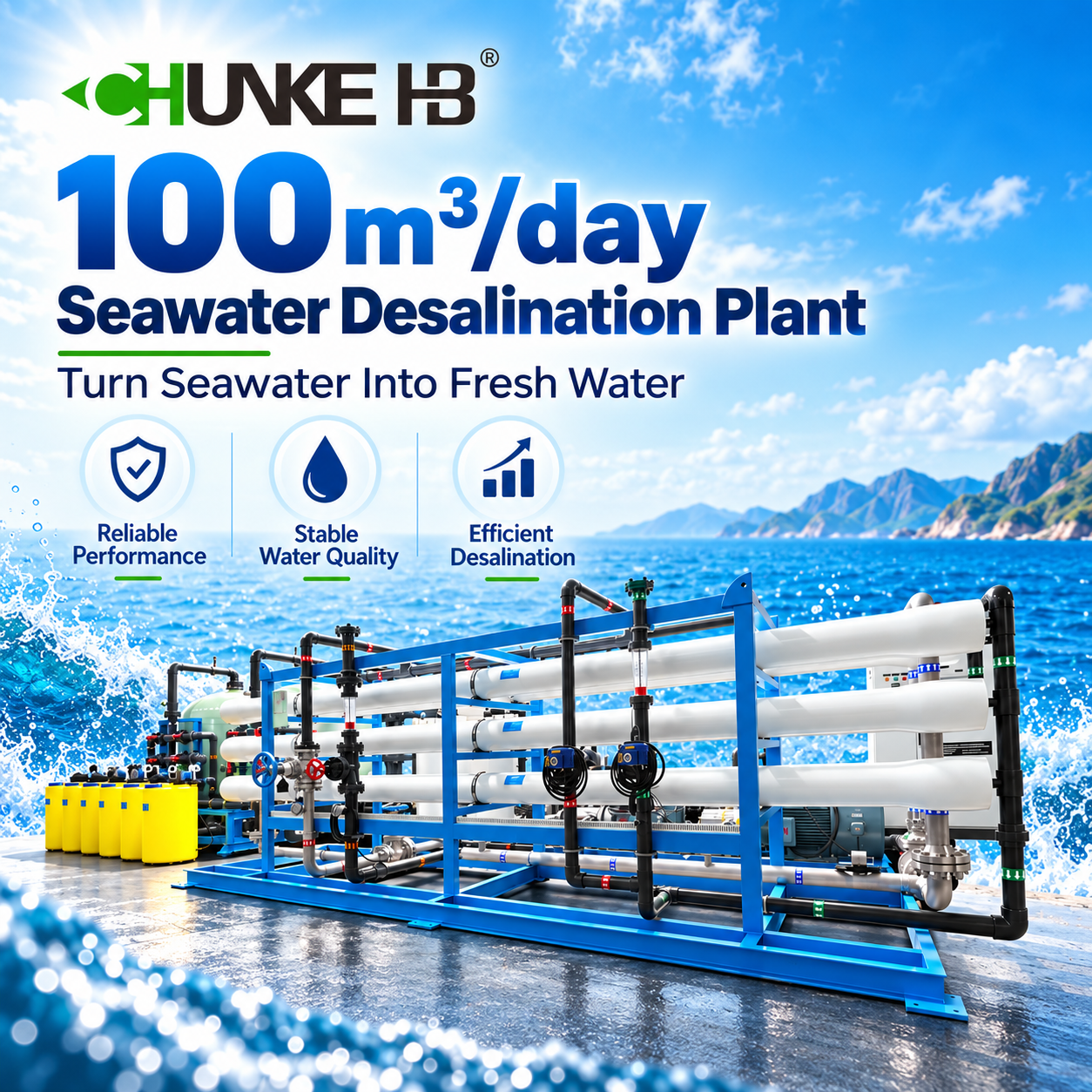
A 100 m3/day seawater desalination plant turns about 250 m³ of seawater into 100 m³ of drinking water every day. It treats feed water up to 45,000 mg/L TDS and delivers product water below 500 mg/L. Meanwhile, energy use stays between 3.2 and 4.0 kWh/m³ with an isobaric energy recovery device.
This capacity sits in a sweet spot for many buyers. It serves a small island community, a 120-room resort, a mining camp, or an aquaculture farm. So it remains compact enough for one skid or one 20ft container. At the same time, it runs on standard industrial parts that any local technician can maintain.
In this guide, we explain how Chunke designs every 100 m3/day seawater desalination plant. You will see the full specification table, the process steps, and the main component brands. Furthermore, you will learn the real energy numbers, the right way to size your plant, and the typical maintenance plan.
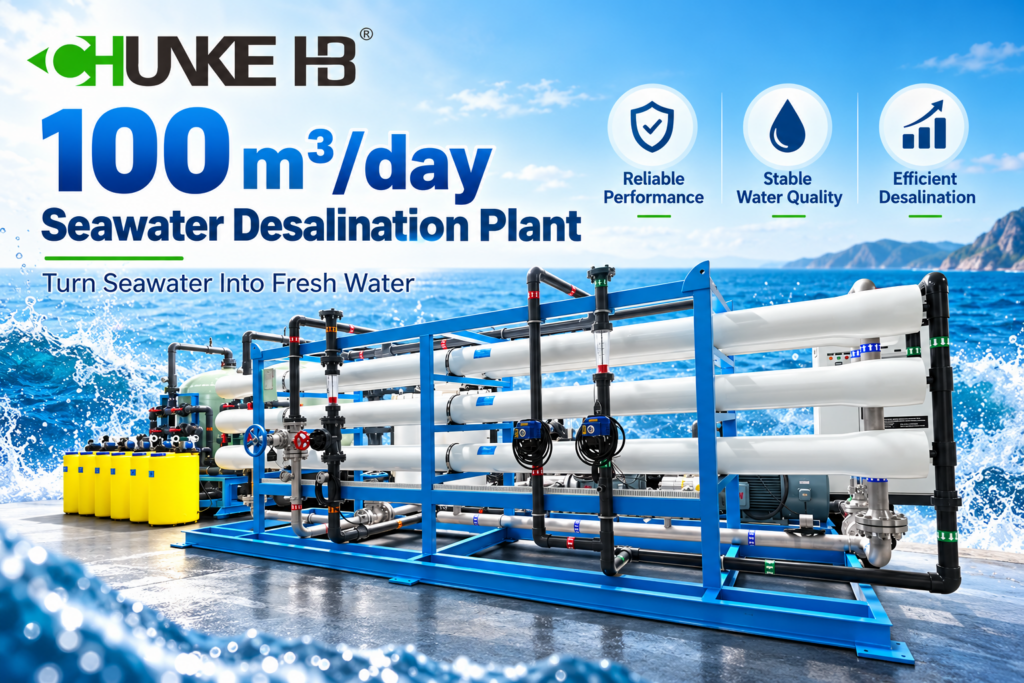
What Is a 100 m3/day Seawater Desalination Plant?
A 100 m3/day seawater desalination plant is an SWRO system with a daily output of 100 cubic meters. In hourly terms, that equals about 4.2 m³/h or 4,170 liters per hour. Many suppliers also call it a 100 TPD plant, because one cubic meter of water weighs one tonne.
Tender documents and government projects usually quote capacity per day. In contrast, equipment suppliers often quote capacity per hour. Therefore, buyers sometimes compare the wrong numbers. Our 4000 LPH seawater to drinking water system delivers 96 m³/day at full 24-hour operation. Consequently, a true 100 m³/day design needs a little more margin.
The plant uses high-pressure pumps to push seawater through semi-permeable membranes. The membranes let water molecules pass and reject over 99.7% of dissolved salts. As a result, fresh water leaves on the permeate side, while concentrated brine flows back to the sea.
Who Needs a 100 m³/Day SWRO System?
This capacity fits buyers who need reliable water but cannot justify a municipal-scale plant. Typically, we supply it to the following users:
- Island villages: At 150 to 200 liters per person per day, 100 m³ serves 500 to 650 residents.
- Hotels and resorts: A beach resort with 100 to 150 rooms fits this size well. Our guide on desalination plants for hotels and resorts covers this market in detail.
- Mining and construction camps: Remote coastal camps use it for drinking water, kitchens, and dust control.
- Aquaculture and fish processing: Fish farms need fresh water for washing, ice making, and hatchery work.
- Ports, naval bases, and offshore platforms: These sites need independent water supply without long pipelines.
- Small factories: Food plants and boiler houses use it as a first stage before polishing.
In each case, the buyer wants one thing above all. They want clean water every day without constant operator attention. Hence, we design every 100 m³/day unit for simple, automatic operation.
100 m3/day Seawater Desalination Plant Technical Specifications
The table below shows our standard design basis. Naturally, we adjust each value after we review your water analysis and site conditions.
| Parameter | Specification |
|---|---|
| Daily capacity | 100 m³/day (100 TPD) |
| Hourly output | 4.2 m³/h (about 4,170 LPH) at 24 h/day |
| Feed water | Seawater, 30,000–45,000 mg/L TDS |
| Product water TDS | < 500 mg/L (typically 200–400 mg/L, single pass) |
| Recovery rate | 35–45% (design 40%) |
| Feed flow to RO | About 10.4 m³/h |
| Operating pressure | 55–65 bar (up to 70 bar for Gulf seawater) |
| Specific energy | 3.2–4.0 kWh/m³ with ERD; about 6 kWh/m³ without |
| RO membranes | 8–9 × 8040 SWRO elements (DuPont, Hydranautics, Toray, LG, Vontron) |
| Pressure vessels | 2–3 FRP vessels, 1000 psi rating |
| High-pressure pump | Danfoss APP axial piston pump |
| Energy recovery | Danfoss iSave or Energy Recovery PX isobaric device |
| Pretreatment | Coagulant dosing, multimedia filter, 5 µm cartridge filter (UF optional) |
| Chemical dosing | Antiscalant, sodium bisulfite, CIP system |
| Post-treatment | Calcite remineralization, pH correction, chlorine or UV disinfection |
| Control system | Siemens PLC + HMI touch screen, optional 4G remote monitoring |
| Power supply | 380–415 V / 50 Hz or 440–480 V / 60 Hz, 3 phase |
| Installed / running power | About 30 kW / 15 kW (with ERD) |
| High-pressure piping | SS316L or duplex 2205 |
| Configuration | Skid-mounted (about 7 × 3 m) or 20ft container |
These numbers reflect open-sea intake at 25 °C and 35,000 mg/L TDS. However, Red Sea and Arabian Gulf water often reaches 42,000 to 45,000 mg/L. In that case, operating pressure rises toward 65 to 70 bar, and we adjust the membrane array.
How a 100 m³/Day SWRO Plant Works: Step by Step
Every Chunke plant follows the same proven process train. Each step protects the next one, so the membranes stay clean and last longer.
1. Seawater Intake
First, a submersible or horizontal intake pump draws about 12 m³/h from the sea. A beach well gives the cleanest water, because the sand acts as a natural filter. Alternatively, an open intake with a screen works well when no beach well is possible. We size the intake pump with 15 to 20% extra flow for filter backwash.
2. Pretreatment
Next, the water enters the pretreatment system for SWRO. A coagulant dosing pump adds ferric chloride to bind fine particles. Then, a multimedia filter removes suspended solids down to about 10 microns. After that, a 5-micron cartridge filter protects the high-pressure pump and membranes.
For poor-quality open intakes, we often recommend seawater ultrafiltration instead. UF delivers a silt density index (SDI) below 3 almost every day. As a result, membrane cleaning frequency drops sharply, and the RO stage runs more steadily.
3. Chemical Conditioning
Before the RO stage, dosing pumps add antiscalant and sodium bisulfite. The antiscalant stops calcium carbonate and sulfate scale on the membrane surface. Meanwhile, sodium bisulfite removes any residual chlorine, which would damage polyamide membranes.
4. High-Pressure Reverse Osmosis
The high-pressure pump then raises the pressure to 55 to 65 bar. The water flows through eight 8-inch SWRO elements in two pressure vessels. Fresh water passes through the membranes at about 40% recovery. Thus, every 10.4 m³/h of feed produces 4.2 m³/h of permeate and 6.2 m³/h of brine.
5. Energy Recovery
The brine still carries almost the full system pressure. An isobaric energy recovery device transfers this pressure back to incoming seawater. Consequently, the high-pressure pump handles only the permeate flow, and power demand drops by 40 to 50%.
6. Post-Treatment and Storage
Finally, the permeate passes through a calcite filter to add hardness and raise the pH. A chlorine or UV unit then disinfects the water before storage. The water meets the WHO drinking water guidelines when the post-treatment fits the local standard.
Membrane Selection and Array Design
Membranes decide both water quality and running cost. For this capacity, we use eight 8040-size elements with 37 m² active area each. This layout gives an average flux of about 14 liters per m² per hour. That flux suits beach-well water and UF-treated water very well.
For open intakes with conventional filtration, we usually add a ninth element. A lower flux reduces fouling, so the membranes need fewer cleanings each year. In short, a small extra investment protects a much larger running cost.
We work with all leading membrane makers. Our engineers often specify DuPont FilmTec SWRO membranes for high rejection. Likewise, Hydranautics seawater elements and Toray SWRO membranes deliver excellent boron rejection. For budget-focused projects, LG Chem NanoH2O membranes and Vontron seawater membranes offer strong value.
Our page on seawater reverse osmosis membrane options compares these brands in more detail. If your water standard limits boron, read our article on boron removal in seawater desalination before you choose.
High-Pressure Pumps and Energy Recovery
The high-pressure pump is the heart of every SWRO plant. At 100 m³/day, an axial piston pump gives the best efficiency. We commonly use Danfoss APP high-pressure pumps for this duty. They reach about 90% efficiency and need no oil change.
For intake, feed, and booster duties, we use stainless steel centrifugal pumps. Our standard options include Grundfos multistage pumps and CNP stainless steel pumps. Both brands have wide service networks, so spare parts stay easy to find.
For energy recovery, we pair the pump with a Danfoss iSave unit or an Energy Recovery PX pressure exchanger. Both devices reach over 94% transfer efficiency. Our energy recovery devices page and our seawater desalination pump page explain both technologies.
Energy Consumption and Daily Operating Cost
Energy forms the largest share of running cost. Therefore, the ERD decision deserves careful thought, even at this small size.
Without energy recovery, a 100 m³/day plant uses about 6.0 kWh/m³. That equals roughly 600 kWh per day. With an isobaric ERD, consumption drops to about 3.5 kWh/m³, or 350 kWh per day. So the plant saves around 250 kWh every day.
Let us apply a power price of USD 0.15 per kWh. In that case, the ERD saves about USD 37 per day, or more than USD 13,000 per year. On diesel generators, power often costs USD 0.30 per kWh or more. Thus, island and camp projects recover the ERD cost even faster.
Other running costs stay modest. Chemicals cost roughly USD 0.05 to 0.10 per m³. Cartridge filters need replacement every one to three months. Meanwhile, quality membranes last five to seven years with good pretreatment. For full budget figures, see our guide on seawater desalination plant cost.
PLC Control and Remote Monitoring
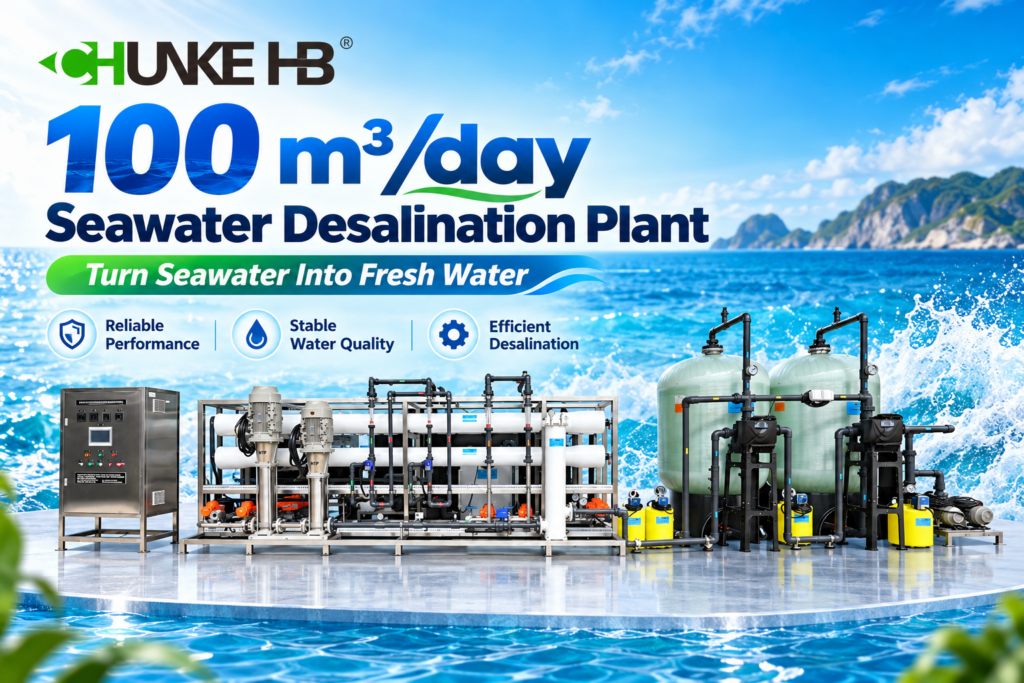
Small plants often run at sites with no full-time engineer. For that reason, automation matters as much as hardware. We build every panel around a Siemens PLC and HMI touch screen. Motor protection and switchgear come from Schneider Electric.
The PLC starts and stops the plant according to tank level. It also runs automatic filter backwash and membrane flushing after each shutdown. Moreover, it trips the high-pressure pump on low suction pressure, high pressure, or high permeate conductivity.
The HMI records flow, pressure, conductivity, and running hours. With the optional 4G module, your team and our engineers can view the plant from any phone. Learn more on our control system for SWRO plant page.
Skid-Mounted or Containerized: Which Layout Fits?
A 100 m³/day plant fits two common layouts. Each layout suits a different site.
Skid-mounted: We mount all equipment on one or two steel frames. The skid needs an indoor plant room of about 7 m × 3 m. This option suits buyers who already have a building.
Containerized: We install the full plant inside a 20ft container with lighting, ventilation, and air conditioning. The unit arrives ready to connect to water and power. If you add UF or larger chemical tanks, a 40ft container gives more working space. Our 20ft vs 40ft containerized SWRO guide compares both sizes.
Containers suit islands, camps, and temporary sites. They also make relocation simple when a project ends.
How to Size Your 100 m3/day Seawater Desalination Plant Correctly
Many buyers order the wrong size, because they skip a few simple checks. Before you request a quotation, consider these five factors.
- Running hours: A plant rated 4.2 m³/h makes 100 m³ only in 24 hours. If you plan 20 hours of operation, choose 5 m³/h instead.
- Water temperature: Cold water lowers membrane output. Below 15 °C, we add membrane area to keep the rated flow.
- Feed salinity: Gulf and Red Sea water needs higher pressure and sometimes a different membrane type.
- Peak demand: Resorts face high season peaks. Hence, a product tank of 50 to 100 m³ smooths daily swings.
- Future growth: We can leave space for a third pressure vessel. Later, you raise output without a new plant.
If demand will grow, compare our 8000 LPH seawater desalination plant and our 10 m³/h SWRO system. For smaller needs, our 2000 LPH seawater reverse osmosis unit may fit better.
Delivered Projects in This Capacity Range
Chunke has delivered several SWRO systems close to this size. Two examples show how the design adapts to each site.
Maldives, 200 m³/day containerized SWRO: We supplied a complete plant inside a 40HQ container for an island client. The system uses LG SW8040 membranes, a Danfoss APP high-pressure pump, CNP feed pumps, and SEKO dosing pumps. The client simply connected intake, outlet, and power on arrival.
Marine vessel, 50 m³/day SWRO: We built a compact marine unit for a ship operator. It uses Toray membranes, a duplex plunger pump, and CNP pumps. Furthermore, it runs on the ship’s power and fits a tight engine room.
You can find more case studies on our SWRO desalination projects page.
Installation and Commissioning
We test every plant at our Guangzhou factory before shipment. During the factory test, we run the pumps, check every instrument, and verify the PLC logic. As a result, site work stays short and predictable.
On site, the process follows four steps:
- Your contractor prepares the intake, outfall, foundation, and power supply.
- Our engineer guides the placement of the skid or container and the piping connections.
- Next, we load the filter media and membranes, then flush the system.
- Finally, we commission the plant, check water quality, and train your operators.
Commissioning usually takes five to ten days once civil works finish. In addition, we provide remote video support whenever travel becomes difficult.
Maintenance Schedule for Long Membrane Life
A simple routine keeps the plant efficient for many years. Operators should follow this basic schedule:
- Daily: Record pressures, flows, and conductivity. Check chemical tank levels.
- Weekly: Check the differential pressure across cartridge filters and the multimedia filter.
- Monthly: Replace cartridge filters as needed and calibrate the conductivity meter.
- Every 3 to 12 months: Clean the membranes when normalized flow falls by about 10%.
- Yearly: Service the pumps, inspect valves, and top up the filter media.
Each plant includes a built-in CIP tank and pump. Our SWRO membrane cleaning guide explains the full procedure. Similarly, our article on seawater RO recovery rate shows how to keep output stable.
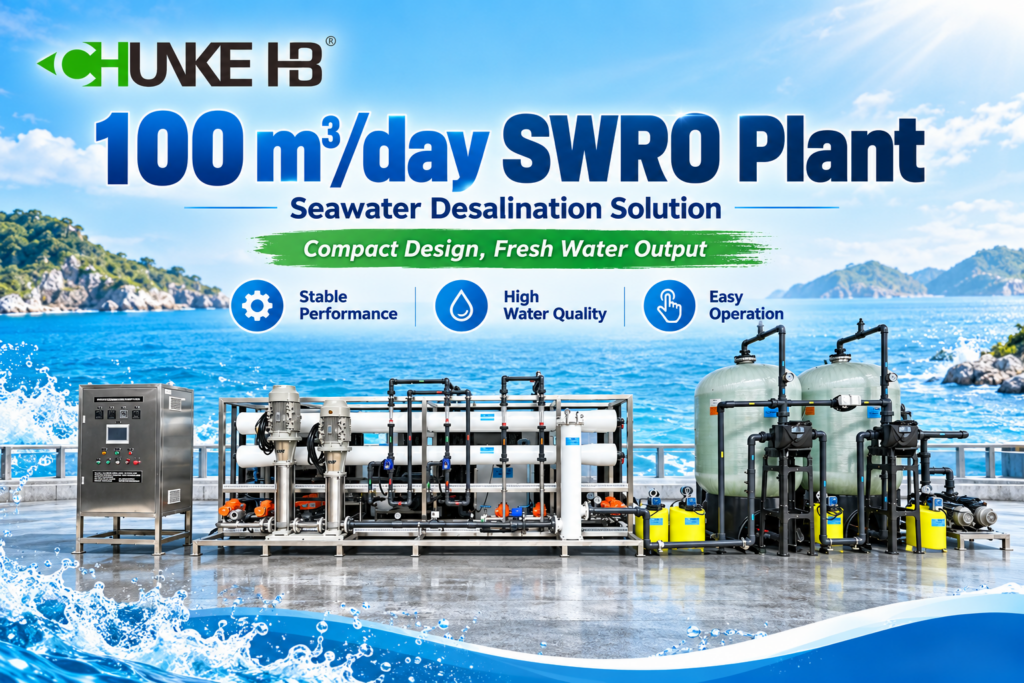
Why Choose Chunke for Your 100 m3/day Seawater Desalination Plant
Chunke designs and builds industrial water treatment systems in Guangzhou, China. We export SWRO, BWRO, UF, and EDI systems to Southeast Asia, the Middle East, Africa, and South America. Above all, we start every project from your water analysis, not from a standard catalog.
- Engineering first: Our engineers run membrane projection software for your exact feed water.
- Named brands: We use membranes, pumps, and controls from global brands with local service.
- Factory tested: Every plant runs at our factory before it leaves.
- Corrosion-resistant build: High-pressure piping uses SS316L or duplex 2205 steel.
- Lifetime support: We supply spare parts, membranes, and remote troubleshooting.
Our sister sites show the wider range. For example, you can review our industrial reverse osmosis systems for fresh and brackish water. You can also read which reverse osmosis system is best for salt water on our RO plant site.
Frequently Asked Questions
How many people can a 100 m³/day desalination plant supply?
It supplies about 500 to 650 people at 150 to 200 liters per person per day. For drinking and cooking only, it can serve several thousand people.
How much power does a 100 m³/day SWRO plant need?
With an energy recovery device, it uses about 350 kWh per day. The running load sits near 15 kW, while installed power reaches about 30 kW.
What is the product water quality?
A single-pass design delivers below 500 mg/L TDS, and usually 200 to 400 mg/L. A second pass reduces TDS and boron further when needed.
Can the plant run on solar power or a generator?
Yes. It runs on diesel generators, grid power, or a hybrid solar system. We size the power system together with the plant.
How much space does it need?
A skid version needs a room of about 7 m × 3 m. Alternatively, the whole plant fits inside one 20ft container.
How long do the membranes last?
Quality SWRO membranes last five to seven years with proper pretreatment. Regular cleaning and stable feed water extend this life.
What information do you need for a quotation?
We need a seawater analysis, the required daily output, the power supply, and your site location. Photos of the intake area also help our engineers.
Request a Quotation for Your 100 m³/Day Plant
Ready to secure your own fresh water supply? Send us your water analysis and project details today. Our engineers will prepare a tailored design, a component list, and a clear quotation.
Fill in the form below, and our team will contact you within 24 hours.

Comments are closed for this post.