
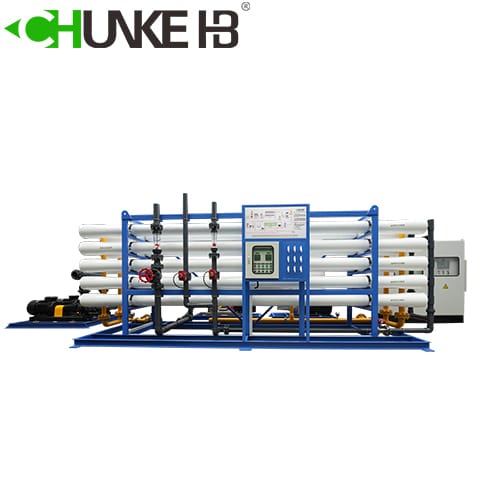
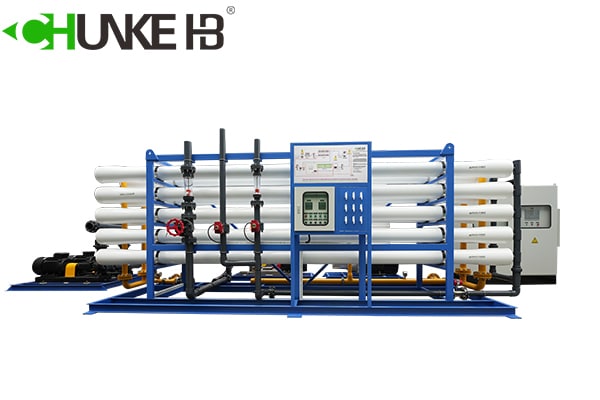
Chunke is Seawater RO Water Plant manufacturer from China, Guangzhou. Fresh water is one of the most important resources for coastal cities, islands, resorts, factories, mining areas, power plants, and remote communities. In many locations, seawater is available everywhere, but usable drinking water or process water is limited. For this reason, reverse osmosis desalination has become one of the most practical and reliable technologies for producing fresh water from the sea.
Chunke Water Treatment designs and manufactures industrial seawater desalination systems for customers who need stable operation, strong corrosion resistance, professional engineering, and long service life. As a 50 TPH seawater desalination plant manufacturer, we provide complete SWRO solutions from pretreatment to high-pressure reverse osmosis, chemical dosing, CIP cleaning, control system, instruments, and after-sales technical support.
Our 50 TPH sea water desalination machine is designed to produce approximately 50 cubic meters of fresh water per hour, equal to about 1,200 cubic meters per day under continuous operation. This capacity is suitable for medium and large water supply projects, including island drinking water, hotels, resorts, coastal factories, fishery bases, agricultural irrigation, construction camps, power plants, and industrial water production.
What Is a 50 TPH Sea Water Desalination Machine?
A 50 TPH sea water desalination machine (50 TPH seawater desalination plant) is an industrial reverse osmosis system that removes dissolved salts and impurities from seawater. “50 TPH” means the system can produce 50 tons of fresh water per hour. Because 1 ton of water is approximately equal to 1 cubic meter, this system is also commonly called a 50m3/h seawater RO plant.
The main function of this machine is to take seawater with high salinity, usually from the ocean, beach wells, or coastal intake systems, and convert it into usable fresh water. Depending on the project requirement, the final water can be designed for drinking water, domestic water, industrial process water, boiler feed pretreatment, irrigation water, or further polishing treatment.
The system normally includes raw water intake, pretreatment, chemical dosing, cartridge filtration, high-pressure pumping, seawater reverse osmosis membranes, product water collection, concentrate discharge, CIP cleaning, instruments, PLC control, and safety protection. Each section has an important role in protecting the RO membranes and ensuring stable water quality.
Choosing the right Seawater RO Plant Manufacturer is very important because seawater desalination is not a simple filtration process. It requires correct hydraulic design, membrane calculation, material selection, anti-corrosion design, pressure control, energy consumption control, and professional operation logic.
How the 50 TPH SWRO System Works
Seawater contains a high concentration of dissolved salts. Normal filtration cannot remove these salts. Reverse osmosis works by using high pressure to push seawater through semi-permeable RO membranes. The membrane allows water molecules to pass through while rejecting most dissolved salts, bacteria, colloids, particles, and organic matter.
Before seawater reaches the RO membranes, it must be properly pretreated. Pretreatment is one of the most important parts of a seawater desalination system because seawater may contain suspended solids, algae, microorganisms, organic matter, silt, and other contaminants. If these impurities enter the RO membrane directly, they can cause fouling, scaling, pressure increase, lower water production, and shorter membrane life.
A professional 50 TPH SWRO system normally includes chemical dosing, quartz sand filtration, activated carbon filtration or multimedia filtration according to water quality, antiscalant dosing, reducing agent dosing, pH adjustment, and high-flow cartridge filters. The purpose is to make the feed water suitable for seawater RO membrane operation.
After pretreatment, the seawater enters the high-pressure pump. The high-pressure pump increases the pressure to overcome the natural osmotic pressure of seawater. Then the water enters the membrane pressure vessels. Inside the RO membranes, the water is separated into two streams: product water and concentrate water. Product water is collected for use, while concentrate water containing higher salt concentration is discharged or partly used for energy recovery according to the design.
Main Technical Design of Chunke 50 TPH Sea Water Desalination Machine
Chunke’s 50 TPH seawater desalination system can be customized according to the customer’s seawater quality, intake method, product water standard, installation area, power supply, budget, and automation requirement. A typical design may include seawater feed TDS up to around 35,000–45,000 mg/L and product water TDS designed to meet drinking water or industrial water requirements, commonly below 500 mg/L depending on the feed water and design conditions.
The system recovery rate is commonly designed around 40–45% for standard seawater applications. This means that for every 100 cubic meters of seawater feed, around 40–45 cubic meters can be converted into fresh water, while the remaining concentrate water is discharged. The exact recovery rate depends on seawater TDS, temperature, membrane type, scaling risk, boron requirement, product water quality target, and project operation philosophy.
A professional 50 TPH seawater desalination plant manufacturer should not only assemble components. The manufacturer must understand how each component affects the whole system. Membrane quantity, pressure vessel arrangement, pump head, flow rate, recovery rate, chemical dosing, pretreatment flow velocity, backwash design, and pipe material must work together as one complete engineering solution.
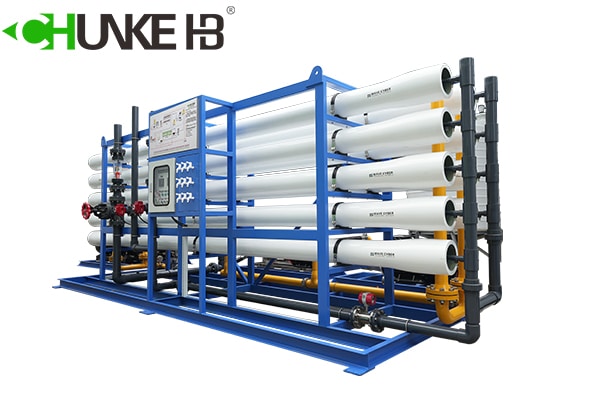
Pretreatment System for 50 TPH SWRO Plant
Pretreatment is the foundation of a stable seawater RO plant. If pretreatment is weak, even high-quality RO membranes and pumps cannot perform well for a long time. Chunke designs pretreatment according to raw water quality, turbidity, SDI, suspended solids, organic matter, algae risk, iron, manganese, microbiological activity, and intake type.
For a typical 50 TPH sea water desalination machine, the pretreatment system may include raw water tank, raw water pump, bactericide dosing, flocculant dosing, quartz sand filter, activated carbon filter or multimedia filter, antiscalant dosing, reducing agent dosing, pH adjustment dosing, 5-micron cartridge filter, and 1-micron cartridge filter.
Quartz sand or multimedia filters remove suspended solids and reduce turbidity. Activated carbon filters can help remove organics, odor, and residual oxidants depending on design requirement. Cartridge filters provide final protection before the high-pressure pump and RO membrane. Chemical dosing systems support biological control, coagulation, scale inhibition, pH control, and chlorine removal.
For seawater systems, material selection is very important. Low-pressure piping can use UPVC, FRP, HDPE, or other corrosion-resistant materials depending on design pressure and temperature. High-pressure piping should use seawater-resistant materials such as 2205 duplex stainless steel, 2507 super duplex, high-pressure hose, or other suitable materials. Chunke selects materials based on chloride level, design pressure, temperature, operation safety, and customer project standard.
RO Membrane System and Water Quality
The RO membrane system is the core of the desalination plant. In a 50 TPH SWRO system, seawater RO membranes are installed inside FRP pressure vessels. High-pressure seawater flows into the pressure vessels, and the membranes separate fresh water from salt water.
The desalination rate is normally around 97–99%, depending on membrane type, feed water quality, operating pressure, temperature, recovery rate, and system condition. Product water TDS can be designed below 500 mg/L for many drinking water and domestic water applications. If the customer needs lower TDS, the system can be designed with second-pass RO, remineralization, degassing, UV sterilization, or other post-treatment systems.
For drinking water projects, final water treatment may include pH adjustment, mineral dosing, UV sterilization, ozone, sodium hypochlorite dosing, or other disinfection systems. For industrial use, the water may need further polishing by second-pass RO, EDI, mixed bed, or ion exchange according to the process requirement.
For project owners, working with a 50 TPH seawater desalination plant Manufacturer that understands both desalination and final water application can reduce mistakes during design. A hotel, a power plant, a food factory, and an island community may all need 50 TPH water production, but their final water quality requirements and operating philosophy may be different.
Automation and Control System
Chunke’s 50 TPH sea water desalination machine can be supplied with PLC automatic control and HMI touch screen operation. The control system can monitor pressure, flow, conductivity, pH, ORP, tank level, pump status, valve status, and alarm signals.
The system can include automatic start and stop, low-pressure protection, high-pressure protection, low tank level shutdown, high product water tank level shutdown, automatic flushing, chemical dosing interlock, conductivity monitoring, alarm display, and manual operation mode for maintenance.
Electrical components can be selected from brands such as Siemens, Schneider, Mitsubishi, ABB, or other options depending on project requirement. For industrial projects, the control cabinet can be designed with suitable protection level, clear wiring, emergency stop, operation indicators, and remote signal interface if required.
Automation helps customers operate the plant more safely and easily. It also reduces human error. For large-capacity desalination systems, professional automation is not only convenient but also necessary for membrane protection and long-term operation.
Energy Consumption and Operating Cost
Energy consumption is one of the biggest concerns in seawater desalination. Because seawater RO requires high pressure, the high-pressure pump consumes most of the power. A well-designed system should consider efficient pump selection, correct recovery rate, suitable membrane type, pressure loss reduction, and energy recovery options.
For some projects, energy recovery devices can significantly reduce power consumption. In large SWRO systems, energy recovery is especially important because the brine stream still contains high hydraulic energy. By recovering part of this energy, the system can reduce operating cost and improve long-term economic performance.
However, energy recovery is not only a matter of adding one device. It must be correctly matched with feed flow, concentrate flow, membrane recovery, pump selection, pressure loss, control logic, and maintenance capability. Chunke can provide technical suggestions based on your project’s electricity cost, operating hours, investment budget, and water production target.
As a China-based 50 TPH seawater desalination plant Manufacturer, Chunke focuses on providing a practical balance between investment cost and operating cost. Some customers need the most economical initial investment. Other customers prefer lower long-term operation cost. Our engineering team can help compare different configurations and recommend a suitable solution.
Why Buy from Chunke Water Treatment?
Chunke Water Treatment is a direct factory manufacturer, not only a trading company. We have many years of experience in reverse osmosis systems, ultrafiltration systems, EDI systems, seawater desalination plants, brackish water RO systems, pure water systems, and industrial water treatment equipment.
Buying from a manufacturer gives customers several advantages. First, the system can be customized according to actual water quality and project conditions. Second, the price is more competitive because there is no unnecessary middleman cost. Third, technical communication is faster because our sales team, engineering team, and production team work together. Fourth, after-sales support is more professional because the equipment is designed and manufactured by our own team.
Chunke can provide process design, equipment layout, P&ID, technical proposal, quotation, production, factory testing, packing, shipping support, installation guidance, commissioning support, spare parts, operation manual, and technical training. For customers who need a turnkey desalination solution, we can support the project from inquiry stage to final operation.
We also understand that every seawater project is different. An island project may have limited space. A resort may need quiet operation and beautiful installation. A power plant may require strict documentation. A mining project may need strong equipment for harsh site conditions. A drinking water project may need stable product water quality and post-treatment. Chunke can adjust the design to match these different requirements.
Strong Product Advantages
The 50 TPH sea water desalination machine from Chunke has several important advantages.
First, the system is designed for high-salinity seawater. The RO membranes, high-pressure pump, pressure vessels, valves, and pipes are selected for seawater desalination service.
Second, the system uses complete pretreatment protection. Proper pretreatment helps reduce membrane fouling, extend membrane life, and keep operation more stable.
Third, the system can use internationally recognized main components. Customers can choose DOW / DuPont, Hydranautics, Toray, Danfoss, Grundfos, Siemens, Schneider, and other famous brands according to their budget and standard.
Fourth, the system is designed with corrosion resistance in mind. Seawater is highly corrosive, so material selection is a key engineering point. Chunke can use UPVC, FRP, 2205 duplex stainless steel, 2507 super duplex stainless steel, and other suitable materials in different sections.
Fifth, the system is easy to operate. PLC and HMI control make operation clearer, while instruments and alarms help operators understand system condition.
Sixth, Chunke provides professional after-sales support. A seawater desalination plant is a long-term investment. Customers need not only equipment but also a reliable technical partner.
When you select Chunke as your 50 TPH seawater desalination plant Manufacturer, you are choosing a company that understands industrial water treatment, project customization, practical engineering, and international customer service.
Applications of 50 TPH Sea Water Desalination Machine
The 50 TPH capacity is suitable for many medium and large projects. For island communities, it can provide daily domestic water for residents. For hotels and resorts, it can supply water for rooms, kitchens, laundry, swimming pools, landscaping, and general service areas. For coastal factories, it can provide process water and utility water when municipal water is not enough or too expensive.
In agriculture, desalinated seawater can be used for greenhouse irrigation or crop irrigation after proper quality adjustment. In power plants, desalinated water can be used as pretreatment water before further polishing. In construction camps and military camps, the system can provide a stable fresh water source in remote coastal areas. In fishery and seafood processing, desalinated water can support cleaning and process requirements.
Because the system is modular, it can be designed as skid-mounted, containerized, or installed inside a water treatment room. Containerized systems are useful for remote projects because they are easier to transport, protect equipment from harsh environments, and reduce site installation work.
Customization Options
Chunke can customize the 50 TPH SWRO plant according to project needs. Available options include containerized design, stainless steel frame, carbon steel anti-corrosion frame, 2205 duplex high-pressure piping, energy recovery device, second-pass RO, UV sterilizer, remineralization system, CIP cleaning system, online monitoring instruments, remote monitoring, automatic flushing, chemical dosing skid, and different electrical standards.
The customer can also choose different brands for membranes, pumps, instruments, valves, PLC, HMI, and electrical components. If the project has a specific standard, such as industrial, municipal, drinking water, marine, oil and gas, or power plant requirements, Chunke can prepare the design accordingly.
Before final design, we recommend the customer provide a seawater analysis report, required product water quality, daily water demand, power supply information, installation location, seawater intake method, site temperature, and any special project standards. With this information, our engineering team can make a more accurate and reliable design.
A Reliable Partner for Your Desalination Project
A seawater desalination project is not only about buying a machine. It is about solving a real water problem. Customers need a system that can run every day, produce stable water, resist corrosion, reduce operation cost, and be easy to maintain.
Chunke Water Treatment focuses on practical engineering and long-term customer value. We do not only sell equipment; we help customers understand the process, select the right configuration, control cost, and operate the system correctly. Our goal is to make seawater desalination easier, safer, and more reliable for your project.
If you are planning an island water supply project, resort desalination project, coastal factory water treatment project, or industrial seawater RO plant, Chunke can provide a customized technical proposal and quotation based on your actual water quality and capacity requirement.
Contact Chunke today and let our engineering team help you design the right 50 TPH sea water desalination solution. As your trusted 50 TPH seawater desalination plant Manufacturer, we are ready to support your project with professional design, factory manufacturing, quality components, competitive price, and long-term technical service.