
A containerized seawater reverse osmosis system fits a complete SWRO plant inside a standard 20ft or 40ft ISO container. Capacity ranges from 20 m³/day up to more than 2,500 m³/day. This guide compares the two container sizes side by side. It explains capacity, membrane count, pressure, energy use, and how to pick the right size for your project. Chunke Water Treatment designs and builds both formats for islands, resorts, construction camps, and emergency water supply worldwide.
What Is a Containerized Seawater Reverse Osmosis System?
A containerized seawater reverse osmosis system is a complete SWRO plant built inside a steel shipping container. The container houses pretreatment filters, a high-pressure pump, RO membranes, chemical dosing, and a PLC control panel. Everything ships as one unit. Installation only needs a level pad, seawater intake, power connection, and a discharge line for the concentrate. This design saves months compared with building a civil-works plant on site.
Chunke ships these systems in two standard box sizes: 20ft and 40ft. Each size fits a different capacity range, project budget, and site condition. Choosing the right box avoids two costly mistakes. First, it avoids paying for space you do not need. Second, it avoids running a plant beyond its rated capacity.
20ft vs 40ft Container: Capacity and Size Comparison
The table below compares the two most common container sizes for a containerized seawater reverse osmosis system. Use it as a starting reference. Then confirm final numbers after a feed water analysis.
| Parameter | 20ft Container | 40ft Container |
|---|---|---|
| Daily Capacity | 20–200 m³/day | 200–2,500+ m³/day |
| Feed Water TDS | Up to 45,000 mg/L | Up to 45,000 mg/L |
| Product Water TDS | Under 500 ppm (single-pass) | Under 500 ppm, or under 10 ppm with double-pass |
| Recovery Rate | 35–40% | 40–45% |
| Operating Pressure | 55–65 bar | 60–82 bar |
| Membrane Elements | 6–12 x 8-inch SWRO elements | 20–60+ x 8-inch SWRO elements |
| High-Pressure Pump | Single-stage centrifugal | Multi-stage centrifugal or duplex plunger |
| Energy Recovery Device | Optional | Standard on most designs |
| Energy Consumption | 4.0–5.0 kWh/m³ | 3.0–4.0 kWh/m³ |
| Container Footprint | 20ft ISO container, 6.1 m long | 40ft ISO container, 12.2 m long |
| Configuration | Skid inside standard 20ft box | Skid inside standard or high-cube 40ft box |
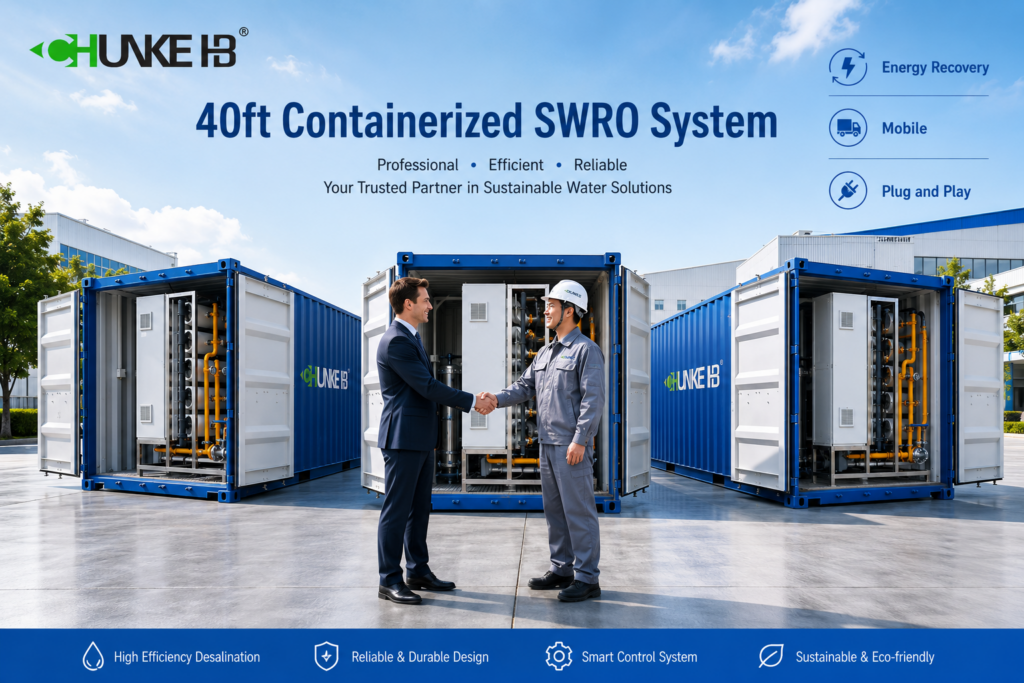
A 20ft containerized seawater reverse osmosis system suits small islands, single resorts, remote clinics, and construction camps. Meanwhile, a 40ft unit fits municipal supply, large resorts, naval bases, and industrial process water. For very large demand, Chunke connects several 40ft containers in parallel. This approach reaches tens of thousands of cubic meters per day without a custom civil-works design.
Containerized vs Skid-Mounted: Why Choose a Container
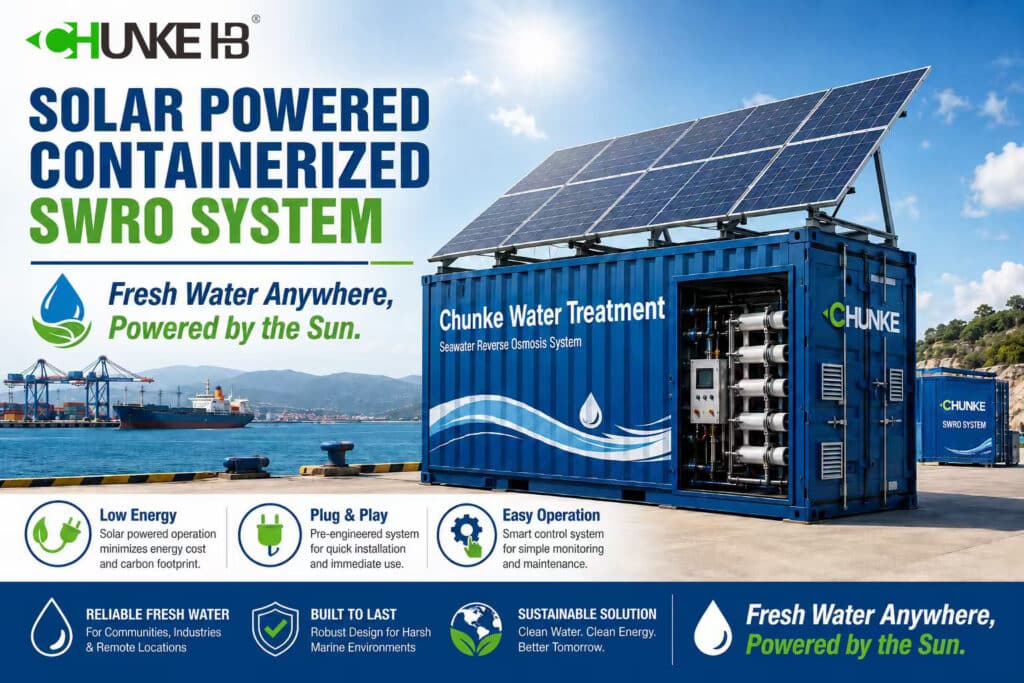
Chunke also builds skid-mounted SWRO systems for indoor installation. However, a containerized seawater reverse osmosis system offers advantages a skid cannot match. The steel container gives weatherproof housing without a building. It also gives built-in lighting, ventilation, and insulation. As a result, the plant can sit outdoors on a bare concrete pad from day one.
Shipping is simpler too. A container travels by standard ocean freight or flatbed truck, just like any other cargo box. Meanwhile, a skid-mounted plant usually needs a purpose-built room, which adds construction time and local labor cost. For remote islands or disaster zones, that difference often decides the entire project timeline.
Core Components and Trusted Brands
Component quality decides how long a containerized seawater reverse osmosis system runs without failure. Chunke selects proven brands for every critical part. This gives clients predictable performance and easy spare-parts support anywhere in the world.
RO Membranes
The membrane element is the heart of the system. Hence, Chunke offers a choice of established brands. Clients can specify DuPont FilmTec seawater elements, Vontron SW series membranes, LG Chem seawater RO elements, or Toray Romembra elements. For difficult feed water, Hydranautics SWC membranes offer strong fouling resistance. All these brands meet the salt rejection and flux targets a containerized seawater reverse osmosis system needs.
High-Pressure Pumps and Energy Recovery
The high-pressure pump pushes seawater through the membranes. It must reach the pressure needed to overcome seawater’s osmotic pressure. Chunke fits Grundfos or CNP pumps, driven by Danfoss variable frequency drives for stable pressure control. A VFD reduces water hammer risk. It also adjusts flow as feed water temperature or salinity changes through the year.
Control System
Automatic operation depends on a reliable PLC and HMI. Chunke installs Siemens PLC and touch-screen HMI on every containerized seawater reverse osmosis system. The panel handles start-stop sequencing, membrane flushing, and alarm monitoring. It also supports remote data logging, so operators can check plant status from a phone or laptop.
How to Choose the Right Container Size
Sizing starts with daily water demand, not container size. First, calculate how many cubic meters your site needs per day. Add a safety margin for peak season or population growth. Then match that number against the capacity ranges above. For example, a 40-room island resort typically needs 40–80 m³/day. That demand fits comfortably in a 20ft unit. A regional hospital or naval base needing 300–800 m³/day requires a 40ft unit instead.
Feed water quality also affects sizing. Higher turbidity or biological load pushes designers toward a 40ft box, because it has room for stronger pretreatment stages. Power availability matters too. A 20ft unit often runs on a standard diesel generator. Meanwhile, a 40ft unit may need a dedicated transformer or larger generator bank.
Finally, consider future expansion. Chunke designs piping and electrical panels with spare capacity. Clients can then add a second container later without redesigning the whole plant. This approach protects the initial investment as demand grows.
Pretreatment Requirements Inside the Container
Pretreatment protects the RO membranes from fouling and scaling, so it deserves careful design even in a compact container. Open seawater intake normally needs stronger filtration than a beach well source. Chunke fits multimedia filters, cartridge filters, and antiscalant dosing as standard on most units. For high-turbidity intake, Chunke can add an ultrafiltration stage inside a 40ft box. Alternatively, the team supplies a linked pretreatment container next to the main SWRO unit.
Correct pretreatment extends membrane life significantly. Therefore, Chunke reviews feed water analysis before finalizing the pretreatment train for every containerized seawater reverse osmosis system. This step avoids early membrane replacement and keeps operating cost predictable over the plant’s service life.
Applications of Containerized SWRO Systems
A containerized seawater reverse osmosis system solves water shortage problems across many industries. Common applications include:
- Island hotels, resorts, and residential communities without municipal water
- Coastal construction camps and worker accommodation
- Fish and seafood processing plants near the coast
- Offshore platforms, naval bases, and marine support facilities
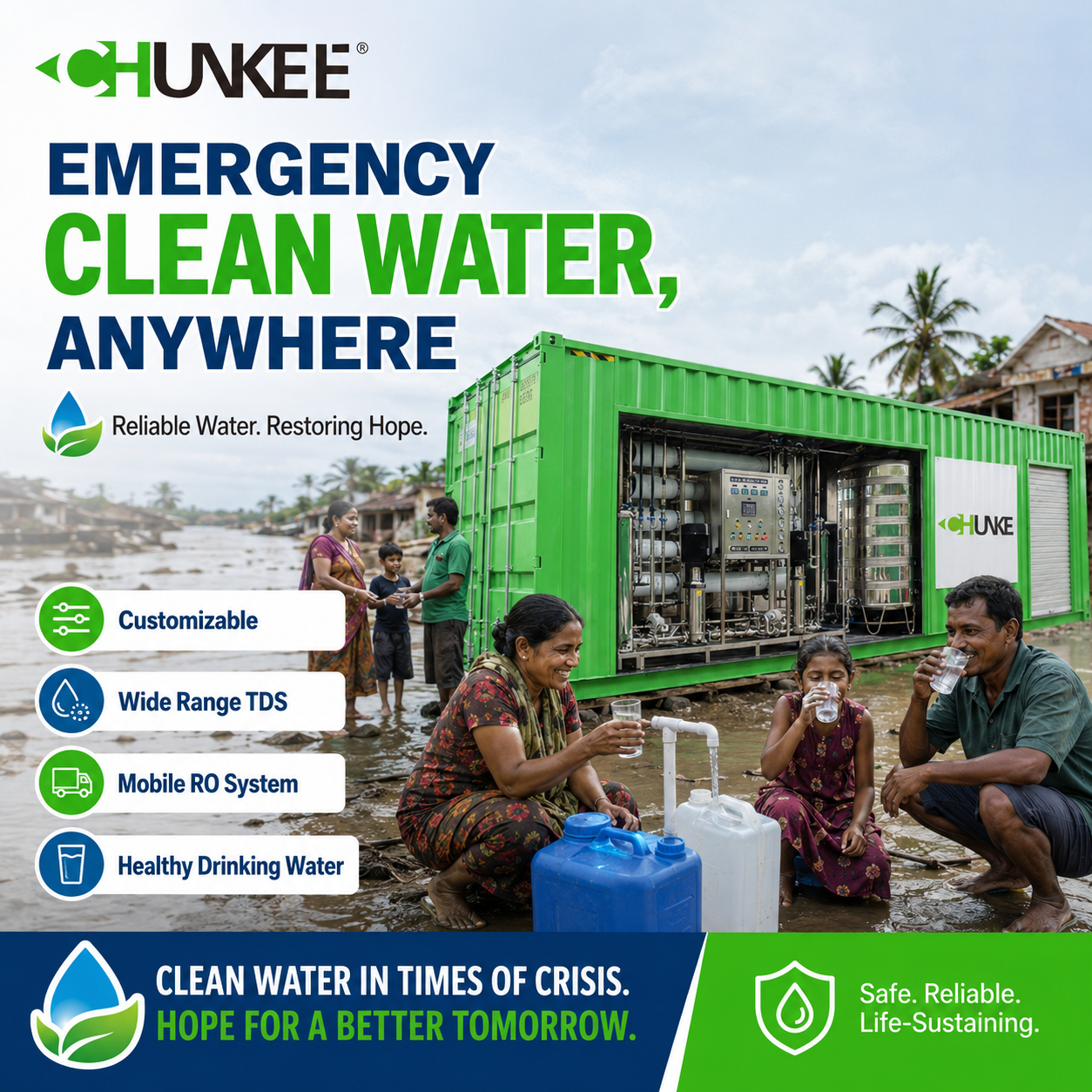
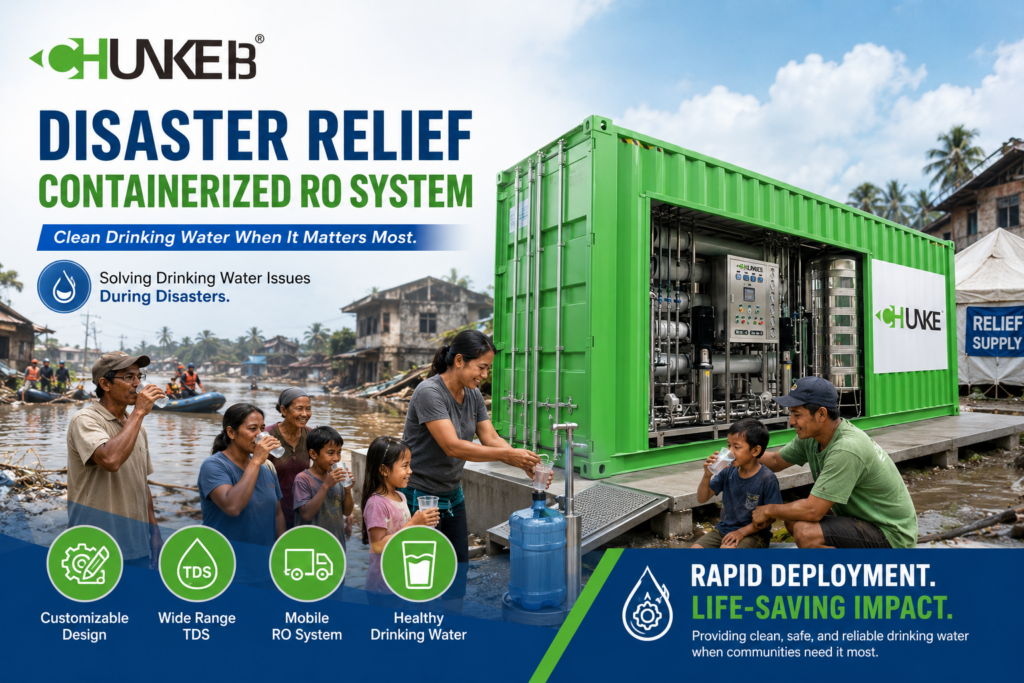
- Emergency and disaster relief water supply
- Small coastal towns and villages with limited groundwater
The unit ships ready to run. Hence, project teams can start fresh water production within days of arrival on site. This speed matters most during emergency response, when delay puts communities at risk.
Installation and Commissioning
Installing a containerized seawater reverse osmosis system is faster than building an equivalent civil-works plant. Site preparation only needs a level concrete pad, a seawater intake line, a concentrate discharge line, and a power connection. Chunke pre-wires and pre-pipes every container at the factory. The team then performs a full wet test before shipment.
On site, the installation team connects intake and discharge piping, links the power supply, and runs a commissioning check. This process usually takes two to five days, depending on site access and utility connections. Remote monitoring then lets Chunke’s engineers verify performance after startup, without needing another site visit.
Maintenance and Energy Optimization
Regular maintenance keeps a containerized seawater reverse osmosis system running at rated capacity for many years. The cartridge filter needs periodic replacement. The membrane elements need chemical cleaning when pressure rises or flow drops. Chunke’s PLC logs these trends automatically. So, operators know when cleaning is due before performance drops sharply.
Energy consumption is the largest ongoing cost for any SWRO plant. Therefore, Chunke fits energy recovery devices on 40ft units as standard. These devices recover pressure energy from the concentrate stream. This can cut energy use by 30 to 40 percent compared with a system with no energy recovery. As a result, the payback period for the extra equipment cost is often under two years for continuously operating plants.
Cost Factors for a Containerized Seawater Reverse Osmosis System
Price depends on capacity, membrane brand, pump brand, and how much automation the project needs. A 20ft unit generally costs less overall, but not always less per cubic meter of water produced. Larger 40ft units benefit from economy of scale and energy recovery. Hence, the cost per cubic meter often drops as capacity rises.
Other cost factors include feed water quality, remote location surcharges, and post-treatment requirements. For example, drinking water standards add remineralization and disinfection equipment, which raises the initial price. Meanwhile, harsh feed water raises the pretreatment cost, because it needs stronger filtration and more chemical dosing. Shipping distance and import duty also affect the landed cost at the client’s port.
Chunke provides a detailed cost breakdown with every quotation. This breakdown separates equipment cost, freight cost, installation support, and optional spare parts packages. Clients can then compare offers on equal terms, instead of guessing what each supplier actually included.
Shipping, Delivery, and Import Logistics
A containerized seawater reverse osmosis system ships like standard ocean freight cargo, since it already sits inside an ISO container. This removes the need for special crating or oversized transport permits in most countries. Chunke handles export documentation, packing lists, and factory test reports for every shipment.
Typical lead time runs from 45 to 90 days after order confirmation, depending on capacity and customization level. Ocean freight then adds 2 to 6 weeks, depending on the destination port. Chunke’s team tracks the shipment at each stage. Updates cover factory completion, vessel departure, and customs clearance at the destination port.
Typical Delivered Project Types
Chunke has supplied containerized seawater reverse osmosis systems for island resorts, coastal construction projects, aquaculture operations, and emergency relief programs. These projects span Southeast Asia, the Middle East, Africa, and the Pacific. Capacities range from small 20ft units serving a single resort, to multiple 40ft units linked for regional supply. Each project starts with a feed water analysis. Engineers then create a custom process design matched to site conditions and budget.
Why Work With Chunke Water Treatment
Chunke Water Treatment designs and manufactures seawater reverse osmosis systems in Guangzhou, China, for clients across the world. The company also operates Chunke Water Treatment and Chunke RO Water Plant. Both sites cover the full range of reverse osmosis and desalination equipment. Every containerized seawater reverse osmosis system goes through factory testing before shipment. So, clients receive a plant proven to work before it ever leaves the factory.
Chunke’s engineering team reviews water analysis data, site photos, and power availability before proposing a final design. This step avoids costly redesign later. It also gives clients a realistic budget from the first quotation. Support continues after delivery, with spare parts, training, and remote troubleshooting available throughout the plant’s service life. Clients can also request operator training videos and a bilingual operation manual. This helps local staff run the plant confidently from day one.
For related capacity options, see Chunke’s 8000 LPH seawater desalination plant page. Also check the 25 m³/h SWRO system and 50 TPH desalination machine pages. Each one can be built as a containerized unit on request. For the full containerized product line, visit the containerized seawater desalination plant page.
If you need a containerized seawater reverse osmosis system for your project, fill in the contact form below. Chunke’s team replies to every enquiry within 24 hours with a technical proposal and budget estimate.
Frequently Asked Questions
1. What is the smallest containerized seawater reverse osmosis system available?
Chunke’s smallest standard containerized unit starts around 20 m³/day, built inside a 20ft container. Smaller skid-mounted options are also available for capacities below that range.
2. Can a 20ft container be upgraded to a 40ft container later?
The membrane skid can sometimes move into a larger container. However, a cleaner approach is adding a second container in parallel. This method avoids downtime on the existing unit while capacity increases.
3. How long does a containerized SWRO system last?
With correct pretreatment and maintenance, the container structure and major equipment typically last 15 to 20 years. Membrane elements usually need replacement every 3 to 7 years, depending on feed water quality.
4. Does a containerized seawater reverse osmosis system need a building?
No building is required. The container itself provides weatherproof housing, insulation, and ventilation for all equipment inside.
5. What power supply does a containerized SWRO system need?
A 20ft unit commonly runs on a 3-phase generator or grid supply between 30 and 100 kW. A 40ft unit may need 100 to 400 kW, depending on capacity and energy recovery equipment.
6. Can the system produce drinking water directly?
Yes. Chunke adds post-treatment such as remineralization, pH adjustment, and UV disinfection when the project requires drinking water quality output.

Comments are closed for this post.